
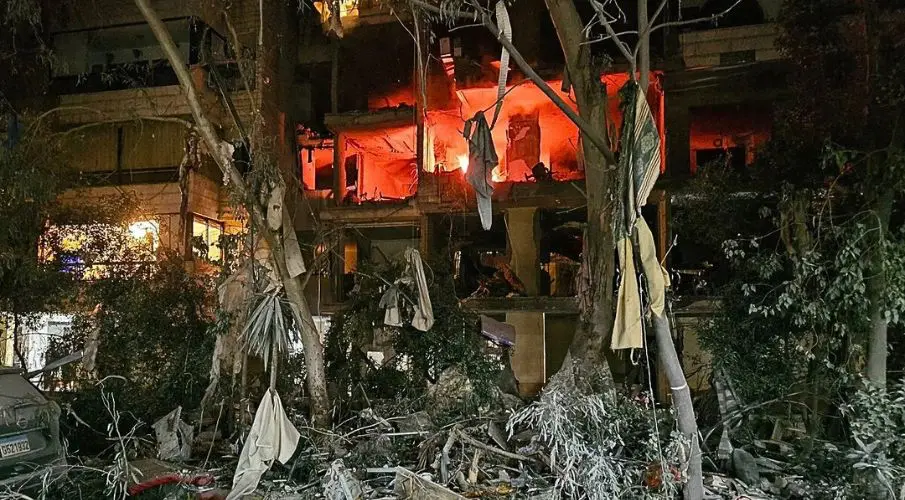
Bahrain reported intercepting a new wave of attacks from Iran. According to the National Communication Center, 70 ballistic missiles and 59 drones were shot down by the country’s own air defense system. The small island state in the Gulf thus finds itself directly in the crosshairs of a conflict that is no longer being fought solely between Washington, Jerusalem and Tehran. At the same time, the US Embassy in Beirut urged all American citizens to leave Lebanon immediately while commercial flights are still available. The security situation is volatile and unpredictable. Israel once again carried out strikes on the southern suburbs of Beirut and on the port city of Tyre. According to the Israeli military, the Hezbollah intelligence official Hussein Mokalleh was killed. US consular services in Beirut are suspended until further notice, and assistance on the ground cannot be provided.
As the front lines expand, political and military coordination is underway in Washington. According to General Dan Caine, Chairman of the Joint Chiefs of Staff, President Donald Trump gave the order to launch the operation on Friday at 3:38 p.m. EST aboard Air Force One. On board were Senators Ted Cruz and John Cornyn as well as actor Dennis Quaid. The president reportedly approved it with the words “Operation Epic Fury approved … good luck,” Caine said. Months of preparation preceded the operation, supported by US intelligence that helped the Israeli Defense Forces precisely time the strike on Ali Khamenei. It was a daytime operation carried out by the Israeli Defense Forces, enabled by the American intelligence community.
Pete Hegseth does not rule out the deployment of US ground troops in Iran but remains noncommittal.
“President Trump is making sure our enemies understand that we will go as far as necessary.”
At the Pentagon, Defense Secretary Pete Hegseth defended the course of action. Iran had pursued a one sided strategy of violence against the United States for years and had merely played for time during recent talks. It had built up missiles and drones to secure its nuclear ambitions. The military operation could last shorter or longer than the four to five weeks mentioned by Trump. “Four weeks, two weeks, six weeks. It can go faster, it can take longer,” Hegseth said. When asked about ground troops, he avoided a direct answer. The United States would not publicly outline how far it is prepared to go. So far, four US soldiers have been killed. Cyberattacks at the beginning of the operation disrupted Iranian communication systems to weaken Tehran’s ability to respond, Caine explained. Speed, surprise and force were decisive.
Geopolitically, the balance is also shifting. Russian President Vladimir Putin spoke by phone with the Emir of Qatar, Sheikh Tamim bin Hamad Al Thani, as well as with Bahrain’s King Hamad bin Isa Al Khalifa. Both conversations focused on the risk of further escalation and the concern that additional states could be drawn into the war. The Kremlin described the US Israeli strikes as a blatant violation of international law. Russia is prepared to contribute to stabilization by all available means.
Iranian drones struck the Ras Tanura facility of Saudi Aramco, one of the largest oil export terminals in the world. Saudi authorities halted operations at the facility following the attack.
At the same time, Europe’s energy arteries are coming under pressure. QatarEnergy announced that it would suspend liquefied natural gas production. As a result, European gas futures for April delivery surged to 45.46 euros per megawatt hour, an increase of around 42 percent. The Strait of Hormuz, already strained by tanker attacks and military activity, is central to LNG transport from the Persian Gulf. If Qatar as a supplier drops out, it will hit Europe in particular, which has relied heavily on LNG imports since the Russian invasion of Ukraine. Energy prices are rising, supply chains are beginning to falter.
Air traffic remains disrupted. Etihad and Emirates resumed limited flight operations in the afternoon after previously suspending all connections. Dubai described it as a restricted resumption, passengers were told to appear only if directly contacted. In Africa, the check in counters of Emirates and Qatar Airways at O.R. Tambo and Cape Town airports remained closed. In Kenya, Nairobi was partially used as a stopover. Around 2,700 Austrian travelers are stranded in the Middle East, more than half of them in the United Arab Emirates. Germany announced that it would send aircraft to Oman and Saudi Arabia to evacuate particularly vulnerable citizens. Approximately 30,000 Germans are currently in the region.

Domestic tensions are also growing. Trump expressed disappointment with British Prime Minister Keir Starmer because he had initially hesitated to authorize British bases for strikes. Bases in England and on Diego Garcia may now be used for strikes against Iranian missile infrastructure, but not for other targets. Trump called it a useful but belated decision and accused Starmer of legal concerns. The British agreement regarding the Chagos Islands, which include Diego Garcia, remains politically controversial. Trump also suggested that he himself never served in the military, the operations against Iran are expected to last four to five weeks, but he is prepared to continue “well beyond that.”
Reports from Iran itself speak of heavy civilian losses. Iranian media reported the death of Mansoureh Khojasteh, the wife of Ali Khamenei, who had reportedly been in a coma after the strikes. A human rights group, citing the Ministry of Education, said 171 students had been killed in the past 48 hours. The deadliest strike reportedly hit a girls school in Minab, with 168 students killed and 95 injured. Additional casualties were reported from Tehran and Abyek.
The conflict has reached a phase in which military decisions, political rivalries and economic consequences are intertwined. Missiles over the Gulf, drones over Beirut, cyberattacks on Tehran, gas prices in Europe. The war does not remain regionally confined. It presses on energy markets, forces governments into evacuations, shifts alliances. And it shows how quickly an exchange of blows can evolve into a situation that engulfs entire continents.
Updates – Kaizen News Brief
All current curated daily updates can be found in the Kaizen News Brief.
To the Kaizen News Brief In English


Starmer ist eingeknickt.😞
Sehr traurig.
Denn wer sagt denn, dass die Flüge, die von dort abgehen, wirklich nur Raketenstellungen beschießen?
Damit ist in den Augen der Iraner UK direkt am Angriff auf ihr Land beteiligt …..
Was das für uns in Europa bedeutet ist noch nicht abzusehen. 😞
Menschlich, wie wirtschaftlich 😞
Der Kongress wusste nichts vom Angriff.
Aber Ted Cruz und John Cornyn… und wtf Dennis Quaid?
Man sieht Trumps Prioritäten 🤬
Und Russland schwingt sich als moralischer Vermittler auf.
Russland das seit 4 Jahren die Ukraine terrorisiert und tausende Zivilisten getötet hat 🤬🤬🤬