
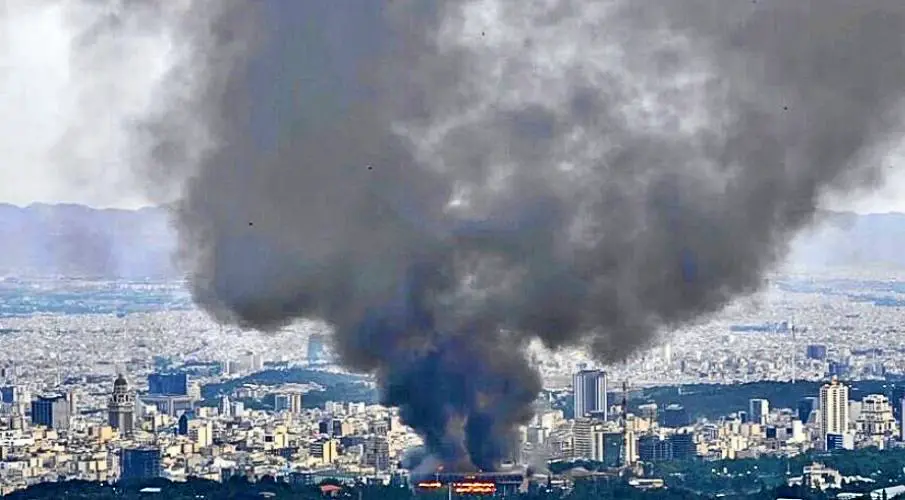
The United States and Israel have struck Iran with a coordinated large scale attack. Smoke rose over government districts in Tehran, explosions were reported from Isfahan, Ilam, Shiraz and other regions. Iranian media reported impacts near the offices of Supreme Leader Ayatollah Ali Khamenei. Whether the 86 year old was present there remained unclear. Foreign Minister Abbas Araghchi later stated on US television that Khamenei and President Masoud Pezeshkian were “as far as I know” alive.
For Washington, it is already the second direct military action against the Islamic Republic within eight months. President Donald Trump justified the strike with Iran’s continued nuclear program and missile developments with potential range into the United States. At the same time, he addressed the Iranian population directly and urged them to “take your destiny into your own hands” and overthrow the leadership that has ruled since 1979. It was a military operation - and a political appeal.
Tehran reacted immediately. According to Israeli statements, dozens of missiles and drones were launched at Israel. Some were intercepted, but military leadership warned that the protective shield was not seamless. At the same time, Iranian attacks were directed against US bases as well as against several Gulf states. Saudi Arabia reported attacks on Riyadh and the eastern part of the country, described them as an “open and cowardly attack” and stated they had been repelled. In Bahrain, a missile struck near the National Security Agency. Kuwait reported a drone attack on the international airport with injuries and material damage. In Irbil in northern Iraq, missiles and armed drones were intercepted; the Khor Mor gas field halted operations, large parts of the region lost electricity.
Pakistan condemned both the attacks by Israel and the United States on Iran and the Iranian strikes against Saudi Arabia, Jordan, Bahrain, Kuwait, Qatar and the United Arab Emirates. Prime Minister Muhammad Shehbaz Sharif spoke by phone with Crown Prince Mohammed bin Salman and declared that Pakistan would stand by Saudi Arabia under all circumstances. Egypt’s President Abdel Fattah el Sissi warned in a conversation with the Saudi crown prince against further escalation. Foreign Minister Badr Abdelatty held consultations with counterparts from Saudi Arabia, Turkey, Germany and France and spoke of serious consequences for regional stability.
The European Union announced an extraordinary security meeting. Ursula von der Leyen stated that further escalation must be prevented. British Prime Minister Keir Starmer emphasized that his country had not participated in the attacks, but had provided air defense to protect its own forces and allies. He sharply condemned the Iranian leadership, yet at the same time called for a return to the negotiating table. France and Germany also joined London in urging the resumption of talks between Washington and Tehran. China expressed that it was “deeply concerned” and demanded an immediate end to military actions. The UN Security Council scheduled an emergency session, Secretary General António Guterres condemned attacks and counterattacks alike.
In Washington, a constitutional dispute erupted immediately. Senator Tim Kaine called it a “colossal mistake” and demanded a vote on war powers. Hakeem Jeffries stated that Iran is a dangerous actor, but outside of compelling emergencies the president must seek congressional approval before a preventive military deployment. Jim Himes described the action as a war without a clear strategic objective. From within the State Department it was said that leading lawmakers had been informed in advance, but without indication of the full scope of the operation.
Economically, attention turns to the Strait of Hormuz, through which about one fifth of the world’s oil supply is transported daily. Before the weekend, Brent had closed at 72.87 dollars per barrel, a seven month high. Analysts expect significant price jumps in the event of major disruptions, and in the case of escalation even beyond that.
While missiles were intercepted over Israel, daily life in the West Bank remained remarkably calm. In Ramallah, people stood at market stalls, although no sirens warned of possible debris. Israel closed checkpoints, gas stations saw long lines. In Argentina, President Javier Milei raised the security level, especially for Jewish institutions and critical infrastructure.
New explosions were reported near Shiraz. Iran emphasizes its right to self defense. NATO stated it is closely monitoring the situation. The fronts are open, the rhetoric is sharp, and every further step carries the risk of turning an exchange of blows into a regional conflagration.
Updates – Kaizen News Brief
All current curated daily updates can be found in the Kaizen News Brief.
To the Kaizen News Brief In English


Ich unterstütze das islamistische Terrorregime im Iran unter keinen Umständen.
Dennoch ist es ein souveräner Staat, der ohne UN-Mandat, völkerrechtswidrig angegriffen wurde.
Wir können uns nicht aussuchen, für wen die Souverenität gilt und für wen nicht.
Das Gleiche gab es vor kurzem in Venezuela.
Auch da gab es einen kurzen Aufschrei.
Dann wurde abgewiegelt und schön geredet, weil Madura ein Diktator war.
Heute spricht Keiner mehr über Maduro oder Venezuela.
Ich störe mich auch daran, wenn Länder einseitig die Verteidigung Iran’s verurteilen.
Sie wurden ohne kriegerische Provokation angegriffen.
Es ist ihr Recht sich zu verteidigen.
Auch wenn ich die Art und Weise verurteile, da unbeteiligte Zivilisten in Ländern betroffen sind, die nicht an den Angriffen beteiligt waren.
Die ganze Region kann „explodieren“.
Trump hat schon mal did Zündschnur angezündet und Israel hat Öl dazu gegeben.
Und Europa, die NATO und die UN, werden wieder verurteilen, mahnen und dann zum Tagesgeschäft übergehen.
Heimlich denken sicher Einige „lass die USA und Israel machen, dann gibt es bald ein Terrorregime weniger“
👍