
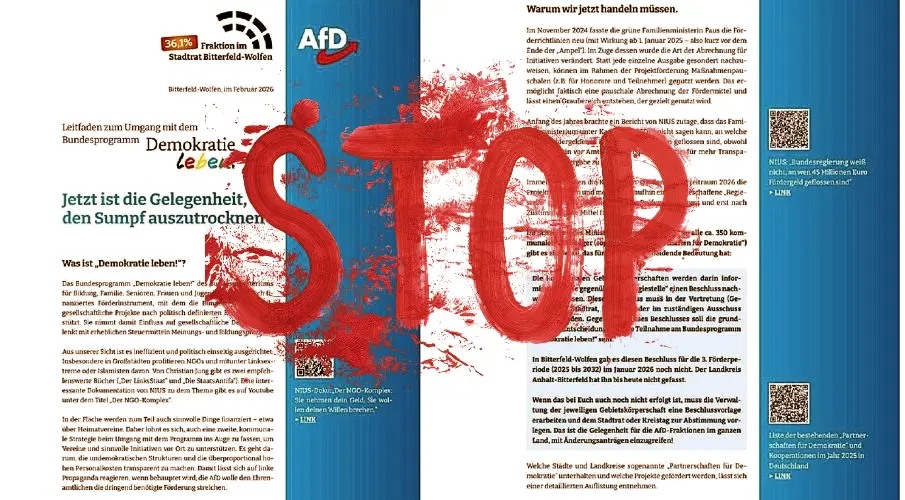
This paper is not a contribution to transparency. It is a manual for political intimidation. Under the guise of parliamentary oversight, it creates a climate of generalized suspicion in which engaged citizens, youth initiatives, integration projects, and prevention programs are to be systematically placed under scrutiny. Those who work against extremism, who support refugees, who involve young people, are not understood here as part of democracy - but as potential adversaries. What is lost in the process are real protective spaces: projects that prevent radicalization, that give young people direction, that defuse conflicts in communities, that make integration possible. When such structures are dried out through constant attacks, political labeling of individuals, and targeted scandalization, it is not parties that lose - it is children, volunteers, social workers, entire municipalities.
This document reveals an understanding of democracy reduced to mistrust, devaluation, and power logic. It recognizes majorities, but not pluralism. It recognizes control, but not trust in civic engagement. It is detached from reality because it pretends that social cohesion arises through political cleansing rather than participation. And it is dangerous because it uses democratic instruments to deliberately eliminate democratic spaces.

Even the title, with the formula “drain the swamp,” sets a normative framework. “Swamp” does not come from the language of administration, but from right wing ideological combat rhetoric. A democratically adopted federal funding program is thus rhetorically coded as an illegitimate, corrupt system. This semantic pre structuring is central: it defines the object of investigation not as a legitimate subject of political oversight, but as a morally contaminated opponent. The perspective shifts from evaluation to eradication.
In the section “What Is ‘Demokratie leben!’?” the program is described as an instrument that “influences social debates” and directs “opinion and educational processes” with substantial taxpayer funds. This wording contains an implicit accusation of state manipulation of opinion. Yet no normative standard is cited that would render such influence unlawful. Democracy promotion is inherently political, but not partisan. The rhetorical technique here is to portray political education work as manipulative intervention.
Particularly relevant is the passage claiming that especially in large cities NGOs benefit, including “left wing extremists or Islamists.” This equation is analytically problematic. It implicitly links integration, anti racism, or prevention work with proximity to extremism, without differentiated evidence. Migration does not appear here as a policy field, but as an implicit environment of danger. In this way, the entire spectrum of civil society integration work is placed under suspicion. This is not an argument, but a mechanism of stigmatization.
On page 2, the change in funding logic is interpreted as a gateway to opacity. The decisive passage, however, is the reference to the necessity of a municipal resolution to participate in the program. This resolution is strategically identified as leverage to reopen the “fundamental decision” to participate politically. The guide transforms a formal administrative requirement into a political battleground. The goal is not merely transparency, but the possibility of questioning participation altogether.
Page 3 contains a particularly explicit statement of purpose: it is crucial to retain control over the use of funds to prevent money from being used “against the AfD.” The program is thus explicitly interpreted as being directed against the AfD in partisan terms. The argument reverses the logic: if democracy promotion addresses right wing extremism or group based hostility and the AfD feels affected, this is reframed as partisan discrimination. Here a detached, if not entirely absent, understanding of democracy becomes visible: criticism of a party is reinterpreted as illegitimate use of state funds.

Also on page 3, the “alliance” and the “youth forum” are described as bodies with “political explosive power” that lack democratic legitimacy. In reality, such bodies are components of participatory democratic forms. They do not replace elected institutions, but complement them. The guide defines legitimacy exclusively through direct election or formal decision chains. Participatory democracy is thus normatively devalued. This is not a legal argument, but an ideological narrowing of the concept of democracy.
Page 4 makes the strategy concrete. It recommends detailed examination of the personnel structures of the external office, including political classification of individual actors. The formulation that these are often “left or green persons” who also organize alliances against the right in their private time makes clear that the aim is not only institutional transparency, but political marking of individuals. This represents a qualitative strategic shift: oversight no longer targets only funds, but convictions.
The recommendation to uncover a “scandal” through personnel and material costs is also telling. The word “scandal” appears here not at the end of an evidentiary chain, but at the beginning as a strategic objective. Oversight is conceived as a means of public scandalization. That is politically permissible, but it shows that the guide is a propaganda paper, not a neutral handbook.
On pages 5 and 6, an extensive catalogue of questions follows. Formally, these questions are permissible. Substantively, however, they create a permanent regime of justification: personnel hours, tenders, qualifications, conflicts of interest, documentation mechanisms. The density of the questions points to a strategy of structural review up to the limits of administrative capacity. Politically, this can produce a chilling effect: organizations withdraw because they must expect constant political scrutiny.

Page 7 makes the thrust explicit. In the sample motion for access to files, it is stated that there is suspicion that funds were used to purchase flyers or banners “against the AfD.” This is the documented proof of the previously implicit assumption: the guide presumes partisan hostility and deliberately seeks evidence for it. Access to files is thus described not merely as a right of oversight, but as a partisan investigative instrument.

From a democracy theory perspective, the core problem is as follows: the guide accepts democratic procedures only insofar as they can be reduced to elected bodies. Civil society participation, preventive democracy promotion, integration and migration work appear as illegitimate influence. Democracy is functionally sealed off as majority decision making. Pluralism, minority protection, and preventive safeguarding of democracy are portrayed not as integral components, but as problematic cases.
Legally, the guide itself contains no direct instruction to break the law. Its danger lies in the instrumentalization of legitimate oversight rights for a pre defined political goal: the structural delegitimization and obstruction of civil society democracy promotion. If information from funding files were used for public political labeling of individuals as enemies, this would touch on personal rights and data protection. If funding were blocked solely for partisan motives, this could implicate the prohibition of arbitrariness and the administration’s obligation to act according to law.
Anyone who knows history does not need a prophecy. The Third Reich did not begin with the camp, but with the form - with the systematic redefinition of enemy and friend, of control as care, of exclusion as order. What this document shows is not politics in the classical sense, but a grammar of submission: civil society as swamp, participation as threat, transparency as a weapon against one’s own population. That this takes place within elected bodies does not make it more legitimate - it makes it more dangerous. An AfD in governmental responsibility, whether at the state or federal level, would not merely be a setback. It would be a repetition with modern means: the surveillance infrastructure of the GDR, the political cleansing logic of the Third Reich, the performative hostility of a system that promises its citizens freedom while dismantling it step by step. We are witnessing this nightmare in America right now - in real time, in high resolution, every day. ICE raids against immigrants, the throttling of civil society structures, the killing of people, the simultaneity of free speech rhetoric and free speech destruction: those who vote in order to be free and in doing so vote for right wing populist parties such as the AfD fall for a lie that authenticates itself. No country on earth is perfect. But to risk the very concept of country in favor of an apparatus that treats its own population as a case of suspicion is not a political experiment. It is a calamity from which, once inside it, one can free oneself only with extreme force and enormous loss. We know this. We are living it. And we resist, every single day, what comes when people stop paying attention.
Updates – Kaizen News Brief
All current curated daily updates can be found in the Kaizen News Brief.
To the Kaizen News Brief In English


Der Slogan abgekupfert bei ihrem großen Vorbild, „drain the swamp“
…das stimmt
Danke für diese klare Analyse. Afd-Verbot sofort.
… gerne und ja, dem kann ich nur zustimmen
Omnia mea mecum porto
… tóte olíga phérousin
Unglaublich.
Wie kann ein vorläufiges Gerichtsurteil ergehen, dass die AfD nicht als gesichert rechtsextremistisch angesehen werden darf.
Die AfD Kommentare (Bots und real) überschlagen sich vor Freude und tönen noch lauter, dass ein Verbot nicht demokratisch wäre.
Nicht demokratisch, da kann man sich vor Lachen nur in die Hose machen.
Und eine Aussage „man muss die AfD weg regieren, nicht verbieten“ (ich habe vergessen, wer es sagte) ist naiv und gefährlich.
Das hat schon 1933 nicht funktioniert.
Danke fûr den Bericht.
Leider bekommen viel zu wenig Menschen mit, was AfD wirklich bedeutet.