
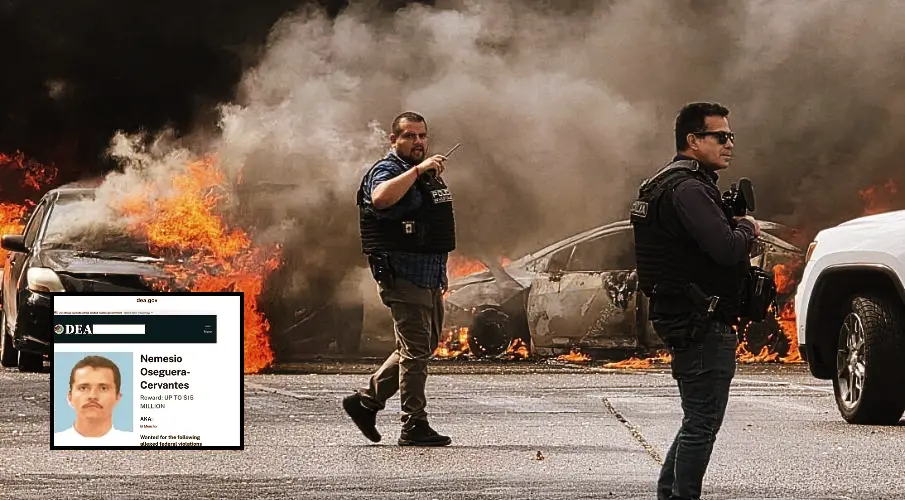
Guadalajara - Nemesio Oseguera Cervantes was dead on Sunday. The Mexican military killed him in a town called Tapalpa, twenty kilometers from Guadalajara. “He was wounded during the operation in Tapalpa. Later, on the way to Mexico City, he died.” That was at eleven in the morning, maybe also at noon. It is unclear. The exact time does not matter. What matters is that he was dead. And then Mexico began to burn.

He was called El Mencho. That was his name in the underworld, in the headlines, in the minds of Americans who were hunting him for 15 million dollars. A bounty. The state had put up a reward higher than the value placed on many human lives. El Mencho was the head of the Jalisco New Generation Cartel, the cartel that had become the most powerful in Mexico. Not Sinaloa, not anymore. Jalisco. His cartel.

Police officers cordon off an area in Zapopan after members of organized crime set vehicles on fire there.
He was 59 years old. From Aguililla. A poor boy who went to California, later went to prison for heroin trafficking, served three years, got out, and went back to drugs. That was his life. At some point he founded a new cartel with another man. That was in 2007. Since then it grew. It grew and grew. The cartel was in all 50 American states. It sold fentanyl, cocaine, methamphetamine. Billions of dollars per year. These are not numbers one understands. Billions. Ten billion perhaps, 15, no one knows exactly. And El Mencho controlled all of it. He sat somewhere in Jalisco and controlled an empire larger than many countries.
El Mencho was killed during the military operation in Tapalpa in the state of Jalisco, Mexico. His son is serving a life sentence in a US prison, while he himself had been hiding with kidney failure. In response, road blockades are now burning in five states, including in Puerto Vallarta.
American President Trump had said he would bomb Mexico if the cartels were not stopped. That was a threat. Trump meant it seriously. Mexican President Claudia Sheinbaum said that would never happen, that it would be a violation of sovereignty. But she knew the Americans were applying pressure. That is why she ordered El Mencho to be captured. Or killed. That was the goal. On Sunday it happened. The Mexican army entered the town of Tapalpa. They fired. El Mencho fired back. There was a fight. Four people died there, three more died later, one of them was El Mencho. Three soldiers were wounded. The army arrested two other cartel members. They also seized weapons. Rocket launchers. Things that can shoot down helicopters. But that was not the end.
Footage shows intense gun battles in La Desembocada in the Mexican state of Jalisco between armed members of the CJNG - Cártel Jalisco Nueva Generación, led since 2007 by El Mencho - and Mexican security forces after the killing of cartel leader El Mencho.
The real fire came afterward. Not at one or two, but hours later. In Guadalajara, a city of 1.4 million people. In Puerto Vallarta. In Cancún. In 20 states. Everywhere. The cartel set cars on fire. They blocked roads with burning vehicles. They set supermarkets on fire. They set banks on fire. They killed people. At least 14 on Sunday. Seven of them were soldiers of the National Guard. One was a prison guard. Another was a prosecutor.
The images show Guadalajara. Empty streets. Black smoke, gunfire. Planes turning around. The airport terminal with people running. Families were caught in a cartel blockade. They saw wounded people on the street. Announcements advise: “We ask people not to go outside.” After what one had seen, it is clear that these people show no consideration for anyone. One would not wish what one experienced on any human being.
This is the moment after a death. This is what happens when a cartel has to show its strength. It is not mourning. It is not even revenge, not directly. It is a message. The message is: you cannot simply kill our boss. If you do that, you pay a price. A big price. We control this country more than your government. See it.
Flights were canceled. Air Canada said no flights to Puerto Vallarta. Other airlines followed. The Mexican government warned Americans and Canadians to remain where they are in five states. Not to go out. In Jalisco, Tamaulipas, Michoacán, Guerrero, and Nuevo León. Schools were closed. Public transportation was stopped. In Guadalajara, a city of millions, the population sits at home and waits.

The governor of Jalisco, Pablo Lemus, said the country was living through critical hours. Critical hours. That is the word used when a state is no longer in control. President Sheinbaum said everything was running normally. She said coordination with all states was complete. That is what governments say when nothing is normal. That is what they say to avoid fear. But the people at home know this. They see the burning cars. They see the videos. They hear the gunshots. They know nothing is normal.

An analyst named David Mora from the International Crisis Group said something important. He said that since she took power, Sheinbaum has made the military more confrontational. That means she is trying to fight the cartels. That is different from other presidents. It is a signal to Trump that Mexico can do it alone, without American troops on Mexican soil. But that is not what people on the street see. They only see that a man is dead, and now the country is burning.

The interesting thing is that it could have looked so simple. The state kills the head of the cartel. That should be a victory. The boss is dead. The cartel should collapse. That is the theory. That is what everyone thinks when they hear that the president of a cartel has died. But that is not what happens. That is never what happens. What happens is that a cartel shows it is still there. That it still has power. That it still has more control than the government in some places.
The death of El Mencho is as significant as the arrest of El Chapo in 2016. That was a big deal. El Chapo was a legend in those circles. But El Mencho was worse. El Mencho was younger. El Mencho was hungrier. El Mencho had fentanyl. Fentanyl is what kills the world and America the fastest, not cocaine, not methamphetamine. Fentanyl.
Investigations have not yet determined whether the Jalisco cartel has a clear succession. If it does, then it remains united. If not, then it fractures. And if it fractures, there is more blood. More violence. That is what happens when a power breaks apart. Others fight over the pieces. It has always been that way, research has shown it again and again.
That is the real story. Not that El Mencho is dead. That is known. That is finished. The real story is that the government tried to show that it is superior to the cartels. And the cartel answered with fire. And now no one knows what happens next. That was Sunday. On Monday schools are closed. On Tuesday some flights are still canceled. People are still sitting at home. El Mencho is dead. But his cartel is not.
To be continued ...
Updates – Kaizen News Brief
All current curated daily updates can be found in the Kaizen News Brief.
To the Kaizen News Brief In English


Der Artikel liest sich so, als sollte man besser die Finger von solchen Kartellen lassen.
Mexiko scheint eh keine Wahl gehabt zu haben.
Es würde entweder durch Bomben in Brand gesteckt – und viele Menschen dadurch getötet,
oder nun durch die Macht des Kartells.
Ironisch könnte man sagen: Trumps Kartell gegen das dieses Drogenbosses.
Alle anderen dazwischen in Geiselhaft.
…auf jeden fall nicht in solch einer überstürzten art, die etlichen menschen das leben gekostet hat und noch opfer folgen werden. die kartelle müssen bekämpft werden, ohne wenn und aber, aber trumps druck führt genau zu solchen schlecht vorbereiteten operationen – eine politik die jahrzehnete recht wenig dagegen tat, wird das nicht in 2 wochen beenden. auch die transportwege sind teils noch unbehelligt, europa ist da viel zu offen
Sollte die Fußball WM nicht nur nach Kanada gehen. México und USA sind beide nicht sicher.
…dem kann ich nur zustimmen
Die ganze WM ist mehr als unsicher.
Wer ein Attentat plant – in welcher Art und Weise auch immer, das Zeitfenster und die vielfältigen Möglichkeiten, werden so schnell nie wieder so günstig stehen wie zur WM Zeit.
Kann man alle Austragungsstätte, alle Wege, alle Straßen usw. wirklich so genau sichern?
Selbst die USA kann nicht jeden Einreisenden so gründlich durchleuchten, dass diese Gefahr ausgeschlossen sein wird. Zumal Attentäter auch nicht dumm sind!
Und! Wir sahen am Sonntag: Attentäter müssen nicht zwingend schon Erscheinung getreten sein! Auch Neulinge packt die Mordswut auf Trump und seine MAGAs.
Die WM ist aus meiner Sicht ein irres Wagnis!
****Hier sind die Gruppen, bei denen ein Rückgang der Unterstützung oder aktive Gegnerschaft beobachtet wird:
Kartelle sind leider sehr, sehr mächtig.
Weil sie skrupellos sind.
Menschenleben sind uninteressant, wenn es nicht die oberste Hierarchiebene betrifft.
El Menche ist tot.
Das ist prinzipiell gut.
Aber, wie Du schreibst, nicht so.
Meist gibt es zwei oder drei Ranghohe Mitglieder, die ein Kartell weiter führen.
Zumindest anfangs.
Jeder will die alleinige Macht.
Aber erstmal gilt Kartell gegen Regierung.Die neue Generation der Kartelle weiß, dass man effektiver ist, wenn man zusammenhält.
Ein Machtvakuum bringt mehr Jämpfe, aber nicht unbedingt mehr Erfolg.
Sheinbaum ist in einer schwierigen Lage. Und sie lässt sich zu sehr von Trump unter Druck setzen.
Anstatt gut geplante und effektive Zugriffe vorzunehmen.
Amerikanische Truppen in Mexiko sind de facto eine Kriegserklärung.
Ohne UN Mandat.
Kann sich Trump das tatsächlich erlauben? Also im Sinne von „hat er dafür einen breiten Rückhalt“
Oder macht er es wie in Venezuela?
Sheinbaum beseitigen und die Regierungsgeschäfte quasi übernehmen?
Die Kartelle würden da nicht still sitzen.
Es würde ein langwieriger, leidvoller und sehr blutiger Disput werden.