
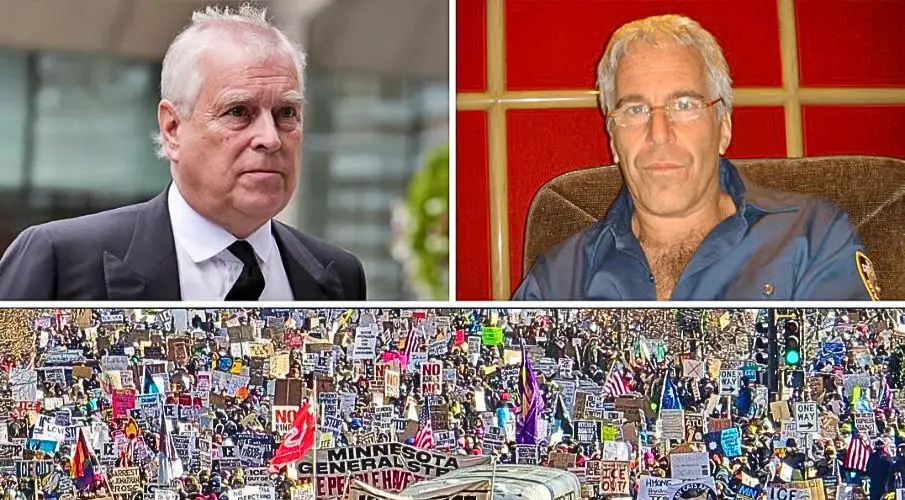
The past months have shifted something that long seemed immovable. Names once considered untouchable are suddenly under pressure. Andrew Mountbatten-Windsor was arrested on his 66th birthday. In Minneapolis, the federal government was forced to retreat after massive protests against ICE operations. Two completely different developments - and yet both expressions of the same reality: public pressure works.

For years, the public was reassured, relativized, and only partially informed in the Epstein case. Again and again, it was said there was nothing new, nothing substantive, nothing that truly concerned the big names. Yet the demand for transparency did not subside. Files were requested, disclosures forced, connections exposed. The case of Andrew is not an isolated event, but the result of a long process. His role as British trade envoy already ended in 2011 in the shadow of Epstein. Years of evasion, lapses in memory, and damage control followed. In 2022, he paid Virginia Giuffre a multimillion dollar settlement without admitting guilt. With every new release, the pressure increased. Eventually, King Charles III stripped him of titles and privileges. Now came the arrest.

In the United States as well, it became clear that political decisions are not made in a vacuum. The protests against ICE in Minnesota began locally, became nationally visible, and led to a federal retreat. For weeks, it was explained that the operation was necessary, unavoidable, without alternative. Yet the resistance persisted. People took to the streets, organized, kept the issue present. In the end, Washington stepped back.

Remarkable is who built pressure together here. Evangelical groups that have for years demanded the full release of the Epstein documents. Civil rights activists. Left wing initiatives. Conservative gun rights associations that took a position in the case of Alex Pretti. Young voters who last year helped Zohran Mamdani to victory against all predictions. This coalition cannot be pressed into a simple party scheme. It is contradictory, complex, but effective.
Meanwhile, large parts of the media focused on side issues. Personal stories, celebrity news, distractions. The structural shift remained underreported. Yet it is evident: decisions are not prepared solely in government buildings. They emerge under pressure, under scrutiny, under the threat of political consequences.

Investigative journalists - those few who did not allow themselves to be deterred - went deep, took a different path, where others looked away. They researched despite obstacles placed in their way, despite threats, despite defamation that endangered their work. In Minneapolis they stood with citizens against ICE and held their ground - out of an inner necessity to reveal truth. They exposed what was meant to remain hidden. They pointed out, they helped those affected, the invisible. And they showed no fear. Some of them found themselves in prison. Yet the investigative mandate was clear: if one wanted to change something, if one relentlessly brought truth to light, there was a price. The price was not always the same. Sometimes it was freedom. Sometimes peace. Sometimes reputation. Sometimes more. This was and is also the story of those who knew: that the price of investigative work was not negotiable. That one could not have both comfort and integrity. That real change always cost something from those who wanted to bring it about. They paid. And they are still paying.

Bill Gates also recently came under pressure. After the publication of an email from Epstein in which he claimed Gates had sought his medical advice, the Gates Foundation canceled a high profile appearance at a global AI summit in India at short notice. Gates rejects the allegations. Regardless of the assessment, the episode shows how sensitively even billionaire actors react to public debate. A sentence circulating in Washington captures the dilemma. Marjorie Taylor Greene reported that Trump told her in a phone call he could not fully release the Epstein files because otherwise “friends would be hurt.” Whether this quote was said exactly in that way is secondary. What matters is that the idea of political consideration for powerful networks sounds plausible to many.

ROYAL COMMUNICATIONS
Thursday, February 19, 2026A STATEMENT BY HIS MAJESTY THE KING
It is with deepest concern that I have taken note of the news regarding Andrew Mountbatten-Windsor and the suspicion of misconduct in public office. There will now follow the full, fair, and proper process in which this matter will be investigated appropriately and by the competent authorities. In this, as I have previously stated, they have our full and unrestricted support and cooperation.
Let me be clear: The law must take its course.
While these proceedings continue, it would not be appropriate for me to comment further on this matter. In the meantime, my family and I will continue to fulfill our duties and service to you all.
Charles R.
The release of the Epstein documents did not come from Congress. It was not the gift of party leadership. It was forced. Just as the retreat in Minnesota did not occur out of nowhere. Politicians react to pressure. When they act, it is often because they must. Cynicism helps in such moments only those who benefit from lack of transparency. It suggests powerlessness where room for action exists. Recent developments show the opposite. Public pressure can reach even those who for decades felt secure behind titles, wealth, and networks.

Andrew Mountbatten-Windsor was once “His Royal Highness.” Today he is a suspect in a criminal investigation. The federal government declared ICE operations unavoidable. Shortly afterward it withdrew. These are not coincidences. They are the result of persistent public scrutiny. He has meanwhile been released from custody.
The decisive question is not whether this dynamic continues. It is who will shape it in the future, in whatever country.
Updates – Kaizen News Brief
All current curated daily updates can be found in the Kaizen News Brief.
To the Kaizen News Brief In English


Ohne Menschen wie Euch, die unermüdlich recherchieren, Fakten prüfen und auch unter Bedrohung der Wahrheit verpflichtet bleiben, würde sich bichts bewegen.
Andrew wurde erst von der Queen militärisch degradiert.
Von King Charles wurden ihm alle Titel entzogen.
Aber alles nur um noch größeren Schaden von der Krone abzuwenden.
Leider nicht, damit den Opfern Gerechtigkeit wiederfährt.
Die Festnahme betrifft nicht die Missbrauchsvorwürfe, sondern die Frage nach einem möglichen Amtsmissbrauch.
Es ist aber gut, dass eine Festnahme erfolgte.
Öffentlich.
Nicht verdeckt und nicht geschützt.
In Minnesota war es die breite Menge, die unermüdlich für Demokratie, Verfassung und Menschenrechte aufgestanden ist.
Aber, das muss man leider auch sagen.
Die ICE Mitarbeiter, die Good und Pretty auf dem Gewissen haben, wurden bis heute nicht zur Verantwortung gezogen.
Ermittlungen gibt es nur gegen Good und Pretty … ansonsten mauert das FBI.
Die Öffentlichkeit kann viel bewirken, wenn sie sich für eine gute Sache einsetzt ❤️
Man siehe auch den Druck auf Disney mit tausenden Kündigungen der Abonnements.
👍