
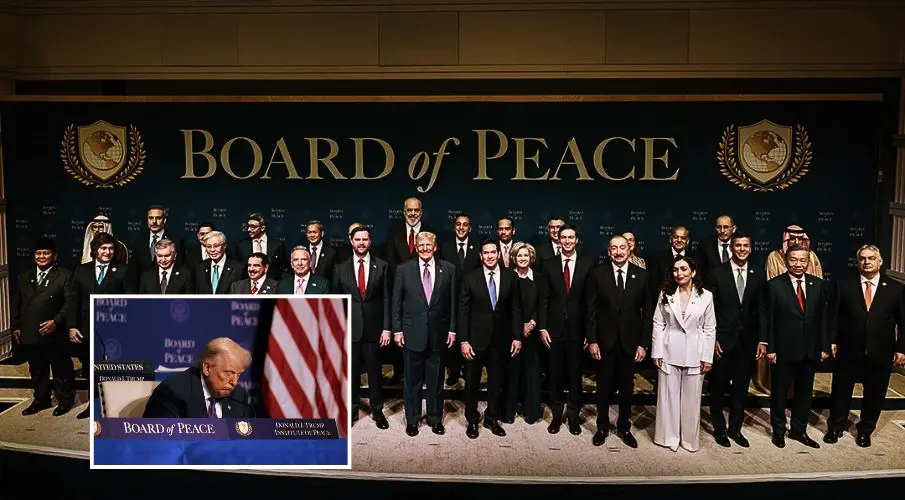
Washington witnessed a meeting this Thursday that offered more self staging than substance. Donald Trump opened the first session of his newly created “Board of Peace” at the U.S. Institute of Peace and declared it one of the most important projects of his term. Around him: heads of state and government from Saudi Arabia, Indonesia, Qatar, Argentina, Hungary, Pakistan, Bahrain, and other countries. Many wore red caps bearing the inscription “USA,” placed them demonstratively next to their nameplates, and lined up for the group photo. At Trump’s side stood Vice President JD Vance and Secretary of State Marco Rubio.
Trump opened the first session of his “Board of Peace” in proper fashion with a “family photo.” Before a single word about Gaza was spoken, there was smiling, arranging, and posing. Next to him Vice President J.D. Vance and Secretary of State Marco Rubio, behind them representatives from Saudi Arabia, Indonesia, Qatar, and other states - ready for the image that is later to be sold as a historic moment. Several participants, including Argentina’s President Javier Milei and Hungary’s Prime Minister Viktor Orbán, had brought red “USA” caps and placed them demonstratively next to their country placards. World politics with fan merchandise.
The setting itself was already a message. This body is initiated by Trump, led by Trump, and explicitly conceived as a new global authority. He said the peace council would strengthen the United Nations - only to explain in the next sentence that one would “in a certain way oversee the United Nations and ensure that it works properly.” The Charter of the United Nations knows no such supervisory body. Nevertheless, Trump presented his project as a supplement and promised that they would work closely with the UN in the future. In the end, he even announced that they wanted to “fix up” the headquarters in New York - visually as well.
After awarding Trump an alleged “peace prize,” FIFA President Gianni Infantino also took part in the meeting of Trump’s “Board of Peace.” Infantino has finally turned FIFA into a laughingstock. Not only heads of state wanted to collect applause at the “Board of Peace,” FIFA President Gianni Infantino also appeared with a grand gesture. In a region where homes lie in ruins, clinics can barely function, and entire streets are destroyed, he declared that one must not only build houses, but “people, emotions, hope, and trust.” And of course one thing above all could achieve that: soccer.
The numbers sounded impressive: 50 million dollars for a national stadium with up to 25,000 seats, 15 million for an academy, plus 7.5 million for mini and full size playing fields. While concrete commitments for power grids, water lines, and hospitals are scarcely mentioned, the grass is already imagined as lush green. If there is no roof over one’s head, at least there is floodlight. What a shameful appearance.
FIFA President Gianni Infantino, a figure long associated with questionable proximity to power. In 2026 as well he delivers more headlines because of embarrassing appearances and ethical boundary crossings than because of reforms. Trump used the stage to announce that FIFA had awarded him its first peace prize. They had seen how he had been “set up” by Norway and therefore had given him a peace prize, he said - and turned even this award into a personal reckoning.
The President’s pursuit of peace in the world is at the same time a mandate for prosperity here in America. I am proud to have participated this morning in Washington in the historic session of President Trump’s Board of Peace.
JD Vance attempted to give the whole thing a domestic political direction. With a view to the midterm elections, he emphasized that it was not only about peace, but about prosperity for American citizens. The states represented on the peace council stand for investments in the trillions and secure millions of jobs through the purchase of American products. The direct connection between the new body and concrete economic effects, however, remained unclear. Trump’s trade conflicts have recently strained relations with several allies, including states that deliberately did not join this council. Several NATO partners stayed away from the meeting. Trump commented on this by saying that some countries were playing “a little clever.”

The major announcement followed shortly thereafter: The United States would provide 10 billion dollars for the Board of Peace. For what exactly the money is to be used, he did not say. It also remained unclear whether Congress has approved these funds or still has to approve them. Trump merely said that the body shows how a better future can be built - “here in this room.”
Investor Marc Rowan, a member of the executive committee of the peace council, became more concrete. He outlined plans for reconstruction in the Gaza Strip. In Rafah in the south, 100,000 houses for 500,000 people are to be built initially, plus infrastructure projects totaling 5 billion dollars. In the long term, there is talk of 400,000 new apartments and 30 billion dollars in infrastructure. He did not name a timetable. His conclusion: The problem is not money, but peace.
Billionaire Marc Rowan declared that Gaza’s coastline alone has a value of 50 billion dollars.
The meeting itself proceeded like a cabinet session with international participation. Representatives from Peru, Bahrain, Pakistan, and other countries used their remarks primarily to praise Trump. Pakistan called him the “savior of South Asia.” Several times it was noted that previous US administrations had not achieved in years what Trump had managed within a single year. Substantive debates or detailed conflict solutions receded into the background.
At the same time, Trump sharpened his tone toward Iran. He repeated his demand for a new nuclear agreement and said that otherwise “bad things would happen.” In the next ten days one would see where developments go. US armed forces are currently strengthening their presence in the Middle East. Resistance is growing in Congress. Democratic Representative Ro Khanna announced that he wants to force a vote to restrict Trump’s military freedom of action toward Iran without parliamentary approval. Republican co sponsor Thomas Massie reminded that only Congress may initiate a war. A similar initiative failed last year shortly after Trump independently ordered strikes on three Iranian nuclear facilities.
In his remarks, Trump also expressly praised Hungary’s Prime Minister Viktor Orbán and assured him of his “full and total support” in the upcoming election campaign. Orbán is considered a close political ally of Trump and faces criticism in Europe for his course. This too was part of the signal intended to emanate from this meeting: The peace council is not only a forum for conflict resolution, but also a political alliance.

Donald Trump was politically never viable. But by now a point has been reached where it is no longer only about political misjudgments, but about something more fundamental. When a president with access to nuclear weapons delivers appearances marked by overconfidence, distortion of reality, and sleepy self staging, the question of his health and mental condition inevitably arises.
In the end, Trump held a signed resolution up to the cameras and promised to “make the United Nations healthy again.” He emphasized that the United States would continue to work closely with the world organization. At the same time, the central question remains open: Is the Board of Peace an additional instrument of diplomatic coordination - or an attempt to establish a new power structure alongside the UN?
We followed the entire meeting - and in the end one question above all remains: What is all this for? It looked less like serious diplomacy than like a club of mutual affirmation, organized around a person who in every constellation seeks above all his own advantage. While the participants praised one another, another reality faded from view: The US trade deficit most recently stood at 901 billion dollars, despite the tariffs imposed. Economically, America is increasingly tilting off balance - and the new “peace council” provides above all one thing: distraction.
What became visible on that day was less a finished plan than a claim to power. Ten billion dollars without a clear purpose, billion dollar reconstruction promises without a timetable, military threats against Iran, open support for selected heads of government, and the announcement that the United Nations would in the future be “overseen.” The peace council is to bring peace and create prosperity. Whether it actually defuses conflicts or generates new tensions will not be decided in opening speeches, but in the actions that follow these words.
Updates – Kaizen News Brief
All current curated daily updates can be found in the Kaizen News Brief.
To the Kaizen News Brief In English


Es war vor allem eines, eine peinliche Lobhudelei um Trumps Person.
Alleine, wenn man sich die Mitglieder ansieht 🙈 Autokraten, Diktatoren und „Kõnige“.
Alles Staaten in denen Menschenrechte, Recht und Gesetz eher „Empfehlungen“, „Interpretation“ oder gar „nicht existent“ sind.
Trump als lebenslanger Führer.
Egal wie dement und wahnsinnig er noch wird.
Selbst, woran ich nicht glaube, dass es vor Ablauf seiner 2. Amtszeit ein Impeachment gibt, bleibt er der Leiter des „Board of Peace“
Mit all den machtgeilen Staatsmännern.
Ungarn und Bulgarien.
Den „Mitgliedsbeitrag“ zahlt dann wohl indirect die EU.
Beide Länder bekommen viel Unterstützung von der EU.
Die sollte man in dem Zusammenhang in Frage stellen. Und zwar öffentlich und deutlich.
Wer 1 Milliarde an Trump zahlt, braucht offensichtlich ja kein Geld von der EU.
Albanian und Kosovo.
EU Beitrittskandidaten.
Sollte man dringend auf Eis legen.
Trump will nach Gutdünken Herrscher der Welt spielen.
Als Konkurrenz zur UN.
Vielleicht will er sie auch „einverleiben“, weil er ja effiezienter ist.
Der Satz „wir werden die UN überwachen, ob sie richtig arbeiten“, lässt nichts Gutes erahnen.
Der Gott-Kaiser hält Hof und die übrige Welt weiterhin in Atem. Hauptsache die Dollars fließen..