
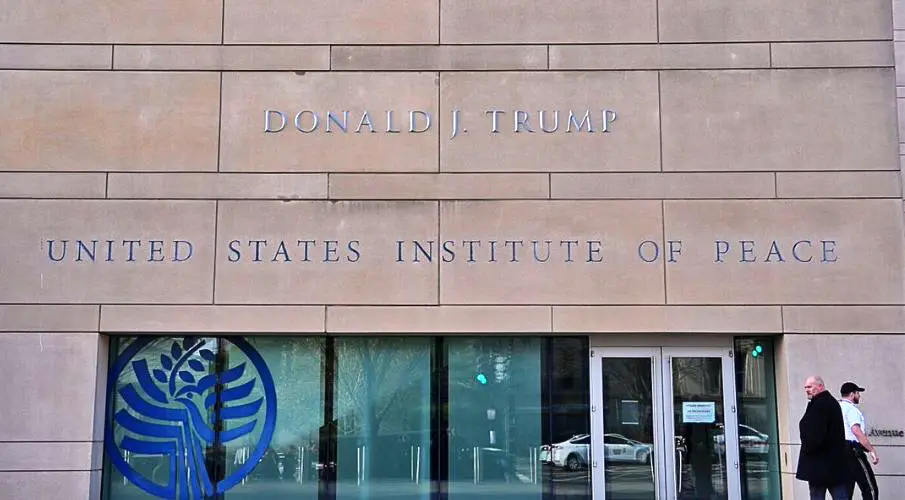
Donald Trump is convening representatives from more than two dozen states in Washington today for the first meeting of his newly created “Board of Peace.” Officially, the focus is on rebuilding the devastated Gaza Strip and on forming an international stabilization and police force. Five billion dollars have been pledged, Trump says. Roughly seventy billion are needed according to estimates. The gap is enormous, and so is the ambition. What was announced as part of a twenty point plan to end the Gaza war has now taken on a broader scope. Trump says this body will not only secure lasting peace between Israel and Hamas, but could in the future resolve conflicts worldwide. He calls it the “most consequential gathering of all time.” At the same time, he criticizes the United Nations, saying it has not exhausted its potential and must “get moving.” The message is clear: a format is emerging here that stands alongside the existing world order - or challenges it.

Donald Trump introduced his latest creation on January 22, 2026 in Davos: a „Board of Peace,“a peace council that, in his words, could one day make the United Nations obsolete.
More than forty states and the European Union are sending representatives. Germany, Italy, Norway, and Switzerland are participating as observers but have not formally joined. The situation in Gaza was moved up for discussion in the United Nations Security Council after it became clear that the schedules would collide. From the Vatican came the remark that international crises should primarily be managed by the United Nations. The White House rejected the concerns and described the Board as a legitimate organization with broad international participation. The US ambassador to the United Nations declared that they were not only talking, they were acting - and that the old approaches had not worked. At the center of the deliberations is the question of disarming Hamas. Israel demands it as a prerequisite for any stable order in Gaza. So far, only Indonesia has made a firm commitment to participate in a possible international force. From Jakarta it is said that they want to cooperate with leading Islamic states to achieve lasting peace in Palestine, even if obstacles remain. The US administration makes no secret of the fact that demilitarization will be difficult. They have no illusions, it is said, but are encouraged by feedback from mediators.
Alongside Trump, among those speaking will be Secretary of State Marco Rubio, Special Envoy Steve Witkoff, Jared Kushner, former British Prime Minister Tony Blair, the head of the operational executive body Nickolay Mladenov, and the US ambassador to the United Nations. The executive body is to report on progress in establishing functioning administrative structures and public services in Gaza. The skepticism of many partners is directed less at reconstruction itself than at the unclear expansion of the mandate. Without a clear basis in international law beyond Gaza, the Board appears as a political instrument that Washington can deploy flexibly. States with strong engagement in the Middle East apparently hope, through their participation, to secure influence and to persuade Trump to use his leverage over Israel for concrete steps.
Whether this “Board of Peace” becomes a viable structure or ends as a parallel architecture to the existing international order will not be decided by slogans, but by results. Five billion is a beginning. The disarmament of an armed organization, the establishment of functioning institutions, and the integration of regional actors are the real test. The ceasefire in Gaza is fragile. A new body changes nothing - as long as questions of power, security guarantees, and political perspectives are not credibly resolved.
Updates – Kaizen News Brief
All current curated daily updates can be found in the Kaizen News Brief.
To the Kaizen News Brief In English


Das Ganze dient nur der Schwächung der UNO und dem Größenwahn Trumps, samt Konsorten. Schon die Struktur mit Konzentration auf die eine Person zeigt dies. Gefährlich wird aber diese Organisation allemal, da sie eine Schwächung der Demokratien darstellt. Wenn ich an den anderen Artikel denke mit all den möglichen Einfluß der Kontrolle der Staaten durch Überwachungssysteme kann einem schlecht werden. Danke für Eure penibel Arbeit
vielen dank… da kann ich Ihnen nur zustimmen
Peace ist an diesem „Board of Peace“ gar nichts.
Es geht vor allem um Trump.
Er trifft letztlich die Entscheidungen, auch wenn die anderen Abstimmen können.
Eine einseitige Machtkonzentration sondersgleichen.
Und eine Selbstbeweiräucherung sondersgleichen.
Die klare Aussage, nur sein Board of Peace, also er der großartige Trump, ist in der Lage die Kriege der Welt zu beenden.
Die UN hat nichts bewirkt, gemäß Trump.
Ja, die UN ist zum Papiertiger mutiert, leider.
Vieles liegt am Konstrukt. Z.B. dass Länder gegen die Sanktioniert werden sollen, ein Veto einlegen können. Das Gleiche bei gemeinsamen Erklärungen.
Aber dennoch ist die UN die größte Organisation, die die meisten Staaten der Welt vereint.
Sie hat bisher für eine halbwegs solide Stability gesorgt.
Es gibt die UN-Blauhelne, die in vielen Regionen hilfreich waren. Sie waren durch den Auftrag der UN legitimiert.
Trump will auch eine „internationale Truppe“. Aber nur seiner Mitglieder.
Ohne völkerrechtliche Legitimation.
Aber mit Einfluss der zahlenden Mitglieder.
Es geht bicht um Frieden und Demokratie.
Es geht um Machtausübung zu deren Bedingungen.
Dieses Board of Peace ist sehr gefährlich in meinen Augen.
Es erschreckt mich aber auch, wie international darauf reagiert wird.
Die große UN zieht die Gaza Diskussion vor, weil sonst die Termine kollidiert hätten.
Das muss man sich mal auf der Zunge zergehen lassen.
Und Europa kraucht hin. „Als Beobachter“…. sie geben Trump damit die internationale Aufmerksamkeit, die er haben will.
Ein Beobachter hätte gereicht.
Ich fürchte ja eher, dass der eine oder andere Staatschef doch damit liebäugelt Mitglied zu werden. 🤬
…ja europa sass knuffelig in der ecke und zuckten nicht einmal