
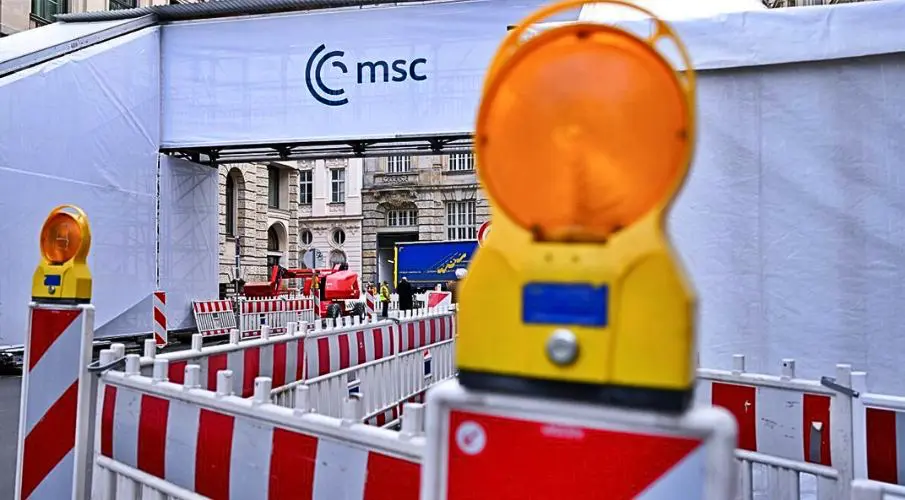
One year ago, on the same stage at the Munich Security Conference, an American vice president openly lectured, snubbed and ideologically attacked Europe. JD Vance’s speech marked the beginning of a phase in which the transatlantic relationship disintegrated not only politically, but atmospherically. Trade disputes, mockery, open contempt, threats directed at allies - much of what had long been considered a quiet consensus was publicly called into question. This year, the tone is softer. No open insults, no demonstrative disdain. Instead, American representatives speak of “pragmatic realism.” Yet behind the new wording stands the same message: Europe must pay for its own security. Europe must stand militarily on its own feet. Europe must end its dependence on Washington.
And in Munich, it is clear that this message has been heard. Federal Chancellor Friedrich Merz declared at the very start of the conference that the international order based on rights and rules no longer exists in its previous form. The claim of the United States to global leadership has been challenged, perhaps squandered. That is not a diplomatic half sentence, it is a sober assessment. Merz spoke openly of a “gap” in the transatlantic relationship and listed where paths have diverged: in dealing with hate speech, in climate protection, in free trade. Values that Germans and many Europeans long regarded as a shared foundation with America no longer stand self evidently side by side.
“If this money is used only for national solo efforts, we will waste our money, waste our time and create many misdevelopments.”
Emmanuel Macron phrased it differently, but no less bluntly. Europe is rearming, he said, but that is no longer enough. The continent must become a geopolitical power. Not only economically, but in security policy. Not as a junior partner, but as a capable actor. And he added: a stronger Europe is a better ally for the United States. This is not a turning away from America, but a rejection of one sided dependence.
What scarcely needed to be spoken was the trigger for this acceleration. Trump’s push to bring Greenland under American control, the public belittling of European heads of government in Davos, the tariff threats, the flirtation with a possible NATO withdrawal - all of this has burned itself into the European memory. In Paris, people now speak of the “Greenland Moment.” A turning point. The moment when it became clear that territorial integrity is no longer a taboo even among allies. Trust that had grown over decades can be damaged in a few weeks.
Marco Rubio: “The world is changing very quickly right before our eyes. The old world is over. We are living in a new era of geopolitics.”
In Munich, the United States was represented not by Trump or Vance, but by Secretary of State Marco Rubio and Under Secretary of Defense Elbridge Colby. Rubio is regarded in Europe as someone who seeks to prevent the connection from breaking completely. Colby spoke in Brussels and Munich of a transitional phase for NATO. The past year, he said, had served to realign the relationship. Europe must carry conventional defense itself. The American nuclear umbrella would remain in place, but the division of labor is shifting.
At the same time, Colby left no doubt that terms such as “rules based international order” carry little weight in Washington. Alliances, his message made clear, are not based on feelings, but on burden sharing. Those who want security must pay. NATO members have now committed to increasing spending on core military capabilities to 3.5 percent of their gross national income by 2035. In Munich, this was discussed not as an imposition, but as a new reality. Yet skepticism remains. Wolfgang Ischinger, the long time chairman of the conference, reminded participants that destroyed trust rarely fully returns. Polls show deep uncertainty among the European public toward Trump and American foreign policy. The question is not only whether Washington will keep its commitments, but whether its political direction will remain predictable.
Merz went one step further. Germany is holding talks with France about a European nuclear deterrent. France is the only nuclear power within the European Union, while the United Kingdom also possesses nuclear weapons but is no longer part of the EU. Until now, the United States has guaranteed the nuclear umbrella for Europe within NATO. The fact that a European solution is now openly discussed shows how deep the uncertainty runs. Merz emphasized that this would not replace NATO, but serve as a strong European pillar within the alliance. Europe must not allow zones of differing security. Macron added that there can be no peace for Ukraine without Europe. Anyone negotiating security guarantees must not exclude the continent. Europe has armed Ukraine, financed it, supported it politically. It will also have to bear responsibility for the postwar order. Economically and militarily exhausting Russia is a prerequisite for stable security.
At the same time, domestic political tension was visible on the American side. The Speaker of the House, Mike Johnson, abruptly canceled the official delegation of dozens of lawmakers - in the midst of a budget dispute. Several members of Congress nevertheless traveled to Munich, including Lindsey Graham, Alexandria Ocasio Cortez, Gretchen Whitmer and NATO Ambassador Matthew Whitaker. Joe Wilson, long time chairman of the bipartisan EU Caucus in Congress, stated from his district that European partners had clearly expressed to him their concerns about tariffs and Greenland threats. Damage had been done. One must be personally present on the ground to reaffirm the inseparable bonds.
The shift was also evident in American remarks. Rubio said on the way to Munich that the old world is over. We are living in a new geopolitical era. Everyone must redefine their role. Thom Tillis described it as a sober discussion among partners, not a rupture. Yet even if the tone is gentler, the structure remains the same: America expects a Europe capable of defending itself independently.
In the corridors of the conference, less was said about unity than about reordering. Europe is to become more economically independent, expand its military infrastructure, diversify supply chains, strengthen its own defense industry. Macron spoke of European steadfastness. Merz spoke of repairing trust - together, not unilaterally.
What becomes visible in Munich is not a dramatic break, but a gradual decoupling from assumptions once taken for granted. Eight decades of military dependence on Washington are drawing to a close. Not because Europe rejects America, but because it no longer wants to rely on America alone. And perhaps that is precisely where the real shift lies. Europe does not object loudly. It reorganizes itself.
Updates – Kaizen News Brief
All current curated daily updates can be found in the Kaizen News Brief.
To the Kaizen News Brief In English


Hier in den Medien wird Rubios Rede zumeist als „Zusage an Europa und die NATO“
Das war sie nicht.
Rubio ist mehr Politiker, als der Rest von Trumps Entourage.
Er fällt nicht mit der Tür ins Haus.
Aber dennoch ist die Aussage klar „die USA sind nur ein Partner, wenn man akzeptiert, dass die USA bestimmen wie, wo und wann“
Und das Rubio gleich danach nach Jngarn reist, ist wohl ein deutlicher Wink mit dem Zaunpfahl. Auch das zweit Land, Slowenien, passt in das Bild.
Fakt ist auch, dass weder Trump noch Putin, noch XI ein Interesse an einem geeinten und starken Europa haben.
Putin kratzt mit Desinformation, Trump mit Zöllen an der Stabilität.
Xi hält sich öffentlich zurück, denn Russland und USA sind die aktiven treibenden Kräfte.
Umso wichtiger ist es, dass Europa nun endlich aufwacht und in Bewegung kommt.
Einig wird es mit Orban und Slowenien nicht, da darf man sich nichts vormachen.
Umso wichtiger ist es, dass die anderen Staaten enger zusammen rücken und Europa mit UK und Kanada unabhängiger machen.
Noch sehe ich das nicht.
Zuviel wird in Europa tot diskutiert.
in europa wird aktuell tatsächlch alles bis zum letzten, und letzten punkt diskitiert, medien haben teils bezug zur strasse verloren und rubios rede war nicht wirklich pro europa…