
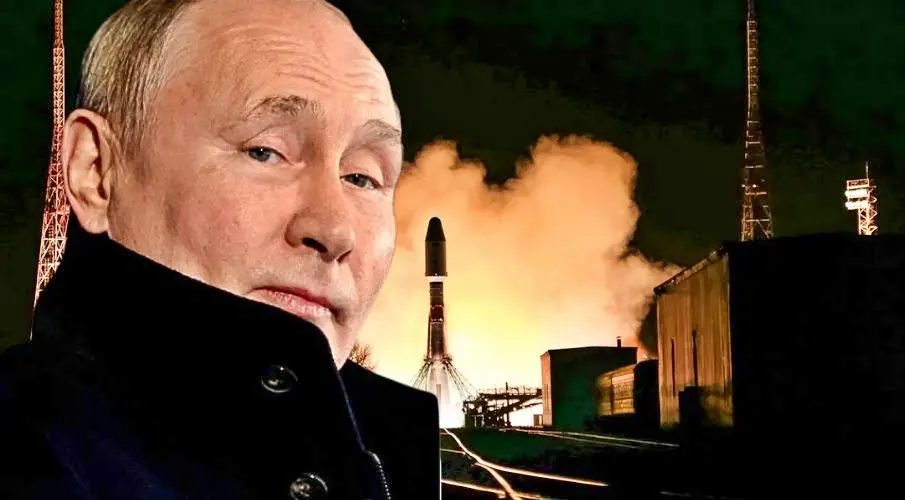
On February 5, 2026, the last remaining treaty limiting strategic nuclear weapons between Russia and the United States expired. It ended without extension, without replacement, without a new control regime. For the first time in decades, no binding mechanism exists that creates transparency over the respective arsenals. As this security vacuum emerges, the Kremlin presents a series of allegedly “unprecedented” weapons systems that are said to secure Russia’s strategic position for decades. In reality, they have neither changed the war in Ukraine nor strengthened the country’s long term security. On the contrary.
The Russian nuclear submarine BS 329 “Belgorod” is equipped with six nuclear armed Status 6 “Poseidon” torpedoes, which are said to be capable of triggering nuclear tsunamis. The yield of a “Poseidon” torpedo is cited as 100 megatons, that is 100,000 kilotons. The frequently mentioned 100,000 kilotons sound immense, yet precisely this figure raises doubts about actual operational reality - because such an extreme yield would be technically conceivable, but militarily difficult to integrate and so far unconfirmed by independent evidence.
Since 2018, Vladimir Putin has regularly presented a list of so called “wonder weapons”: the nuclear powered cruise missile “Burevestnik,” the unmanned nuclear torpedo “Poseidon,” the intercontinental missile “Sarmat,” the hypersonic glide vehicle “Avangard,” the air and sea launched missiles “Kinzhal” and “Zircon,” and most recently the intermediate range missile “Oreshnik.” All of them are described as having “no analogues in the world.” The promises are vast: unlimited range, invulnerability to missile defense, kinetic impacts “like meteorites,” speeds beyond Mach 20, destructive power capable of devastating entire regions.
Burevestnik, NATO designation SSC X 9 “Skyfall,” is a Russian ground launched cruise missile with nuclear propulsion. It is said to have virtually unlimited range and to remain airborne for very long periods. This is supposed to be made possible by a miniature reactor on board. Technically, a very long range would be conceivable, but independent evidence of a serial production, permanently operational system is still lacking.
Yet the overall record is sobering.
The intermediate range missile “Oreshnik” was used twice against targets in Ukraine. In its first deployment in November 2024, Putin spoke of warheads heating to 4,000 degrees and producing an effect on impact comparable to a meteor strike. Entire lakes could be formed, he said, drawing a comparison to the Tunguska event. In reality, the missile struck the Yuzhmash plant in Dnipro without verified massive destruction. The second use in January 2026 in Lviv also produced no strategic effect. Militarily, the conventional version of “Oreshnik” is considered expensive and imprecise. Moreover, the launches apparently took place from stationary test sites, not from fully operational mobile systems. The announced deployment in Belarus appears more like a political signal than a credible military posture.
“Burevestnik” is described as a cruise missile with nuclear propulsion, virtually unlimited range, and the ability to evade defense systems. In 2025, successful tests were again reported. Earlier attempts were accompanied by serious incidents, including a 2019 explosion in the Arkhangelsk region that left several people dead and elevated radiation levels. The concept recalls a US project from the 1960s that was abandoned due to technical risks and radioactive contamination. Even if it proves possible to integrate a functioning miniature reactor into a missile, questions remain regarding operational safety, infrastructure, and real world deployability. A system that is theoretically capable of bypassing any defense is only as credible as its practical availability.
“Poseidon,” an autonomous underwater drone with a nuclear warhead, is described as a weapon capable of devastating coastlines with gigantic tidal waves. State broadcasts have even spoken of 500 meter high tsunamis. Physical models do not support that. It is also unclear at what stage of maturity the system actually exists. Although the special submarine platform “Belgorod” has been commissioned, full proof of the functionality of the overall system is still lacking. The project has been running since the 1980s, consumed enormous resources, and created a new, difficult to control type of weapon. Here as well, research shows that strategically it expands the category of nuclear delivery systems without necessarily delivering a clear military advantage.
“Avangard,” a hypersonic glide vehicle, is said to be capable of maneuvering through dense atmospheric layers at speeds exceeding Mach 20. Officially, it has been in service since 2019. Technical questions remain open: guidance under extreme heat conditions, signal transmission through plasma, real maneuverability at high speeds. Even if the performance data are accurate, a single new delivery system changes little about the fundamental logic of nuclear deterrence, which already rests on the capacity for mutual destruction.
Avangard is a hypersonic glide vehicle that has reportedly been in service since December 2019. It can be launched from various intercontinental missiles, including the latest and widely described as highly advanced RS 28 Sarmat.
Er kann von verschiedenen Interkontinentalraketen abgefeuert werden, einschließlich der neuesten und als besonders fortschrittlich gehandelten RS-28 Sarmat.
Particularly problematic is “Sarmat,” the intercontinental missile intended to replace the Soviet era “Voevoda.” After a single officially confirmed test, it was declared operational in 2022. Since then, indications of technical difficulties have multiplied. Several planned or presumed launches apparently ended unsuccessfully. At the same time, the older “Voevoda” missiles are reaching the end of their service life. If “Sarmat” does not function reliably, a gap emerges in the strategic arsenal.
The systems “Kinzhal” and “Zircon,” used in the war in Ukraine, have also tempered the initial promises. “Kinzhal” proved less precise than claimed and was intercepted multiple times by modern air defenses. According to available assessments, “Zircon” does not sustain the announced top speeds and suffers from limited targeting capability. Both weapons generate media impact but no military breakthrough. The decisive factor is the broader context. With the expiration of the last arms control treaty, a framework disappears within which new weapon types could be inspected, counted, and limited. Systems such as “Burevestnik” or “Poseidon” fit into no existing category. Their development significantly complicates future arms control negotiations. At the same time, they create incentives for other states to examine comparable concepts or to develop countermeasures. The result is not a gain in security, but an expansion of insecurity.
In the war against Ukraine, the “wonder weapons” have not produced a strategic turning point. In the long term, they increase complexity, shift the boundaries of what is technically possible, and undermine the remnants of an already fragile arms control architecture. Instead of stable deterrence, an environment emerges in which technical promises, political demonstration, and actual operational capability diverge. Russia’s security does not depend on spectacular announcements, but on reliable structures, dependable systems, and verifiable agreements. With every new “unique” weapon developed outside existing treaties, it becomes more difficult to return to such structures. The real risk lies not in the claimed invulnerability of these systems, but in the erosion of the rules that have so far prevented an uncontrolled arms race.
Updates – Kaizen News Brief
All current curated daily updates can be found in the Kaizen News Brief.
To the Kaizen News Brief In English


Putin bläht seine Wunderwaffen auf, damit Alle eingeschüchtert sind.
Danke für das „Auseinanderpflücken“ der angeblichen Wunderwaffen.
Aber ja, ein fehlender „verbindlicher“ Vertrag ist ein (globales) Problem.
Wobei man sagen muss, dass seit 2020 keine gegenseitigen Kontrollen mehr erfolgt sind.
Erst Corona, dann der Ukrainekrieg.
Ich glaube nicht, dass Putin und auch Trump derzeit ein echtes Interesse an einem neuen Vertrag.
Trump nur, damit möglichst sein Name darüber steht.
gerne, putin hat kaum interesse am frieden, trump möchte verdienen …