
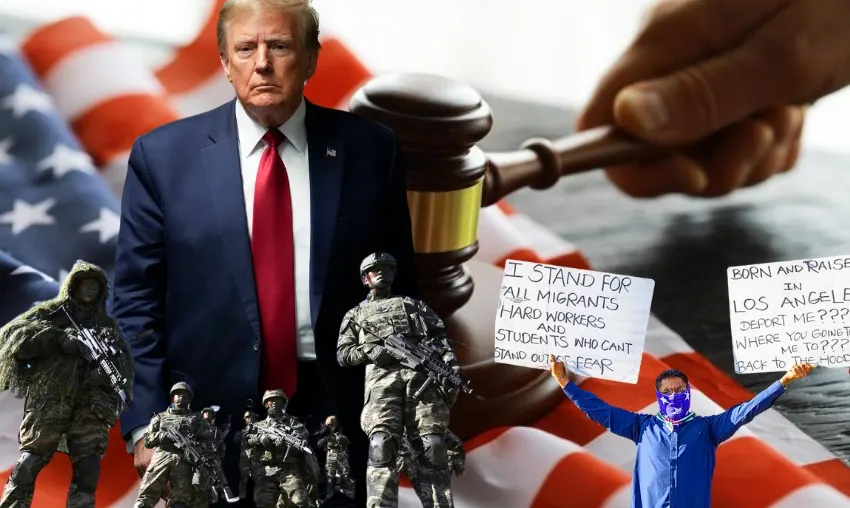
Without a press conference, without a victory pose, without a word of self-criticism, the federalized National Guard units vanished from Chicago, Los Angeles, and Portland; in Minneapolis, they are pulling out. In Minnesota, relief mixed with anger. Activists speak of a victory against the raids — yet they remind the public that people have died and families have been torn apart. For residents, nothing is over as long as no one takes responsibility for the chaos that was unleashed. What for months had been sold as an indispensable measure against supposedly out-of-control cities ended quietly in the background. By January 21, more than 5,000 soldiers from California, around 500 from Chicago, and about 200 from Oregon had been sent home. The demobilization was handled by U.S. Northern Command, which stated in dry terms that the troops had completed their activities. Nothing came from the White House.

Just weeks earlier, the administration had claimed that only these “patriots” had reduced crime. The cities would have been “lost” without federal intervention, the president wrote in December. They would return “in a different and stronger form” if crime rose again. Now came the withdrawal - after a series of defeats in court.

Chicago will remain with us for a long time
Federal judges accused the administration of testing the limits of its authority and effectively attempting to create a national policing structure under the direct control of the president. Several lawsuits filed by states and municipalities ultimately led the Supreme Court in December to halt further deployment to Chicago. The justices signaled that protests against immigration policy do not justify a permanent military presence on city streets. Under Title 10, troops may be placed under federal command, but they are not permitted to carry out law enforcement tasks such as arrests or searches. It was precisely this gray area that the administration had stretched.
The deployments cost nearly half a billion dollars, according to estimates by the Congressional Budget Office. Money for troops who in Washington D.C. at times collected trash, while others patrolled the National Mall or train stations. More than 2,500 National Guard members remain stationed there, however under a separate agreement set to expire later this year. Two soldiers from West Virginia were shot near the White House in November. Air Force Staff Sergeant Andrew Wolfe has since been fighting his way back through rehabilitation, while soldier Sarah Beckstrom died one day after the attack.
A Shot at Close Range - 20-year-old soldier Sarah Beckstrom has died and a president who uses the moment for himself

(Article dated November 28, 2025)
Only a few hundred meters from the White House, something happened on Wednesday afternoon that plunged Washington into a mix of shock, grief and political calculation. Two National Guard soldiers from West Virginia, recently deployed to the capital to support the government, were shot on the open street. On Thursday evening, Donald Trump announced during a Thanksgiving call with troops that one of the two wounded, twenty-year-old Specialist Sarah Beckstrom, had died. His sentence came without preparation, without visible restraint: "She just died. She is no longer with us. Her parents are with her."
Units also remain in Memphis and New Orleans, but there under the leadership of the respective governors. We will report from Memphis in the coming days - initial articles are already in the magazine. The crucial difference: in Chicago, Los Angeles, and Portland, the president had federalized the Guard against the explicit resistance of Democratic governors. For many legal scholars, that was a power move with explosive political implications. In Illinois, Governor J.B. Pritzker responded with a brief statement: after multiple court defeats against Illinois and other states, the National Guard had finally been quietly withdrawn from the streets. The pressure is working - and must be maintained.

Minneapolis Demanded Everything from Everyone - The Solidarity and Backbone of Its Residents Are Simply Unbelievable
The conflict had escalated most recently when the Department of Defense in January prepared around 1,500 active duty soldiers for a possible deployment to Minneapolis. The trigger was protests against massive immigration raids. The planned transfer never took place. After the fatal shootings of demonstrators Renee Good and Alex Pretti, the administration withdrew not only that option, but also the so called Commander at Large of the Border Patrol, Greg Bovino, along with around 700 federal officers.

What remains is a bitter image. A president who sought to demonstrate strength through military presence. Courts, civil rights organizations, journalists, attorneys, activists who repeatedly set limits. Cities that became stages for a struggle over power. And two names that mark the price this escalation demanded.
It is a hard won success. But it was paid for dearly. The research, documentation, and support for victims continue - and in Memphis it is no different. Because Minneapolis is everywhere in Trump’s America. If you value our work for human rights, we welcome your support.
Updates – Kaizen News Brief
All current curated daily updates can be found in the Kaizen News Brief.
To the Kaizen News Brief In English


Man darf wohl darauf warten, was sich die Regierung mit Blick auf die Midterms und ihre Wähler daraus zurechtlügt: Wir konnten die Truppen jetzt zurückziehen, weil wir den Frieden wieder hergestellt haben? Unterstützen kann ich derzeit leider nur via Verbreitung und Bekanntmachung. Und ich hoffe, Anerkennung ist auch eine Form der Unterstützung: Ihr macht tolle Arbeit, Respekt dafür und für Euren Einsatz.
Ich danke Dir für Deine Unterstützung und natürlich ist das eine tolle Unterstützung – bei den Midterms wird es nicht gut enden für die Reps …
Ich hoffe, dass es noch faire Midterms geben wird.
Es ist gut, dass sich die Nationalgarde zurückzieht.
Der unermüdliche Druck durch mutige Bürger, investigativer Journalisten, Bürgerrechtsorganisatoren und auch der demokratischen Bürgermeistern/Gouverneure hat diesen Erfolg erreicht.
Aber es sind Menschen gestorben.
Menschen beim Kampf der Trump Regierung gegen die eigene Bevölkerung.
Das darf nie vergessen werden..
In Memphis/Tennessee und New Orleans/Louisiana ist bedauerlicherweise eine andere Ausgangssituation.
Beides sind tiefrote Staaten mit republikanischen Gouverneuren.
Die Trump gefallen wollen und uneingeschränkt mit ICE zusammenarbeiten.
Ihnen sind die demokratischen Bürgermeister der Städte ein Dorn im Auge.
Die Nationalgarde ist für sie eine gute Option Macht auszuüben und den Bürgermeistern zu drohen.
Die Städte sind kein Zufall.
Es ist das Muster. Immer nur gegen demokratische Staaten oder Städte.
Gab es solche Einsätze in Houston?
In Alabama?
Nein.