
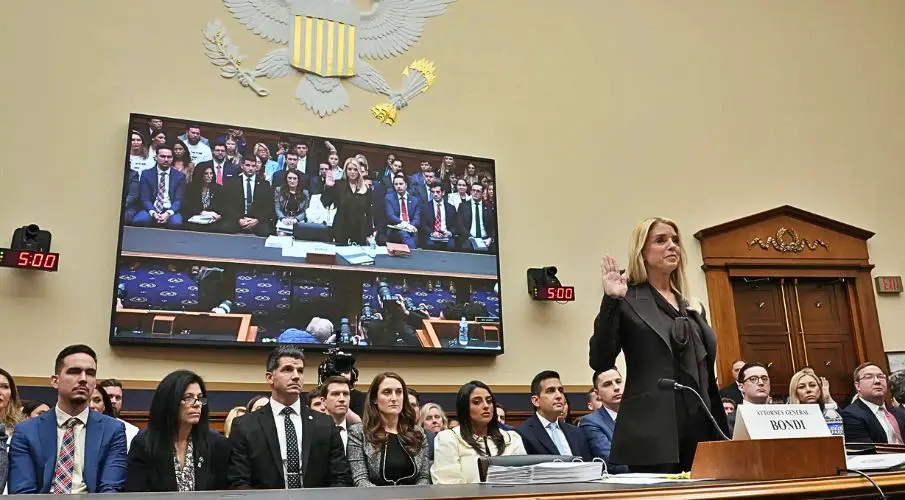
Pam Bondi knew it would not be a friendly appearance. When she appeared before the House Judiciary Committee, the room was already tense. At the center was her handling of the released files on Jeffrey Epstein - millions of pages, released under political pressure, accompanied by accusations that sensitive victim information had been insufficiently redacted.
Representative Jerry Nadler asked: “How many of Epstein’s co-conspirators have you charged? How many perpetrators are you even investigating?”
From the outset it was clear how hard the tone would be. Jamie Raskin, the ranking Democrat on the committee, accused her of siding with perpetrators and ignoring victims. If she did not change course, he said, that would be her legacy. He spoke openly of a massive cover-up originating directly from the Department of Justice.
Bondi responded loudly. She spoke of “theater” by Democrats. Yet she herself was the loudest voice in the room. The Republican committee chair, Jim Jordan, had to rein her in repeatedly so that she would not shout down questioners. Raskin explicitly warned her against repeating the strategy she had used at a Senate hearing in October - where she had deflected questions, responded with prepared attacks, and delivered personal jabs. “We saw your performance in the Senate, and we will not accept that here. This is not a game,” he said in substance.
Thomas Massie, the Republican representative from Kentucky, delivered one of the toughest moments of the day for Bondi from within her own party. Massie had broken with parts of the party leadership and helped push through the law that forced the release of the Epstein files. He confronted Bondi head on - not over political symbolism, but over the consequences for those affected. The release, he said, had exposed personal information of survivors, and in essence he stated that the worst possible thing that could be done to survivors had happened. Massie also asked why other men with apparent connections to Epstein were not the focus of new investigations.
Massie: “Can you determine who redacted the name of Les Wexner as a co-conspirator in an FBI document?” Bondi: “We corrected that within 40 minutes.”
Massie: “Within 40 minutes after I caught you in the act.” Bondi: “This man suffers from Trump obsession. You are a failed politician.”
Bondi did not respond with a factual explanation, but with an attack. She claimed that Massie was only interested in the files because Donald Trump was mentioned in them. She then escalated, accusing him of a pathological fixation on Trump and calling him a hypocrite. This exchange made visible how much the hearing oscillated between reckoning and defense - and how quickly even criticism from within one’s own ranks was treated as hostile contact.
Representative Jayapal called on Bondi to directly address the Epstein survivors present in the room. Bondi did not. Jayapal said: “I wish you would turn around to the survivors standing directly behind you and apologize to them on a human level.” Bondi replied: “Theater.”
The pressure intensified when Pramila Jayapal confronted her directly with the victims sitting in the room. Jayapal spoke of an editorial disaster: names of powerful alleged perpetrators redacted, intimate details of victims disclosed, even nude photos released. She read from an email in which a withheld name was mentioned in connection with a “torture video.” She then asked the survivors present to raise their hands if they had not had a conversation with the Department of Justice. Every single hand went up. Jayapal demanded an apology. Bondi deflected, instead attacking Jayapal and asking why she had not posed the same question to her predecessor Merrick Garland. “I will not stoop to that level,” she said. Voices were raised, the confrontation open.
Later, Bondi addressed the victims directly. She said she was “deeply affected” by what they had endured. An explicit apology for the release of insufficiently redacted documents did not follow. Files had been removed, she said, as soon as problematic content was brought to attention. Staff had done “their best” within the legally mandated deadline requiring the release of more than 3.5 million documents. Any allegation of criminal conduct would be taken seriously and examined.
Representative Jayapal asked the Epstein survivors present to raise their hands if they had not yet been invited to a meeting with Pam Bondi or the Department of Justice. Every single person raised a hand. Sometimes gestures speak louder than words.
The criticism did not subside. Democrat Lou Correa asked the survivors to stand and indicate whether they had confidence that the Department of Justice supported them. No one responded. Bondi countered that the department wanted to work with the victims and that they should reach out. Pushback also came from the Republican side. Representative Thomas Massie of Kentucky, who had broken with his party leadership and helped push the law mandating the release of the files, sharply challenged Bondi. The release of personal data, he said, was “literally the worst” thing that could be done to survivors. He also asked why other men with alleged connections to Epstein were not being investigated.
Bondi reacted as she had earlier with Democratic members: she accused Massie of focusing on the files only because Donald Trump’s name appeared in them. She spoke of “Trump obsession” and called him a hypocrite. The political dimension of the case was palpable throughout the hearing. What for a long time had been driven mainly from the right as a scandal is now being used by Democrats to apply pressure on Trump and his personnel decisions at the Department of Justice and the FBI. When Democratic Representative Ted Lieu referenced an old video of Trump and Epstein at a party and asked whether she would investigate their connections, Bondi called the question ridiculous. It was merely an attempt, she said, to distract from Trump’s successes.
In a longer statement she shifted into a broad defense of the president. She presented herself as his primary shield, even praised the rising Dow Jones index, and spoke of unjustified impeachments and investigations. In doing so, she falsely claimed that Special Counsel Robert Mueller had found no foreign interference in the 2016 election. Beyond the Epstein complex, other issues surfaced. Democrat Eric Swalwell complained that the Department of Justice had not brought charges over death threats against him and other members of Congress. Bondi assured him that such threats were taken seriously and actively investigated. No member of the committee, she said, should feel threatened.
Republican Representative Scott Fitzgerald played her a video of earlier statements by leading Democrats on illegal immigration. Bondi used the opportunity to praise Trump for his border policy. The president, she said, had closed the borders on his first day, thereby protecting Americans from violence and drugs.
When questioned by Jim Jordan, she neither confirmed nor denied whether the former CIA director John Brennan was under investigation in connection with the Russia inquiries. “No one is above the law,” she said simply. Brennan’s attorneys had made public in December that he was the target of an investigation in Florida; he denies any wrongdoing. Zoe Lofgren pointed to emails in the released files that could suggest additional individuals were involved in the exploitation of minors and asked about new investigations. Bondi replied that any case involving a victim would be reviewed. At the same time, she complained loudly that Lofgren was wasting her speaking time.
In addition, the FBI had stated in an internal memo last year that no further individuals would be charged. A review of internal materials had also found that investigators uncovered only limited evidence of a far-reaching network that systematically supplied powerful men.
A heated moment occurred when Bondi refused to comply with Jayapal’s request to turn around and address the Epstein victims present, all of whom had stated they had not yet met with her. The situation escalated into a loud exchange, with Bondi saying she would not participate in “theater.”
Beyond the verbal clashes, a sober balance remains: more than three million documents were made accessible in a reading room with four computers. Members of Congress were permitted to take handwritten notes. At the same time, intimate details of victims were made public while the names of allegedly influential participants remained redacted. For those affected in the room, this was not an abstract debate. When they were asked to express confidence in the Department of Justice, the room remained silent. That is where the true fault line of the day lies - not in the clash between parties, but in the question of whether a state that promises transparency has fulfilled its duty toward the most vulnerable.
The hearing lasted nearly five hours, and still everything revolved around the same question: how is the Department of Justice handling the Epstein files - and the people who were harmed within them? Pam Bondi was under constant fire, deflected accusations of a cover up, and instead went on the offensive. Again and again she passionately defended Donald Trump, mocked Democratic members of Congress, and avoided direct answers to the question of why victims have still not been granted access to her.

The moment that lingered in the room came at the initiative of Dan Goldman. Several survivors present were asked to raise their hands if their requests for meetings with the Department of Justice had gone unanswered. Every single hand went up. Goldman also pointed to a published email containing a list of affected individuals in which only one name had been redacted, and he spoke of targeted intimidation. Bondi rejected the accusation.
Jared Moskowitz also attacked her and mocked her prepared notes, demonstratively rating her political jabs with a zero. Bondi responded by accusing him of having previously mocked the Bible. The debate repeatedly turned personal.
Democrat Jesús Garcia ultimately raised the possibility of impeachment and resignation, referring to a report that Trump had privately expressed doubts about Bondi’s effectiveness. Bondi struck back by attacking Garcia’s own political conduct in Illinois. The conflict shifted from the content of the files to personal score settling.
What remains is the image of an attorney general who does not refute criticism, but ignores it - while those affected stand behind her in silence.
Updates – Kaizen News Brief
All current curated daily updates can be found in the Kaizen News Brief.
To the Kaizen News Brief In English


Ich meine: Auch diese Frau, Bondi, müsste mal genauer durchleuchtet werden.
Normal ist ihr Verhalten nicht!
…das haben wir schon, und es läuft in florida auch ein verfahren
Leugnen, diskreditieren, zu konkreten Fragen schweigen, ablenken, lügen… Das Muster ist überall dasselbe. Und noch immer dürfen sie weitermachen mit dieserTaktik. Republikaner scheinen allesamt eine sehr erfolgreiche Gehirnwäsche hinter sich zu haben. Das Ergebnis: Siehe Bondi. Wie infiltriert muss jemand sein, der einen fünfstündigen Dauerbeschuss aushält, ohne einzuknicken? Dass kognitive Verzerrung dermaßen allumfassend effektiv sein kann ist einmal mehr ziemlich ernüchternd. Wahrheit und Fakten sind dagegen machtlos. Sie erreichen einfach nicht die Richtigen. Zur Zeit des NS-Regimes resultierten daraus Denunziationen selbst von Eltern durch ihre Kinder.Was ist mit diesen Menschen los, die so emotional abgestorben sind, dass sie selbst Pädophile schützen und stützen? Würden sie ebenso reagieren, wenn es ihre Kinder wären, die missbraucht wurden? Aber das sind mehr rhetorische Fragen. Die Psychologie dahinter ist ja bekannt, Sekten funktionieren genau so.
Genau so ist es leider.
5 Stunden.
5 Stunden Angriff, Ablenkung, Diffamierung, Diskreditierung, persönliche Beleidigungen.
Bondi hat Trumps Werdegang gut studiert.
Wie man sich meistens sehr erfolgreich aus allem herauswindet und den schwarzen Peter jemand Anderen in die Schuhe schiebt.
Dazwischen einmal ein halbherziges „ich bin bestürzt, was den Opfern passiert ist“.
MAGA glaubt es vielleicht, bei denen hat die MAGA-Sektengehirnwäsche total gewirkt.
Aber um die es geht, die Opfer, die haben das Vertrauen schon lange verloren.
Nicht nur der Missbrauch, nein, ständig müssen sie weitere entwürdigende Situationen erleben.
Und so wie Bondi Trump verteidigt… nun ja, da kann sich jeder seine Meinung bilden.
Noch fehlen die Beweise.
…es waren harte 5 stunden, auch für uns….die ist einfach in einer anderen welt, noch …