
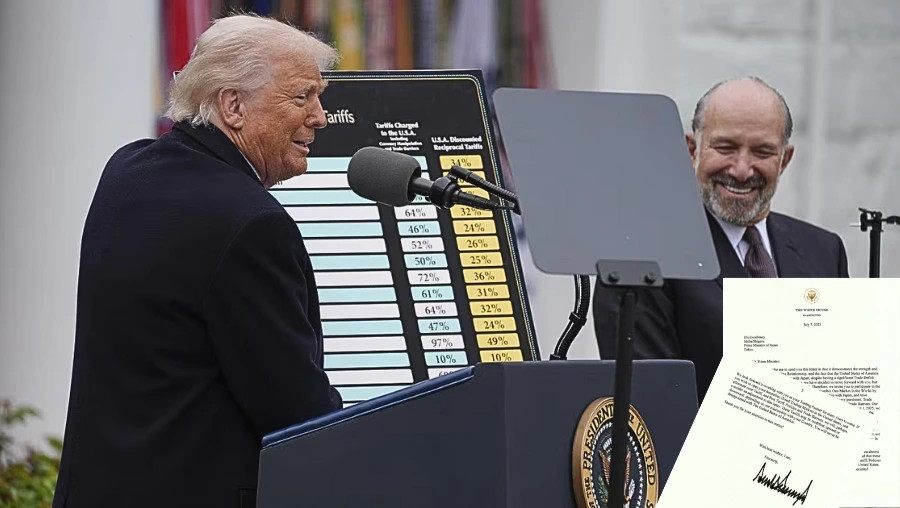
1,000 dollars. That is how much Trump’s tariffs cost the average American household last year. For 2026, economists are already projecting around 1,300 dollars - assuming the existing duties remain in place. This is not a marginal figure but, according to calculations, the largest tax increase as a share of gross domestic product since 1993. At the same time, the White House marketed the tariffs as a machine generating billions and trillions. In reality, the government collected about 264 billion dollars in tariff revenue in 2025 - far from the promised sums.

While strength is being proclaimed in Washington, the view in the supermarket tells a different story. According to official data, the effective average tariff rate rose within a year from about 2 percent to roughly 10 percent - the highest level since 1946. Overall inflation stood at 2.7 percent in December. But individual product categories are rising far more sharply. Coffee became 33.6 percent more expensive. Ground beef is 19.3 percent higher than a year ago. Lettuce costs 16.8 percent more. Frozen orange juice rose 12.4 percent.

A look at the price tables of the Bureau of Labor Statistics shows what this feels like in concrete terms. 100 percent ground beef most recently stood at around 6.68 dollars per pound. Bacon hovers around 6 dollars. A dozen large eggs costs just under 2.70 dollars - after a drop of more than 20 percent year over year. Potatoes are under one dollar per pound, tomatoes have also declined. But these reliefs do not offset what is being added elsewhere.
Households also feel the movement at the pump. Regular unleaded gasoline costs nationwide around 3.00 to 3.10 dollars per gallon. Premium is close to 3.95 dollars. Diesel stands at about 3.70 dollars. The figures fluctuate, but they are well above earlier campaign promises of drastically falling energy prices.

The White House points out that inflation has not exploded compared to the previous year, that real wages have risen and investments have flowed into the country. At the same time, the president recently declared that food prices would be “falling rapidly.” The latest monthly data, however, show the strongest increase in food prices since 2022. Food prices climbed 2.4 percent year over year, with noticeable spikes in individual products.
Economists cite several causes: drought years that reduced cattle herds. Strong demand for beef and coffee. Higher packaging costs due to 50 percent tariffs on steel and aluminum - canned goods became about 16 percent more expensive. Import-dependent goods such as electronics, toys, or cars were also burdened. Even when new trade agreements are announced, price movements take time to filter through.
At the bottom line remains a contradiction: tariffs were supposed to strengthen industry and protect consumers. In reality, households bear a significant share of the burden. When 1,000 dollars per year disappear from the budget, for many families that is not a statistical value but a concrete gap each month. And for 2026, everything indicates that this gap will grow.
Our investigations show:
The numbers are clear, even if they are politically uncomfortable. In November, the United States trade deficit jumped sharply to 56.8 billion dollars - an increase of 95 percent within a single month. That is something you first have to achieve. Trump delivers, only in a dramatically negative way. One of the central promises of the Trump administration thus collapses: that tariffs would strengthen America economically and permanently reduce the trade imbalance. What is now becoming apparent is that this very policy produces extreme swings without solving the structural problem. Exports fell significantly in November. They declined by 3.6 percent to 292.1 billion dollars. Particularly affected were exports of gold, pharmaceuticals, consumer goods and crude oil. At the same time, imports rose sharply. With an increase of five percent, they reached 348.9 billion dollars. The United States bought primarily foreign medicines and technical equipment for new data centers. The result is a deficit that does not stem from economic strength, but from hectic shifts.

The official data from the US government show that the United States trade deficit rose to 56.8 billion dollars in November 2025 - almost a doubling compared with October. The reason is that exports declined sharply while imports increased significantly, once again massively widening the gap between inbound and outbound trade. This contradicts the political promise that tariffs would permanently reduce the deficit.
This development is not an outlier, but part of a pattern. Since Trump imposed massive import duties, foreign trade has fluctuated with unusual intensity. The deficit had fallen sharply in previous months, in October even to the lowest level since 2009. The government celebrated this as a success. Economists warned early on, however, that this decline was largely due to special effects, such as gold movements triggered by uncertainty in the markets. November confirms this assessment. Trump’s tariffs have primarily changed the timing of trade. Companies moved deliveries forward to avoid duties, or held them back until new rules took effect. In the first months of his term, imports surged as firms tried to stock up ahead of announced tariffs. After the announcement of global punitive duties in April, imports collapsed again. This back and forth was particularly pronounced in sensitive sectors such as pharmaceuticals and semiconductors, which fluctuated repeatedly between import waves and declines over the course of the year.
When these movements are added up over the year, little remains of the supposed success. Through November, the overall trade deficit was still 4.1 percent above the level of the previous year. While exports rose by 6.3 percent in the first eleven months, imports increased almost as strongly at 5.8 percent. There is no talk of a sustainable correction. A look at individual trading partners is particularly revealing. The goods trade deficit with China between January and November amounted to 189 billion dollars. It is thus lower than the deficit with the European Union and only slightly higher than that with Mexico. Trump’s years-long fixation on China as the main problem is relativized by these figures. Trade flows have shifted, not disappeared.
Ökonomen sehen in der aktuellen Entwicklung ein ernstes Risiko für das Wachstum. Der Anstieg des Defizits im November war einer der größten monatlichen Sprünge, die je gemessen wurden. Da Nettoimporte vom Bruttoinlandsprodukt abgezogen werden, dürfte dieser Effekt die Wachstumszahlen für das vierte Quartal nach unten drücken. Der kurzfristige Rückgang des Defizits in den Vormonaten hatte die Wachstumsprognosen noch künstlich nach oben getrieben – nun kehrt sich dieser Effekt um. Hinzu kommt die rechtliche Unsicherheit. Der Oberste Gerichtshof wird in Kürze, unser Stand ist um den 20. Februar, über die Zulässigkeit vieler Zölle entscheiden, die Trump auf Basis eines Notstandsgesetzes aus den siebziger Jahren verhängt hat. Die Regierung hat bereits signalisiert, dass sie mögliche Niederlagen umgehen will, indem sie Abgaben über andere juristische Konstruktionen neu einführt. Das bedeutet: Die Volatilität dürfte anhalten.
At present, the effective US tariff rate stands at almost 17 percent, the highest level since 1935. This figure marks less an economic renaissance than a return to a protectionist level historically associated with instability. November shows what this means in practice: a trade system under constant stress, a deficit that swings wildly, and a policy that cannot explain its own successes without losing them again the following month. In the end, one sober realization remains. Tariffs do not replace industrial policy, investments in productivity or a long-term strategy. They shift numbers, they generate headlines, but they do not heal structural imbalances. The recent rise in the trade deficit is not an operational accident. It is the logical consequence of a policy that confuses short-term effects with economic substance.
What is visible in the trade figures is not an American special problem, but a political dream that also finds supporters in Europe. The AfD openly admires Donald Trump for precisely this kind of economic policy: loud, confrontational, fixated on numbers and blind to interconnections. Tariffs, isolation and the belief that complex economies can be steered with simple punitive mechanisms also belong there to the fixed repertoire. Reality in the United States, however, shows where this course leads: to erratic effects, planning uncertainty for companies, higher costs for consumers and, in the end, worse results than ever before. Anyone who declares Trump a role model also declares failure to be the method. Not out of ideological malice, but out of economic incompetence.
Updates – Kaizen News Brief
All current curated daily updates can be found in the Kaizen News Brief.
To the Kaizen News Brief In English


Leider wird es hier nicht anders werden, wenn die AfD mehr und mehr Einfluß bekommt
Ein Studium in VWL und BWL würde helfen.
Warum ging Trump so oft in die Insolvenz?
Weil er die einfachsten ökonomischen Zusammenhänge nicht begreift.
Bei ihm geht es um Bid Deals, Erpressung und Drohung.
Aber es geht nie um echte Wirtschaft, Handelsbeziehungen auf Augenhöhe.
MAGA feiert ihn noch für seine Stärke.
Die steigenden Preise, daran sind natürlich Biden und die Demokraten Schuld.
Und mit Drill, Baby drill, dem Ausverkauf von Klima und Natur, werden die Benzinpreise fallen.
Es trifft vor allem die armen Familien.
Langsam auch die Mittelschicht.
Aber noch nicht genug, dass den republikanischen Wähletn, außerhalb von MAGA, klar wird, wer und wo das Problem ist.
Und der Supreme Court?
Die werden Trump einen Freifahrtsschein ausstellen, befürchte ich.
Bis dahin und ggf darüber hinaus leidet ein Teil der Bevölkerung unter dem Trump Wahn.