
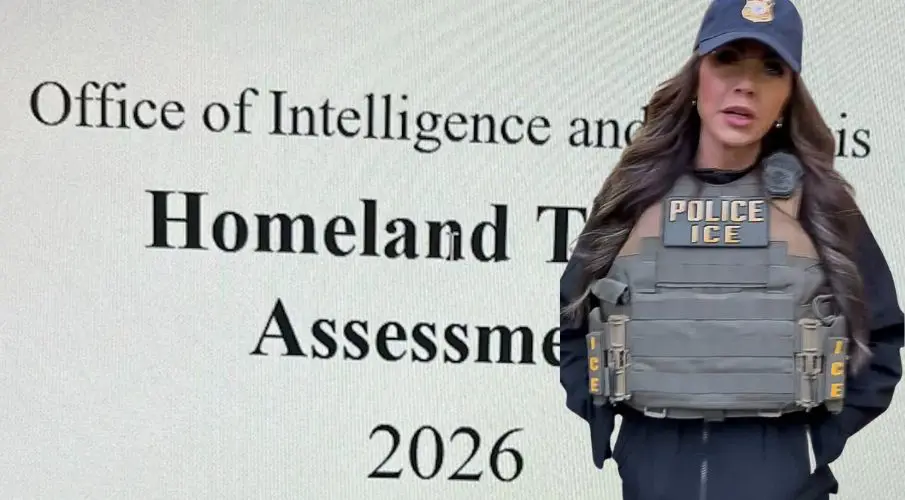
The fixation on Greenland, on Arctic routes, rare earths, and geopolitical threat scenarios belongs to the public rituals of this administration. But while Donald Trump looks northward with military fantasies, the US Department of Homeland Security is directing its real focus inward. Not at external enemies, not at states or organizations beyond the borders, but at its own population.

An internal draft of the Homeland Threat Assessment 2026, marked For Official Use Only and not yet published, marks a clear break with previous assessments. For the first time since the introduction of this annual threat analysis, it does not name migration, drug trafficking, or foreign terrorism as the greatest threat, but so called domestic violent extremists. What is meant are American citizens.

The leaked document shows the structure and key passages of the Homeland Threat Assessment 2026, an internal annual assessment by the US Department of Homeland Security. It defines which dangers the state prioritizes and what security agencies, surveillance, and resources are aligned toward. Formally, the report is divided into four main areas: border and migration security, protection of critical infrastructure, public safety, and economic security. What matters, however, is not the structure but the weighting of content.
Migration, smuggling, drug trafficking, and border enforcement continue to appear, but lose central importance. Instead, the ministry declares public safety to be the greatest challenge of 2026. It explicitly states that the main threat does not come from outside, but from within the United States. The report names so called domestic violent extremists as the most significant danger. They are described as having been the most active perpetrators in recent years and are expected to remain so. What stands out is the justification: motives are said to include not only anti state, racist, or antisemitic beliefs, but for the first time explicitly also social and economic grievances, meaning dissatisfaction with living conditions, inequality, and economic circumstances.
This form of social anger is not categorized politically or socially, but placed directly in the context of terrorism and mass violence. This marks a clear break with earlier assessments. At the same time, the ministry classifies foreign terrorist organizations as less capable than in previous years. The border crossing of alleged foreign extremists is also described as historically low. Migration thus loses security policy priority for the first time in a noticeable way.
The focus instead shifts to major domestic events, such as the World Cup and the 250th anniversary of the Declaration of Independence. These are named as possible targets for attacks. The central message of the document is unambiguous: the greatest security concern lies not with external enemies, but with internal tensions. In summary, this means that the Department of Homeland Security is shifting its security logic from external threats toward its own population. Social conflicts, economic insecurity, and political radicalization inside the country are no longer treated as social challenges, but as potential threats to national security.
Particularly striking is a new formulation that did not appear in any of the previous reports: violence motivations stemming from class based or economic grievances. The term remains deliberately vague. It appears both in the summary and in the public safety section without being defined. Who falls under this category remains open. People with existential worries. Workers who have lost their jobs. Protesting students. Or politically radicalized milieus of very different orientations. It is precisely this vagueness that makes the term dangerous.

The leaked executive summary of the Homeland Threat Assessment 2026 shows a clear strategic realignment of US security agencies. While earlier reports placed migration and border security at the center, the ministry now describes a noticeable easing in this area. Illegal migration and drug smuggling declined significantly in 2025, mainly due to tightened border measures, increased deportations, and growing pressure on smuggling networks. The number of fatal fentanyl overdoses has also declined, which is presented as a security policy success. At the same time, the document warns of new risks. Transnational criminal organizations are said to be adapting their strategies, relying more heavily on human smuggling, and deliberately attempting to infiltrate or corrupt security agencies in partner states. The border issue is thus not considered resolved, but it loses its status as an acute primary threat.
The assessment of critical infrastructure is far sharper. The ministry expects increasing attacks on energy supply, communication networks, and digital systems. State actors such as China, Russia, and Iran are highlighted in particular, as they could cause economic and political damage through cyberattacks, industrial espionage, and sabotage. The use of unmanned systems such as drones against infrastructure is also described as a growing risk. The central focus of the report, however, is public safety. For 2026, domestic violent extremists are expected to represent the greatest terrorist threat. These actors are described as acting from very different motives: anti state beliefs, racist and antisemitic ideologies, but also social and economic frustration are explicitly named. The report directly links these motives to the danger of mass attacks and targeted violence.
Major public events such as the World Cup and the 250th anniversary of American independence are considered particularly sensitive. They are identified as potential targets for attacks. At the same time, the report acknowledges that there is once again a rising threat from individuals influenced by foreign terrorist organizations, intensified by the war in the Middle East. Taken as a whole, the document makes clear that US security agencies no longer see the primary threat at the borders, but within the country. Social tensions, political radicalization, and economic insecurity are increasingly treated as security relevant factors, with far reaching consequences for surveillance, policing, and state intervention.
The message of the document is nevertheless clear. The greatest threat to the homeland is no longer located beyond the borders, but inside. The list of alleged motives ranges from anti state attitudes to racist and antisemitic beliefs and economic anger. Everything is forced into a security policy framework that no longer treats social conflicts as political or social questions, but as a precursor to terrorism. The evidence cited consists of targeted killings, attacks on state institutions, and violence against government personnel.

The document describes a security policy reassessment: as an almost equal threat, it now considers not only foreign terrorism, but also violence by individuals within the United States who are ideologically influenced by foreign terrorist organizations. This danger is assessed as being as high as it has been in five years and is linked to the war between Israel and Hamas, which is said to have significantly fueled international radicalization.
At the same time, the paper notes that classic terrorist organizations such as the so called Islamic State and Al Qaeda are now only limited in their ability to directly send fighters into the United States. Instead, the threat is shifting to individuals within the country who are radicalized through English language propaganda, online platforms, and networks and mobilized to commit acts of violence.
Since October 2024, there have been several attacks and attempted attacks, including fatal assaults and foiled plots with connections to foreign terrorist groups. It is noted that many of those involved were radicalized at a young age, often through digital channels specifically targeting youth.
In addition, the document points out that foreign terrorist organizations are increasingly relying on support within the United States, for example through contact persons, financial flows, or logistical assistance. Security agencies see this as a persistent and difficult to control threat, as this form of danger is less visible than classic externally directed terrorist networks.
At the same time, the ministry downplays external threats. Foreign terrorist organizations are described as weakened. The number of alleged border crossings by individuals with a terrorist background is said to be at the lowest level in decades. Encounters with individuals classified as dangerous at the southern border are also historically low. Migration, once politically inflated into a permanent threat, recedes noticeably into the background in this internal analysis.
Instead, a new enemy image is growing. Major events, anniversaries, public celebrations – everything is placed under the caveat of possible mass attacks. Preparations for the World Cup, for the 250th anniversary of the Declaration of Independence, for every larger gathering of people are described as security policy flashpoints. The tone is alarmist, but not specific. The threat remains abstract, omnipresent, available at any time.
What makes this paper so explosive is not only its content, but its perspective. It does not describe a society to be protected, but a population to be monitored, categorized, and treated preemptively as a risk. Economic hardship, political anger, and social tensions appear not as the result of political decisions, but as a security problem. Anyone who is dissatisfied comes under suspicion.

What is currently being redefined in the United States under the term internal security is not an isolated US phenomenon. In Germany as well, the security policy assessment of social conflicts has been shifting for years. Social tensions, economic disruptions, protest movements, and political radicalization are increasingly no longer treated as subjects of democratic negotiation, but as potential threat scenarios. The logic is comparable: the less politics resolves social conflicts, the more security agencies take their place. The US documents show where this development can lead. They mark the point at which the state begins to primarily perceive parts of its own population as a risk. This is relevant for Germany because similar instruments – from expanded definitions of dangerous persons to preventive surveillance and preemptive intervention powers – have long been part of the political debate. The American planning documents thus read like a glimpse into the future of a security logic that is increasingly accepted here as well.
The shift visible in the US documents from social and political conflict into the realm of internal security shows structural parallels to the programmatic approach of the AfD. The party has for years demanded that social tensions, forms of protest, and political opposition be treated not primarily politically, but in terms of law and order. Terms such as internal enemy, left wing threats, or state subversive milieus serve the same function as the reference in the American paper to class based or economic conflicts as security risks. What matters is not the ideological justification, but the effect: democracy is reduced to order, criticism to threat. While the AfD openly advocates this position, the US document shows that similar patterns of thought can also be established within state security apparatuses without being explicitly partisan. It is precisely this compatibility that makes the development dangerous. It lowers the threshold at which authoritarian interpretive frameworks become acceptable to a majority – even in parliamentary democracies such as Germany. This too is shown by our investigation.
While publicly the focus continues to be placed on external threats, this document draws a different picture. The greatest concern of security agencies is not foreign powers, but their own population. Not because of what it has done, but because of what it might think, feel, or demand.

The real target of this strategy is therefore clear. Not Greenland. Not China. Not the south. But the inside. American society itself.
Updates – Kaizen News Brief
All current curated daily updates can be found in the Kaizen News Brief.
To the Kaizen News Brief In English


Haben die bei den Nazis abgeschrieben?
Bei Putin?
Bei Kim?
Ein Staat, der seine eigene Bevölkerung unter Generalverdacht stellt und sie als inländische Terroristen bezeichnet, ist eine Diktatur.
Nur Autokratien und Diktaturen agieren zum eigenen Machterhalt so.
Sie wissen, die einzigen, die ihnen gefährlich werden können, ist das eigene Volk.
Also wird überwacht, jatalogisiert, eingeordnet und ggf verhaftet.
Minority Report, 1984 …. das waren eigentlich Dystopien, keine Anleitungen 😞
Ich frage mich, inwieweit steht das überhaupt noch mit der Verfassung in Einklang?
… mit der Verfassung wird das schon schwer, und Trump will seine Macht sichern,,,also muss man das Volk überwachen, das übliche Vorgehen in einer Diktatur …
Und nun strebt er auch noch an, dass man die Wahlen „overturn the election in fraudster states“ übernehmen will.
Die Wahlen sind Sache der Staaten.
Der Mann, der vir der Wahl davon sprach mehr Befugnisse an die Staaten zu geben und weniger Einmischung der Bundesstaaten.
Aber als kommender Diktator muss er die Macht bündeln.
Denn sonst tanzen die demokratischen Stasten aus der Reihe