
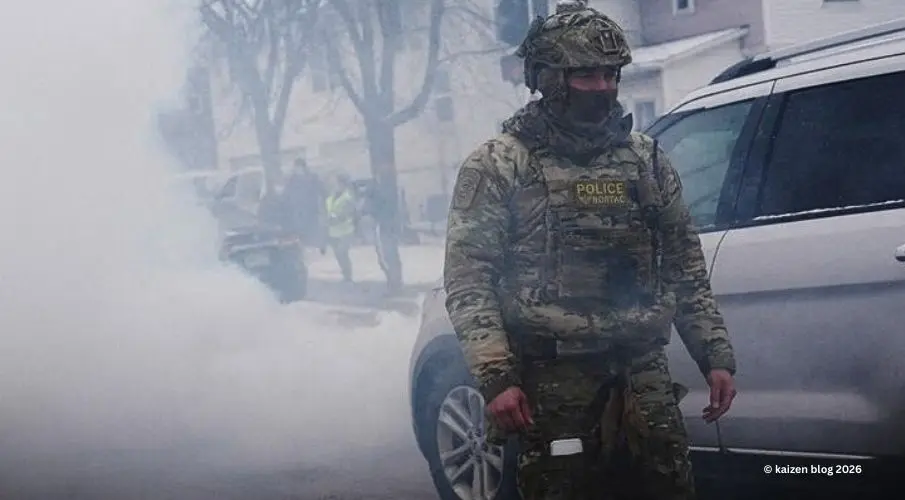
When federal agents brought a severely injured man to a hospital in Minneapolis, the nursing staff immediately knew that something was wrong. Alberto Castañeda Mondragón, 31 years old, had fractures to his face and skull, bleeding throughout the brain, massive neurological deficits. The explanation given by the agents was that he had tried to flee and had deliberately run headfirst into a brick wall. To intensive care nurses, this sounded not only implausible but medically impossible. The injuries did not match a fall, not an impact, not a single event. Bleeding was found throughout the brain, at least eight skull fractures, fractures on both sides of the head. One nurse later described the agents’ account as absurd. There was no possible way a person could inflict this kind of damage on himself by running into a wall. Several nurses and a treating physician independently reached the same conclusion. An external forensic pathologist later confirmed this as well.

Castañeda Mondragón had been detained shortly before, on January 20, 2026, by immigration officers near a shopping center in St. Paul. He was handcuffed when he allegedly attempted to flee. What exactly happened in the hours after his arrest remains unclear to this day. What is certain is that only a few hours later he was brought to an emergency room with life threatening injuries. A CT scan revealed the full extent of the damage. From there he was transferred to Hennepin County Medical Center, one of the region’s most important trauma centers. When he arrived there, he was intermittently responsive. He told medical staff that he had been dragged and abused by federal agents. Shortly afterward his condition deteriorated rapidly. He became disoriented, did not know what year it was, and had to be heavily sedated. Doctors classified him as a patient with a severe traumatic brain injury.
Meanwhile, the agents’ account began to change. At first, they spoke of a self inflicted impact. Later, nurses reported that an agent had said, in effect, that the man had taken a serious beating. At the same time, the agents remained constantly at his bedside. For days. Armed. They insisted on shackling him to the bed, even at the ankles. This clearly violated hospital rules, which allow such measures only when medically necessary. When Castañeda Mondragón stood up in a confused state and took a few steps, the agents interpreted this as an escape attempt. Nurses tried to explain that this kind of behavior is typical for people with severe brain injuries: impulsive, disoriented, not controllable. No one on the team considered it an attempt to escape. The situation nevertheless escalated. Hospital management, security, chief physicians, and lawyers were brought in. In the end, a compromise was forced: a nursing assistant was to remain in the room at all times, and the restraints were later removed.
This scene is emblematic of what has been unfolding in Minneapolis since the beginning of the so called Operation Metro Surge. Federal agents are omnipresent in hospitals, accompany injured patients for days, move around the premises, approach people, demand proof of citizenship. Nurses report intimidation and fear of even approaching agents. Some avoid certain corridors or restrooms to prevent contact. Staff use encrypted messaging services because they fear surveillance. The hospital was forced to tighten its internal guidelines. These explicitly state that federal agents have no access to patients or their data without a judicial warrant. Patients are first and foremost patients, not prisoners. Even senior physicians openly say that these rules are barely enforceable when it comes to federal agents.
The Department of Homeland Security refused to comment on Castañeda Mondragón’s injuries. A lawyer is now involved. In court filings, one agent evaded the question and merely stated that during intake it was determined that a head injury was present requiring emergency treatment. How this injury was sustained remained unanswered. The legal review and investigation brought additional details to light. Castañeda Mondragón had entered the United States in 2022 with valid documents. He later founded a construction business in St. Paul, worked as a roofer, and supported his ten year old daughter in Mexico. He has no criminal record. His attorneys believe he was deliberately stopped because he spoke Spanish and had a dark skin tone. Only after the arrest did agents determine that his visa had expired.
Four hours after the arrest, he was lying in a hospital with life threatening brain hemorrhages. Federal Judge Donovan W. Frank ultimately ordered his release from immigration custody after all facts were presented. The court made clear that federal agents are also bound by law. Shortly afterward, Castañeda Mondragón was discharged from the hospital. Where exactly he went has not been made public. He has no family in Minnesota. In any case, he is now receiving appropriate medical care. He suffers from severe memory problems. Large parts of his life have been erased. He will not be able to work for the foreseeable future. Medical treatment, follow up care, basic subsistence – everything is uncertain, everything step by step. His family in Mexico is worried about how they will cope. There too, ways to provide help will have to be found.
His brother said yesterday that his memory is now only a fraction of what it once was. And he said something that lingers: it is bitter that in the end one does not carry away memories of opportunity or safety, but the feeling of having been treated like an animal. This case is not an isolated incident. It fits seamlessly into an escalation in which medical professionals no longer trust the statements of federal agents, in which courts intervene only after irreversible damage has already occurred, and in which violence is no longer explained but managed. America 2026.
To be continued ...
Updates – Kaizen News Brief
All current curated daily updates can be found in the Kaizen News Brief.
To the Kaizen News Brief In English


Dieser Fall hat mich stark an den Todesfall der ukrainischen Journalistin Wiktorija Roschtschyna erinnert, die in russischem Gewahrsam bestialisch zu Tode gefoltert wurde.
…das stimmt, wir hatten öfters darüber berichtet
Was für eine abscheuliche Schlägerbande!
Sie nutzen ihre sogenannte „Immunität“ voll aus.
Menschen sind ihnen hilflos ausgeliefert.
Die Details kommen erst nach und nach ans Licht, wenn der (gesundheitliche) Schaden entstanden ist.
Die Beamten erwartet keine Konsequenz.
Das Opfer ist immer ein Täter.
In ddm Fall ist der Aufenthaltsstatus abgelaufen.
Eine Abschiebung ist möglich, oder?
Damit würde ein wichtiger Zeuge „verschwinden“.
Sarkastisch muss ich sagen, dass es erstaunlich ist, dass sie ihn ins Krankenhaus gebracht haben.
Bei der nächsten Person endet es vielleicht tödlich, weil Tote nicht mehr reden.
Sie werden Wege finden, die Toten verschwinden zu lassen.😟
Das macht nir Angst.
Bitte passt gut auf Euch auf.
…keine sorge und danke dir
Wieder ein Leben zerstört. Es ist nur mehr zum Weinen!
…es ist schlimm was aktuell in den usa los ist – du musst fast wie im krieg menschen in nacht und nebel aktionen woanders hinbringen, traurig ist das …