
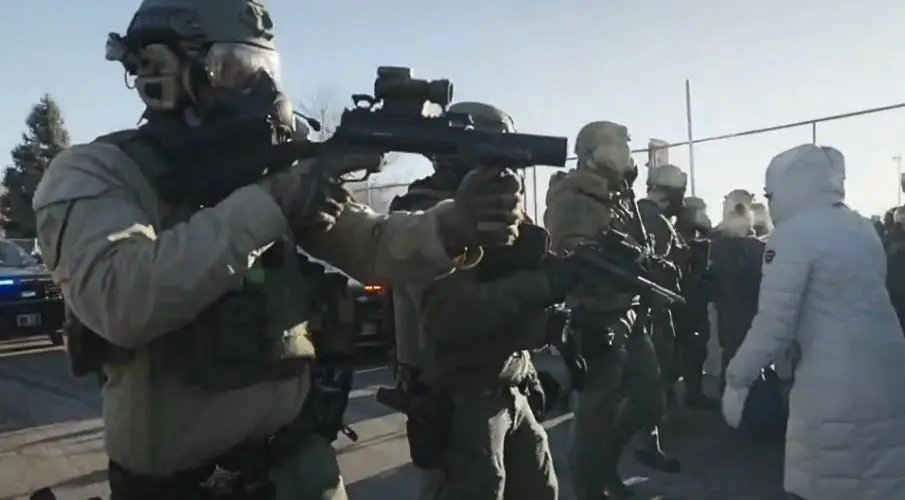
Laughter was the first reaction. Not out of relief, but out of bitterness. When Tom Homan, Trump’s new man for Minnesota, declared that the mission was not being abandoned, only continued “more smartly,” it was immediately clear what was happening. No reversal, no break, no pause after two fatal shootings. Instead, a rhetorical shift meant to calm things down without changing anything. Donald Trump had previously announced that the escalation in Minneapolis would be dialed back “a little.” After polls, after public pressure, after growing unease even within his own camp. Two US citizens had been shot dead in January during operations by federal agents. Cases that hardly anyone considers justified. They simply are not. But instead of consequences came personnel politics. Kristi Noem and Border Patrol commander Gregory Bovino were pushed aside. Bovino, described by Trump himself as a “pretty crazy guy,” demoted, effectively sidelined. Noem isolated, confronted with calls for resignation and impeachment.
“We’ll just continue more smartly” – “Uh huh”
In their place stepped Tom Homan. Not an outsider, not a provocateur, but a familiar enforcer. Under Obama he ran ICE’s deportation division, under Trump he had already served once as the agency’s acting chief. His appearance in Minneapolis is less a correction than damage control. He too admits that mistakes were made. Not out of moral insight, but because the operation spun out of control politically.
“I didn’t come to Minnesota for photo ops or headlines … I came here to look for solutions.”
What is new above all is the tone. Homan talks about improvements, about smarter tactics. And about precision. Internal directives that have since become known state that ICE agents are to arrest only people with a criminal connection going forward. Not only convictions count, indictments are sufficient. All targets must have such a connection. At the same time, officers are being advised to avoid confrontations with protesters. Not because protesters are right, but because it inflames the situation. Communication is to be limited to commands, via megaphone, step by step.

That sounds like order, but it is above all control of the images. Because the reality of recent months up to today looks different. Since Trump’s return to office, ICE and Border Patrol have been sent into numerous major cities, with a new quota of 3,000 arrests per day. The result was a massive expansion of enforcement actions in public spaces. Construction sites, supermarket parking lots, street corners. People with no criminal record whatsoever were detained. The number of arrests without any criminal background exploded. The number of detainees with no prior convictions as well. In Minneapolis, that was exactly the tinder. Not abstract legal questions, but the feeling that enforcement was arbitrary. That masks, weapons and overwhelming force appeared where there was no acute danger. The new guidelines change little about that. They shift the focus, but they do not take back power, the locations remain the same.

The announced withdrawal of forces is also conditional. Homan speaks of a pullback, but only if the states cooperate. What that means is that local jails must notify ICE early so that people can be transferred directly upon release. Less public visibility, less oversight, smoother access. Minnesota is pushing back. The governor, the attorney general, the corrections authorities point out that they already notify ICE when non citizens are in custody. There is not a single documented case in which someone was simply released without offering a transfer. The problem lies not in cooperation, but in the narrative.
Even today, Minneapolis remains a powder keg
Meanwhile, the political conflict in Washington is intensifying. Democrats are tying their approval of the budget to reforms at ICE. No more masks, visible identification, body cameras, clear rules, coordination with local authorities. Demands that would be self evident in any other security debate. Whether they will prevail is unclear. A partial deal to temporarily fund Homeland Security buys time, but no solution. Whether they truly believe in it is another matter.

And Trump himself? His words remain aggressive. After a brief cooling off comes the relapse. He calls protesters paid agitators, lunatics, sick people. He describes detained migrants across the board as brutal criminals, as threats to shopping malls and farms. At the same time, federal agencies are blocking investigations by local prosecutors into the fatal shootings. Evidence was secured only after a judge intervened. Transparency looks different. What is emerging in Minneapolis is not a new beginning. It is an adjustment of the surface. New faces, new phrasing, the same structure. The mission remains, the hardness remains, the power remains. Only the packaging is changing. Smarter, they say.

That fits with the agreement between the Trump administration and the Democrats. While the rest of the federal budget runs through September, Homeland Security remains under political scrutiny. The previous vote had been deliberately blocked to build pressure. The president publicly spoke of a bipartisan breakthrough and called for approval. In reality, it is a ceasefire on time. The fundamental question remains unanswered: how much power should an agency have that is increasingly associated with deadly force inside the country. The Democrats have failed again. After two people were killed by federal agents, their response goes no further than tactical delay. Two weeks of transitional funding is not a political breakthrough, but an evasion. ICE remains untouched, the practice unchanged, responsibility deferred. Anyone who, after deadly violence inside the country, lacks the courage to force real consequences loses all moral authority. Buying time in this case means changing nothing. And that is exactly the problem.

Student organizations called for nationwide protests and work stoppages on Friday to force the withdrawal of federal immigration authorities from Minnesota. At the same time, another legal confrontation is escalating:

The Justice Department had former CNN host Don Lemon arrested, who had been reporting journalistically on a protest in a church in St. Paul. His lawyer speaks of an unprecedented attack on press freedom. Georgia Fort, also a journalist, arrested in Minneapolis. Federal authorities took her into custody in connection with protests against the ICE operations, even though she too was working as a journalist. The incident intensifies the debate over how the federal government is treating media representatives in the context of the current operations. At the same time, internal resistance to the administration’s course is growing. Additional federal prosecutors in Minnesota resigned after being instructed to investigate not the shooters involved, but the families of the victims and protesters. The events reinforce the impression of a government that criminalizes protest while accountability for deadly violence by federal agents continues to be absent.

What remains? Today will be long, the weekend is approaching. New protests, ICE will continue to proceed with full force, the press will increasingly be targeted, in some cases brutally. Endurance is required, not retreat, but documentation, not looking away, but helping - and always with this sentence in the background: “We’ll just continue more smartly.” Laughter.
Updates – Kaizen News Brief
All current curated daily updates can be found in the Kaizen News Brief.
To the Kaizen News Brief In English


Leider ist gdnau das eingetreten, was ich vermutet habe.
Anderes Gesicht, gleiches Vorgehen.
So lange Trump und seine Entourage an der Macht sind, wird sich rein gar nichts ändern.
Der Druck aus der eigenenen Partei?
Bisschen Kosmetik für die Wähler.
Und dann?
Tillis, Murkorski beide stimmten FÜR die Erhöhung des ICE Budget, obwohl sie virher öffentlich gesagt haben, dass sie nicht zustimmen werden.
Soviel dazu.
Viele Kniefälle vor Trump.
Kein Rückgrat.
Von den Demokraten ganz zu schweigen.
Sie hatten es in der Hand!
Aber haben wie so oft, kleinbei gegeben.
Reichen 2 Morde nicht?
Ich hoffe, dass die Alle von fiesen Alpträumen heimgesucht werden, bis an ihr Lebensende!
…es fehlt leider nicht mehr viel, und das pulverfass geht hier hoch