
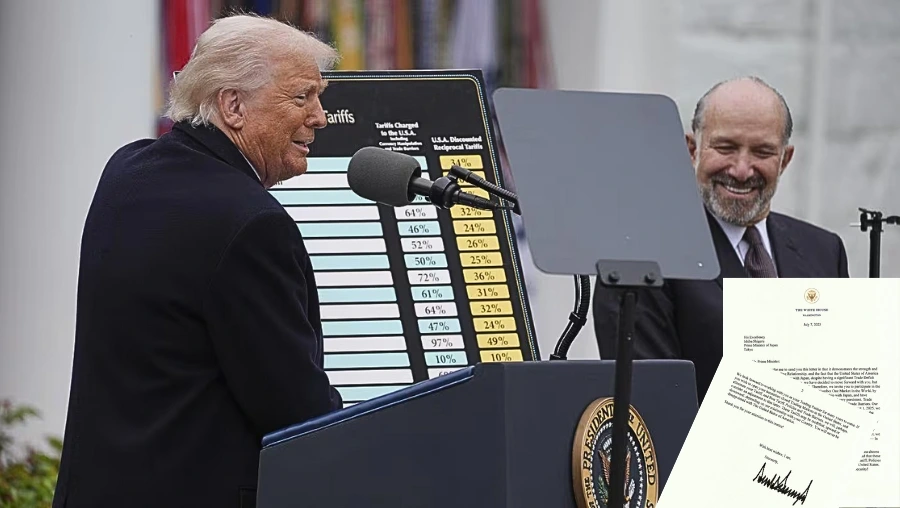
The numbers are clear, even if they are politically uncomfortable. In November, the United States trade deficit jumped sharply to 56.8 billion dollars - an increase of 95 percent within a single month. That is something you first have to achieve. Trump delivers, only in a dramatically negative way. One of the central promises of the Trump administration thus collapses: that tariffs would strengthen America economically and permanently reduce the trade imbalance. What is now becoming apparent is that this very policy produces extreme swings without solving the structural problem. Exports fell significantly in November. They declined by 3.6 percent to 292.1 billion dollars. Particularly affected were exports of gold, pharmaceuticals, consumer goods and crude oil. At the same time, imports rose sharply. With an increase of five percent, they reached 348.9 billion dollars. The United States bought primarily foreign medicines and technical equipment for new data centers. The result is a deficit that does not stem from economic strength, but from hectic shifts.

The official data from the US government show that the United States trade deficit rose to 56.8 billion dollars in November 2025 - almost a doubling compared with October. The reason is that exports declined sharply while imports increased significantly, once again massively widening the gap between inbound and outbound trade. This contradicts the political promise that tariffs would permanently reduce the deficit.
This development is not an outlier, but part of a pattern. Since Trump imposed massive import duties, foreign trade has fluctuated with unusual intensity. The deficit had fallen sharply in previous months, in October even to the lowest level since 2009. The government celebrated this as a success. Economists warned early on, however, that this decline was largely due to special effects, such as gold movements triggered by uncertainty in the markets. November confirms this assessment. Trump’s tariffs have primarily changed the timing of trade. Companies moved deliveries forward to avoid duties, or held them back until new rules took effect. In the first months of his term, imports surged as firms tried to stock up ahead of announced tariffs. After the announcement of global punitive duties in April, imports collapsed again. This back and forth was particularly pronounced in sensitive sectors such as pharmaceuticals and semiconductors, which fluctuated repeatedly between import waves and declines over the course of the year.
When these movements are added up over the year, little remains of the supposed success. Through November, the overall trade deficit was still 4.1 percent above the level of the previous year. While exports rose by 6.3 percent in the first eleven months, imports increased almost as strongly at 5.8 percent. There is no talk of a sustainable correction. A look at individual trading partners is particularly revealing. The goods trade deficit with China between January and November amounted to 189 billion dollars. It is thus lower than the deficit with the European Union and only slightly higher than that with Mexico. Trump’s years-long fixation on China as the main problem is relativized by these figures. Trade flows have shifted, not disappeared.
Economists see a serious risk to growth in the current development. The increase in the deficit in November was one of the largest monthly jumps ever recorded. Since net imports are subtracted from gross domestic product, this effect is likely to drag down growth figures for the fourth quarter. The short-term decline in the deficit in previous months had still artificially boosted growth forecasts - now this effect is reversing. Added to this is legal uncertainty. The Supreme Court is expected soon, our understanding is around February 20, to rule on the legality of many tariffs Trump imposed based on an emergency law from the nineteen seventies. The administration has already signaled that it intends to circumvent possible defeats by reintroducing duties through other legal constructions. That means volatility is likely to continue.
At present, the effective US tariff rate stands at almost 17 percent, the highest level since 1935. This figure marks less an economic renaissance than a return to a protectionist level historically associated with instability. November shows what this means in practice: a trade system under constant stress, a deficit that swings wildly, and a policy that cannot explain its own successes without losing them again the following month. In the end, one sober realization remains. Tariffs do not replace industrial policy, investments in productivity or a long-term strategy. They shift numbers, they generate headlines, but they do not heal structural imbalances. The recent rise in the trade deficit is not an operational accident. It is the logical consequence of a policy that confuses short-term effects with economic substance.
What is visible in the trade figures is not an American special problem, but a political dream that also finds supporters in Europe. The AfD openly admires Donald Trump for precisely this kind of economic policy: loud, confrontational, fixated on numbers and blind to interconnections. Tariffs, isolation and the belief that complex economies can be steered with simple punitive mechanisms also belong there to the fixed repertoire. Reality in the United States, however, shows where this course leads: to erratic effects, planning uncertainty for companies, higher costs for consumers and, in the end, worse results than ever before. Anyone who declares Trump a role model also declares failure to be the method. Not out of ideological malice, but out of economic incompetence.
Updates – Kaizen News Brief
All current curated daily updates can be found in the Kaizen News Brief.
To the Kaizen News Brief In English


Danke für diese gute Recherche.
Warum ist Trump mehrfach in die Involzenz gegangen?
Genau, weil er absolut keinen Schimmer von Wirtschaft hat.
Für ihn geht es um Deals, Drohung etc.
So funktioniert Wirtschaft aber nicht längerfristig.
Was mich aber wundert, dass wohl die Arbeitsmarktzahlen (falls nicht geschönt von Trump) besser sind und die Wirtschaftsdaten in den USA gut aussehen (wenn sie real und nicht geschönt sind).
Leider sind MAGA offensichtlich zu hohlbirnig um das alles zu begreifen.
Selbst die, die eigentlich nicht ungebildet sind, blenden das komplett aus.
Die Älteren wünschen sich die 50er zurück, wie Trump.
Die Jüngeren haben scheinbar nur den Plan gegen woke, links, demokratisch.
Mir scheint, dass jedes Herumschrauben und alle noch so große Anstrengungen dauerhaft keinen Erfolg bringen werden, weder in den USA, noch sonstwo. Erst wenn wir begriffen haben, dass wir in einer Welt endlicher Ressourcen nicht auf immer währendes Wachstum setzen können, werden wir uns darauf konzentrieren, eine lebenswerte und gerechte Zukunft ohne Wachstum zu denken. Ich befürchte allerdings, dass es dann zu spät sein wird. Derweil bleibt mir dann aber wenigstens, Donald Orangeman mit einem Grinsen beim Scheitern zu beobachten. 😏
Irgendjemand überrascht? Das Echo aus dem Tal der Ahnungslosen und Sektierer ist so unendlich vorhersehbar, dass es langweilig ist. Niemals an sachlichen Notwendigkeiten orientiert (dass dafür die kognitive und in jedem Fall die fachliche Kompetenz fehlt, ergibt sich aus den verbalen Absonderungen). Allein Egotrip und die perfide Lust an der eigenen Böswilligkeit zählen.Zum Ko…en. Oder zum Heulen. Oder beides. Dieser pandemische politische, gesellschaftliche und wirtschaftliche Wahnsinn ist wirklich nicht mehr zu überbieten. Die Welt wird von verantwortungslosen, geld- und machtgeilen alten Männern regiert und zerlegt. Was für ein handgeklöppeltes Desaster.