
In Washington, failure is rarely spoken of as openly as it is these days. The demand that Kristi Noem step down from office is not coming from one corner, not from a party headquarters, not from the usual volume of the political fringes. It comes from the center of Congress, from civil rights organizations, from the gun lobby, from ranks that otherwise weigh, remain silent, delay. Two deaths in Minneapolis have crossed a threshold beyond which appeasement no longer holds.

Alex Pretti and Renee Good died during protests against deportations. What followed was not a pause, not a recognizable self-examination within the Department of Homeland Security, but a public appearance by the secretary that further escalated the situation. Noem spoke of attacks on officers, she declared the circumstances of a fatal police operation to be domestic terrorism. These words quickly stood in contradiction to videos, witness statements, and the sequence of events on the ground. That is where the political damage began.

Leading Democrats in the House of Representatives declared that the country was disgusted by the conduct of the department. They demanded Noem’s immediate dismissal and announced impeachment proceedings should this not occur. What matters less is the threat itself than the matter-of-fact way in which it was expressed. In a House dominated by Republicans, such a step long counted as symbolic. Now it is being discussed as a real option.

Support is also crumbling on the Republican side. Many senators openly said that the secretary’s conduct in Minnesota had been untenable. Others phrased it more cautiously, but even that restraint marks a break. When senators publicly say that the president needs to take a hard look at whom he has placed at the head of Homeland Security, that is more than intra-party unrest. Noem’s role within the Trump administration sharpens this situation. She is not just any department head, but the face of an aggressive deportation policy that deliberately relies on visibility. Her demeanor, her closeness to the operational forces on the ground, her loyalty to border protection and deployment leadership were part of this strategy. But precisely this closeness has now become her problem. After border chief Greg Bovino was pulled from the Minnesota operation and Tom Homan took over control, Noem suddenly stood alone in Washington.

Donald Trump continues to stand by her publicly. He answered the question of resignation with a curt no, praised the allegedly closed border, and spoke of success. This defense follows a familiar pattern: loyalty inward, deflection outward. But within his own party, it is now being spoken openly that this is no ordinary conflict anymore.

“I Hated That Dog” – The Story of Kristi Noem and the Shooting of Cricket
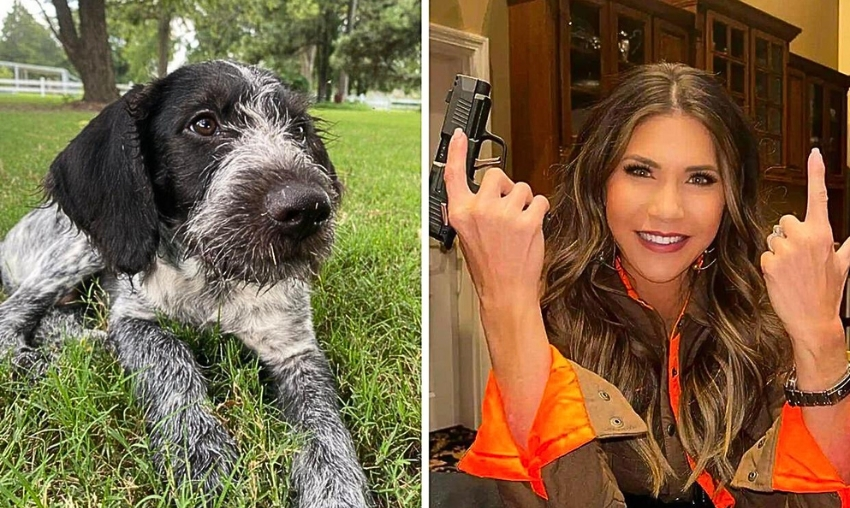
It is a story that reads like something from a dark Southern novel – yet it comes from the pen of a politician who presents herself as an “unshakable patriot” and, until recently, was considered a strong contender for Donald Trump’s vice-presidential pick. In her book No Going Back, published in 2024, Kristi Noem recounts with startling coldness how she shot her 14-month-old hunting dog Cricket. The incident, originally intended as an anecdote about “tough decisions on the farm,” quickly escalated into a political scandal of international proportions. According to Noem’s account, Cricket lost control during a pheasant hunt, killed several chickens, chased another animal, and bit her. For the then-governor of South Dakota, that was apparently reason enough to lead the dog to a nearby gravel pit and shoot it – and later to write: “I hated that dog.” Not only the act itself, but also the laconic language with which she describes it, left many readers stunned. Even more disturbing: In the same passage, Noem says that immediately afterward, she also killed a goat that had supposedly been bothering her children. The goat survived the first shot, so she reloaded and shot again. Location of the execution: the same gravel pit.
At the same time, pressure in Congress continues to grow. The relevant committees are demanding clarification, hearings, concrete answers. Images of operations in which children were torn from families, including a five-year-old child, have triggered a debate that can no longer be confined to paragraphs or jurisdictions. It is about responsibility, about decision-making paths, about political culture.

The Senate majority leader spoke of a point at which it must be examined how policy is implemented and what consequences it has. He dodged the question of personal trust and referred to the president. That, too, is telling. When responsibility is delegated upward, it usually means that something below is no longer sustainable.
Kristi Noem’s future is therefore open. Not because a proceeding has already been decided, but because her political isolation has become visible. Minneapolis was the moment when words, images, and decisions contradicted each other. And it was the moment when Washington began to say out loud what had previously only been said behind closed doors.
Updates – Kaizen News Brief
All current curated daily updates can be found in the Kaizen News Brief.
To the Kaizen News Brief In English


Solche Menschen sollten NIE in Positionen gelangen, in den Wohl und Wehe von Menschen von ihnen abhängt. Bei uns dürfte sie wahrscheinlich nie wieder einen Hund halten, zu Recht.
So lange Trump seine Hand über sie hält, wird sie den Posten behalten.
Ihre Loyalität ist grenzenlos und so lange Trump niemand Anderen für den Posten im Sinn hat, wird er sie nicht entlassen.
Impeachment… selbst wenn genug Stimmen zusammen kommen (was sehr fraglich ist), kann Trump nicht dagegen ein Veto einlegen?
Da weißt Du sicher mehr Rainer
Solche abgrundtiefen bösen Frauen waren die „effektivsten“ 😟 Aufseherinnen in den KZ…..
Sie drangsaliert ein ganzes Land.
In der Kiesgrube sollte man mal buddeln. Wer weiß, was da noch zu Tage kommen könnte 🙈
Oder in ihren Fundamenten von Haus, Pool, Terrasse … immer sehr beliebt bei Mafia und anderen Kriminellen.