
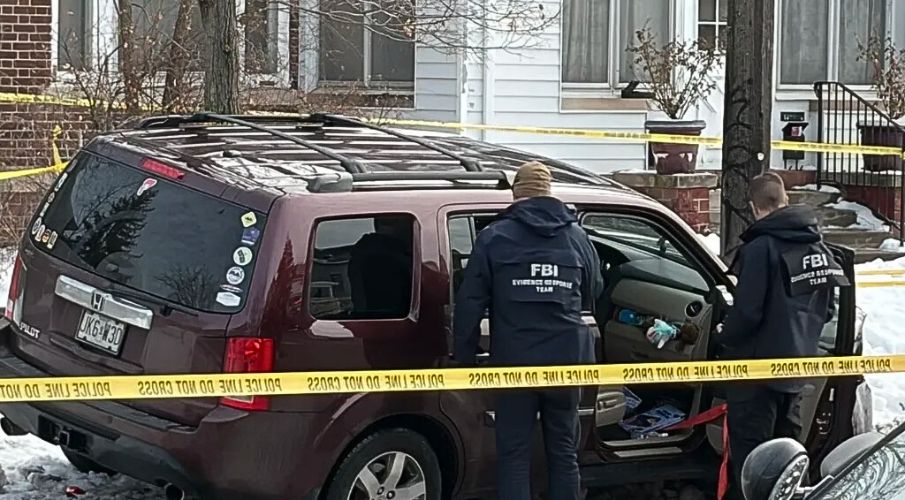
Weeks before an ICE agent in Minneapolis shot and killed the 37-year-old Renee Good, an internal memo lay on the desk of immigration authorities in Washington. Not a marginal note, not a theoretical paper, but a clear warning. De-escalation was decisive, it said, especially during operations involving vehicles. Confronting people inside cars meant playing with lives - those of the individuals involved as well as those of the officers. Exactly this warning was ignored.

The internal memorandum of the U.S. Customs and Border Protection agency sets binding guidelines for so-called vehicle extractions, operations in which people are forcibly removed from vehicles. The central principle is de-escalation. It is explicitly described as decisive for safe and lawful operations. Officers are instructed to begin operations with clear verbal commands and to communicate their intentions clearly. Vehicles should - if necessary - be blocked by other patrol cars to prevent escape. At the same time, officers are expressly required to avoid unsafe positions, particularly standing directly in front of or next to vehicles.
The memorandum emphasizes continuous situational assessment. Every action must be proportionate and based on the perceived risk and the level of cooperation of the individual involved. The protection of officers, the public, and the subject is named as an equally weighted objective. The use of force is strictly subject to the proportionality requirement of the Fourth Amendment. Relevant factors include, among others, the severity of the suspected offense, an immediate threat, and resistance or attempts to flee. Courts always assess the totality of circumstances, not isolated factors. Special emphasis is placed on thorough justification and documentation. Officers must clearly articulate perceived threats and their decisions in order to be legally protected. In summary, the memo demands de-escalation before force, safe positioning, clear communication, proportionality, and legal diligence in every vehicle extraction.
The internal document drafted in November by the Department of Homeland Security explicitly addressed so-called vehicle extractions. This does not refer to rescuing trapped people after accidents, but to forcibly pulling individuals out of their cars. A practice that has long become routine within the federal agency, even though there is neither a clean definition nor a binding regulatory framework for it. Ironically, for one of the most dangerous types of operations, there is no clear line, no mandatory training, no unified language. In Minneapolis, exactly such an extraction took place. An ICE agent approached Renee Good’s vehicle, reached through the window, grabbed the door. He positioned himself in front of the car, in a spot the internal memo explicitly warns against. No secure blocking, no distance, no de-escalation. Seconds later, Renee Good was dead.

The memorandum specifies under what circumstances smashing a vehicle window is permissible. Breaking a window alone is generally not automatically considered a use of force, as long as it is not accompanied by immediate physical force against the individual. Courts deem breaking a window proportionate when the person poses a concrete safety threat, refuses to comply with orders, or is suspected of a serious offense. Force is disproportionate, however, when a person merely offers passive resistance, poses no threat, and is suspected only of a minor offense. The guideline emphasizes that courts favor graduated, restrained use of force. Before any use of coercion, clear warnings must be issued and - if possible - time given to comply. (Even this point was not followed by ICE agent Ross)
As best practice, it is established that officers must always consider the totality of the situation: severity of the offense, level of danger, type of resistance, and other relevant factors. Force may be used only when objectively necessary and appropriate. In closing, the memo states that adherence to these guidelines serves to protect officers and the public and to preserve the legal and professional integrity of the agency. To support this, an additional training video on the proper use of glass-breaking tools is to be developed.
Externally, the political leadership declared that the officer had acted according to protocol. The responsible secretary stated that he had done exactly what he was trained to do. But the internal document tells a different story. It explicitly demands avoiding risky positioning, securing vehicles with other patrol cars, and preventing any escalation. Had these guidelines been followed, Renee Good would still be alive today.
Instead of confronting this discrepancy, the department responded with volume. Just one day after the fatal shooting, the agency released statements claiming a massive increase in alleged vehicle attacks. Cars were declared weapons, officers portrayed as besieged, the public framed as a risk. Such language does not create safety awareness, but battle lines.
Internally, the situation was more sober. Sources have reported for months about concerns within the agencies that this practice would sooner or later end in death. That is precisely what the internal memo warned about. Vehicle extractions are high-risk, especially when improvised, aggressive, or carried out without clear securing measures. Yet nothing changed. Legal consequences for the shooter are hardly to be expected. The internal use-of-force guidelines give the agency broad discretion. Fatal operations are not prevented, but retroactively shielded. Accountability evaporates, while the rhetoric continues to intensify.
There are, however, other voices. The chief of police of Minneapolis publicly reminded that officers are trained to de-escalate situations and protect lives. This is not a radical demand, but the basic principle of any rule-of-law policing. Yet this principle is lost when agencies place themselves in a permanent state of emergency. What becomes visible here is more than an isolated error. It is an agency that understands itself as a fighting unit, not as a civilian enforcement authority. Those who believe they are at war see threats in cars, enemies in people, and weakness in restraint. This is how a logic emerges in which warnings are written, but not followed.
Renee Good did not die because there were no warnings. She died because they were ignored.
Updates – Kaizen News Brief
All current curated daily updates can be found in the Kaizen News Brief.
To the Kaizen News Brief In English


Unglaublich!
…leider ja und schlimm ist, das bei 98,5% die berichterstattung mit zweimal berichtet und erledigt endet. und so entstehen verschobene bilder, die besonders rechts hilft, aber recherchen kosten eben geld, aufwand, gutes netzwerk und vieles mehr…. solange da nicht umgedacht wird, liegt rechts vorne und eben auch die berichterstattung, die in deren sinne ist, ohne das man vielen agenturen absicht unterstellen kann, es ist eben faulheit, kosten und den stuhl nicht verlassen wollen
Da hast Du leider recht Rainer
Urteile, Anweisungen …. ICE ignoriert es ständig und mit Segen der Regierung.
Es wird nicht ermittelt, keine Konsequenzen für Ross und andere brutally ICE Typen.
Wie soll man sich dagegen wehren, wenn man dann schon an der Stastsanwaltschaft, auf geheiß der Trump Regierung, scheitert?
Wenn man selber kein Gerichtsverfahren in Gang bringen kann?
Für die ICE Schergen bedeutet es nur „wir konnen weiter machen, wie bisher bzw noch einen drauf legen“
Furchtbar!