
Since September 2023, a criminal trial has been underway in Stockholm that appears outwardly inconspicuous but breaks new legal ground. Two former executives of the Swedish company Lundin Oil are standing trial on charges of complicity in war crimes. It is the longest criminal proceeding in the country’s history, scheduled to run until at least May 2026. The case is not about orders, not about uniforms, not about direct violence. It is about contracts, reports, decisions made in boardrooms, and the question of whether economic activity becomes criminal when it knowingly intersects with violence in a war.

Proceedings continued in Stockholm at the end of December. On several days, the court resumed the taking of evidence, witnesses were heard again, internal company reports were once more presented and contextualized. This is not a closed historical review, but an ongoing trial that will extend into the spring of 2026. Anyone sitting in the courtroom these days is not witnessing a retrospective reckoning, but legal work in real time: questions of knowledge, decision-making pathways, and responsibility are being further refined, contradictions exposed, memory gaps laid bare. This is precisely what makes these hearing days significant - they show that the question of corporate responsibility for war crimes is not being debated theoretically, but concretely, in the present, and under full evidentiary standards.

Ian Lundin, former chairman of Lundin Oil, inside the courthouse in Stockholm
In the late 1990s, Lundin Oil began extracting oil in the south of what was then Sudan. The region was part of a civil war that had been ongoing since the 1950s. To secure production facilities, personnel, and infrastructure, the company entered into agreements with the Sudanese government. In the years that followed, oil prices rose sharply. At the same time, violence around the production areas escalated. Human rights organizations estimate that around 160,000 people were displaced, their villages bombed or burned to the ground, and around 12,000 people killed. The company disputes these figures and rejects any responsibility.

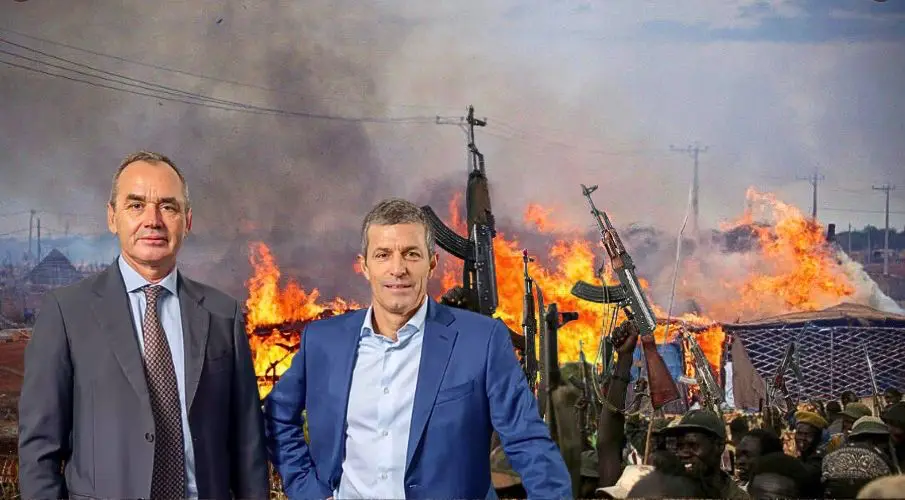
The defendants are Ian Lundin (left), former chief executive, and Alexandre Schneiter (right), former chief operating officer. Prosecutors accuse them of continuing cooperation with the Sudanese armed forces despite detailed knowledge of military operations, displacement, and violence. This cooperation, they argue, facilitated the army’s actions in the immediate vicinity of the oil fields. The defense denies criminal relevance. Economic activity in a conflict zone, they argue, is not illegal, nor is cooperation with state authorities.

The defendants are Ian Lundin, former chief executive, and Alexandre Schneiter, former chief operating officer. Prosecutors accuse them of continuing cooperation with the Sudanese armed forces despite detailed knowledge of military operations, displacement, and violence. This cooperation, they argue, facilitated the army’s actions in the immediate vicinity of the oil fields. The defense denies criminal relevance. Economic activity in a conflict zone, they argue, is not illegal, nor is cooperation with state authorities.

Our investigations clearly showed that Lundin and Schneiter explicitly requested that the Sudanese government assign the military to secure one of Lundin Oil’s exploration areas. According to the prosecution, this decision was followed by aerial bombings, the killing of civilians, and the systematic destruction and burning of entire villages.
Before Barker’s testimony, the court heard statements from 32 plaintiffs from what is now South Sudan. They described the destruction of their villages, the killing of relatives, displacement, and forced recruitment. Their testimony forms the basis of the civil claims and provides the human backdrop to a trial conducted with legal sobriety.
The prosecution relies on a particular feature of Swedish criminal law. Unlike international criminal law, it recognizes not only direct intent and conditional intent, but also liability based on indifference toward foreseeable crimes, often referred to internationally as reckless intent. This describes conduct in which relevant information is available, serious violations of law are foreseeable, and action nevertheless continues deliberately. Prosecutors argue that corporate decision-makers had sufficient information from internal reports, international media, and public sources. Continuing cooperation under those circumstances, they say, fulfills the criteria for complicity.

“We believe it is clear that Ian Lundin was aware that Human Rights Watch considered the oil activities to have exacerbated the conflict and that this led to people being displaced,” said prosecutor Annika Wennerström.
The defense counters that the company merely commissioned a limited security force to protect facilities and had no influence over military decisions. It is not a crime, they argue, to do business in authoritarian states or to use state security forces to protect economic infrastructure. No violence was ordered and no attacks were demanded.
The case stands in a historical line reaching back to the Nuremberg follow-up trials. After the Second World War, executives of the companies Flick, I.G. Farben, and Krupp were prosecuted for economically supporting the Nazi regime. Those proceedings fizzled politically and legally. Prison sentences were lifted early, assets returned. Over decades, this produced a de facto consensus that economic activity, even with knowledge of state violence, would rarely be criminally prosecuted.
This approach also shaped later international proceedings. The Yugoslavia Tribunal focused almost exclusively on political and military leaders and largely ignored the economic dimensions of the wars. The International Criminal Court has likewise never prosecuted corporate actors. Comparable efforts in the United States failed. After Chevron discovered oil in Sudan in 1978, control over production areas became a central factor in the conflict. Under President Clinton, the United States imposed comprehensive sanctions on Sudan. American companies were forced to withdraw. In this environment, Lundin Oil began its operations. In 2001, victims filed a class action lawsuit against the Canadian company Talisman Energy. A court initially allowed the case to proceed, but it later failed because intentional complicity could not be proven.
Only in more recent years have isolated national cases emerged. Chiquita Brands pleaded guilty in 2007 to financing an armed group in Colombia. Lafarge paid a substantial fine in the United States for payments to armed groups, including ISIS, and is also facing proceedings in France. In connection with the war in Gaza, the question of economic responsibility is again being debated, including by UN Special Rapporteur Francesca Albanese.
Sweden occupies a special position here. The country applies the principle of universal jurisdiction and has specialized investigative units for international crimes. Earlier cases involved perpetrators from Rwanda, the former Yugoslavia, Syria, Iraq, and Iran. The Lundin trial is the first to explicitly address economic complicity at the executive level. The case was made possible by years of investigation led by prosecutor Magnus Elving. Over more than a decade, he gathered witness testimony and documents, including materials from company offices in Geneva. Elving died before the trial began, but his work continues to form its foundation.

An extraordinary prosecutor: Magnus Elving - his commitment, particularly in the field of human rights and international humanitarian law, deserved the greatest respect.
An extraordinary prosecutor: Magnus Elving - his commitment, particularly in the field of human rights and international humanitarian law, deserved the greatest respect.
Updates – Kaizen News Brief
All current curated daily updates can be found in the Kaizen News Brief.
To the Kaizen News Brief In English


Wow! Danke für den Einblick!
Donald Trump will sich in Venezuela „sein Öl“ und „sein Land“ militärisch „wieder zurückholen“, was ja für uns normalsterbliche völlig irrational und natürlich außerhalb aller Gesetze steht.
Dein Bericht aus dem Sudan macht klar, dass das eine gängige Handlungsweise zu sein scheint. Mal ganz egal, ob mit Billigung und militärischer Unterstützung des Landes, in dem der „Landraub“ stattfindet.
Hut ab vor den Schweden!
…gerne, ein fall der wegweisend werden kann, und den sudan kennen wir sehr gut, haben das nochmals abrecherchiert
Was für ein spannender Bericht.
Davon höre ich das erste Mal.
Und ich bin sehr gespannt, wie es in Schweden weiter geht.
Das in Deutschland die Nazi-Wirtschaftsschergen quasi ungeschoren davon gekommen sind, habe ich nie verstanden.
Eine Ungerechtigkeit sondersgleichen.
So wie auch im Sudan und wahrscheinlich einem Dutzend anderer Länder.
Profit lässt Moral weichen.
$ Zeichen statt Verhandlungen auf Augenhöhe.
..ja, der ganze fall ist sehr brisant und könnte für zukünftige folgen sorgen …