
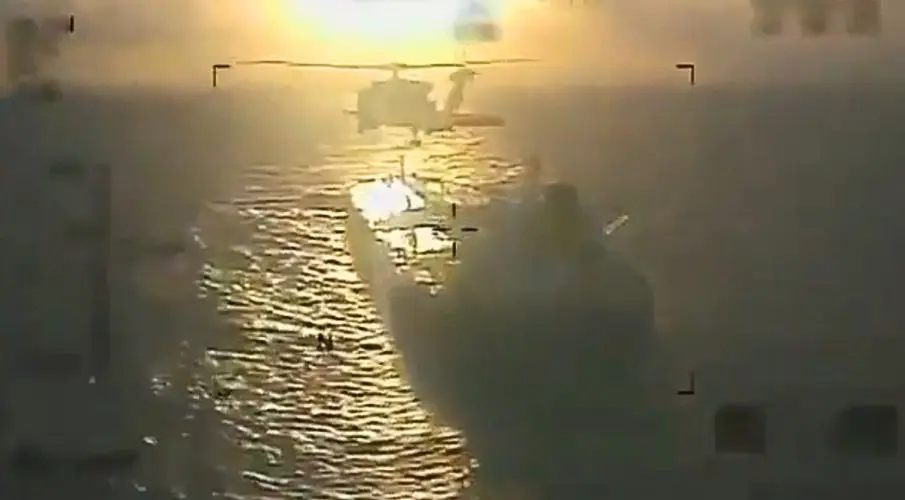
In the middle of the open sea, the crew turned to paint and calculation. While U.S. units were tracking the oil tanker Bella 1, a Russian flag suddenly appeared on the hull. Not a symbol of conviction, but a shield hastily painted on. According to American security officials, the paint job was meant to create the impression that the vessel was now under Russian protection – an attempt to politically complicate the pursuit. The chase had begun days earlier. On December 21, the U.S. Coast Guard attempted to stop the Bella 1 in the Caribbean. The tanker’s destination was Venezuela, where it was supposed to load oil. This put the ship in the crosshairs of the de facto blockade with which the Trump administration is attacking Venezuela’s most important source of revenue. When it became clear that the tanker was not flying a valid national flag, it would have been subject to inspection under international maritime law. This must be noted as a matter of journalistic due diligence. The crew, however, refused to cooperate and continued on its course.
Since then, the route has resembled a flight. The Bella 1’s transponder has been switched off since December 17, and its position can now only be roughly reconstructed via satellite imagery. At one point, the ship sent a distress signal, but falsely indicated a location farther south. Later, it apparently changed course to the northwest, away from the Mediterranean, possibly toward Greenland or Iceland. According to reports, the vessel currently carries no cargo. The ship is fleeing out of sheer fear, several family members of the crew told us, an explanation that must currently be accepted. The Bella 1 has been under U.S. sanctions since last year. American authorities accuse it of transporting Iranian oil, the proceeds of which, according to the official narrative, were used to finance terrorism. The ship is considered part of a so-called shadow fleet used to move oil from Russia, Iran, and Venezuela while circumventing international sanctions. According to the U.S. side, the crew consists primarily of seafarers from Russia, India, and Ukraine. This claim is not complete – people from Venezuela and Trinidad and Tobago also work on the ship.

Why the Coast Guard has not yet boarded the tanker despite its superiority remains officially unanswered. Boarding a moving vessel with a potentially hostile crew requires specialized teams and carries significant risks. That a civilian tanker actively evades inspection is unusual, but given the incidents of recent months, it is humanly understandable. The violation of international maritime law, however, remains a fact. Two other tankers that U.S. forces stopped near Venezuela this month allowed themselves to be inspected without resistance.
At the same time, Washington is increasing pressure on Caracas. The United States has already seized another tanker in the region, and another vessel has been held in a Texas port since December 10. Further seizures are reportedly planned. Simultaneously, the Treasury Department imposed new sanctions on individuals and companies in Venezuela and Iran said to be involved in drone production. Shortly before that, U.S. intelligence carried out a drone strike on a port facility in Venezuela – the first known American operation of this kind inside the country. The government in Caracas has remained silent on the recent incidents, while President Nicolás Maduro publicly projects strength. On social media, the military and police appear on heightened alert, especially around energy facilities in the west of the country. Maduro also rejects the American portrayal of Venezuela as a central exporter of drugs and points to his own operations and the destruction of alleged smuggling infrastructure.
The painted flag on the Bella 1 is therefore more than a curious detail. It stands for a new level of escalation at sea, in which civilian ships become political tools. What began as the pursuit of a sanctioned tanker has long since become part of a larger power struggle between Washington, Caracas, Tehran – and now Moscow as well.
Updates – Kaizen News Brief
All current curated daily updates can be found in the Kaizen News Brief.
To the Kaizen News Brief In English


Der Angriff auf die Hafenanlage in Venezuela ist doch ein klarer Völkerrechtsbruch, oder?
Die USA haben eine kriegerische Aktion gegen ein Land geführt, mit dem sie offiziell nicht im Krieg sind.
Wenn die Besatzung überwiegend aus Russen besteht, dann ist das die Antwort, warum die USA das Schiff nicht entern.
Stärke zeigen, aber nur nicht Buddy Putin auf die Füße treten.
Irgendwann geht dem Frachter der Sprit aus.
Dann wird es schnell zu einem echten Seenotfall