
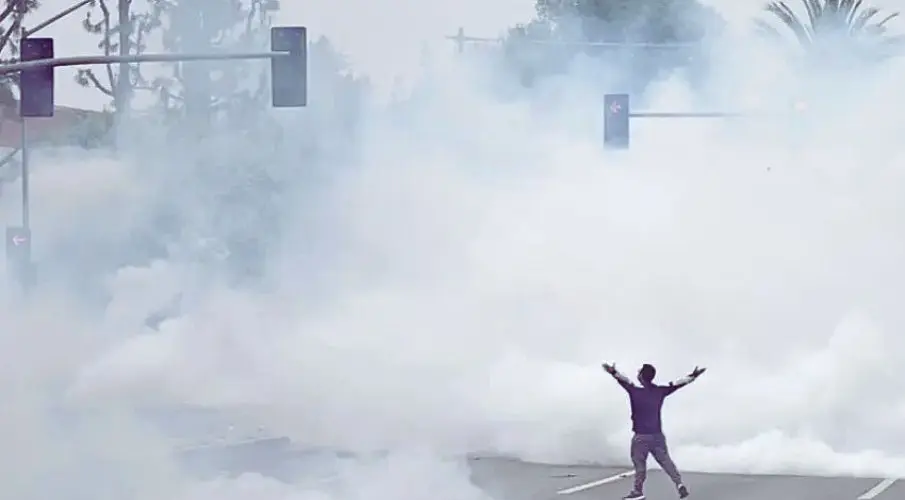
The return came without warning. In mid-December, Gregory Bovino reappeared in the Chicago area, accompanied by several hundred federal agents – and a film crew. The same hard methods that had already sparked protests months earlier were deployed again. Arrests without apparent warrants, massive presence, maximum visibility. For city officials, it was quickly clear what this was about: not law, but staging. A spokesperson for Chicago’s Democratic Mayor Brandon Johnson openly called it political theater. People were being randomly detained, families traumatized, while cameras rolled. The operations were put on display, those affected reduced to extras. This was wrong, destabilized the city, and disregarded any sense of humanity.
But by now this goes beyond images. A new level of escalation has been reached. And what is now emerging goes far beyond staging. A new escalation threshold has been crossed. Until recently, there was an unspoken line: weapons were generally aimed at people only after they had left their vehicles or openly resisted. That line effectively no longer exists. Today, the weapon is drawn almost immediately. The barrel points directly at people, even when they are still in their cars, when journalists are trying to document from their vehicles what is really happening on America’s streets. At observers. At journalists. At those who are doing nothing more than watching and recording what is happening. The threat is no longer indirect, it is concrete. Anyone who films is no longer merely under pressure – they are in the crosshairs.
This is not a movie, but reality on the streets of America. Anyone who actually votes for the AfD is practically inviting such a policy to be adopted in Germany as well. We can judge this, because we are on America’s streets documenting what is happening there, and helping those affected wherever we can.
This approach is not new in principle, but it is new in its consequences. Under President Donald Trump, the Department of Homeland Security has long been more than an agency. It produces images, videos, and clips designed to sell deportations as successes. Kristi Noem herself has published footage of raids. The ministry’s official presence on social media shows arrests, takedowns, handcuffs – carefully edited, distributed, commented on. State power is filmed, packaged, and presented in a fascistic manner.
At the same time, exactly what makes these images controllable is being criminalized: the public’s camera. Noem declared that violence against ICE agents was not only physical assault. What violence against ICE agents, one immediately wonders. Violence, she said, also included filming agents, recording them during operations, or making their locations visible. One statement even claimed that recording or following federal agents constituted obstruction of justice. An assessment that courts have clearly rejected for years. In this way, even family members are now being labeled criminals simply for following an ICE vehicle to find out which detention facility their relatives have been taken to, so that this information can be passed on to lawyers or aid organizations.
In Charlotte, North Carolina, federal agents arrested two people ten days before Christmas. Their offense: they warned others about impending ICE raids.
People who warn about ICE operations are arrested, classified like terrorists, because it is not system-compliant. The madness of right-wing populism knows no limits and tolerates no dissent.
What is often overlooked: journalists, activists, and residents who document these operations are doing so under real danger. Paradoxical but true: anyone who makes state action visible in the United States today increasingly works under conditions that verge on mortal danger. Not because they attack, but because they stay. Because they film. Because they do not look away. Standing up to this system now means consciously exposing oneself to a threat that would once have been unthinkable. Because merely filming police officers or federal agents on duty is protected. As long as no one interferes or endangers anyone, such observation falls under freedom of expression and of the press. It is a central tool of public oversight. This is exactly what David Bier of the Cato Institute points out. He speaks of a nationwide practice of intimidation, deliberately directed at people who want to observe and document operations.

Ryanne Mena, a reporter for the Los Angeles Daily News, was struck in the head by a projectile. The experienced journalist, who has already been exposed to tear gas multiple times, described the day as unprecedented: “I have asthma, and it was really hard for me to breathe or see. My colleague had to guide me around the corner, away from this huge cloud of tear gas. We were just coughing, struggling for air.” The diagnosis: concussion.
When a party like the AfD claims that freedom of expression is being “attacked” in Germany and Europe, it already reveals a double failure. Either this party is not remotely fit to govern because it does not understand what is currently happening in the United States. Or – and this is far more likely – it understands it very well, approves of it, and wants to implement exactly this policy here. In that case, it should stop whining like a wolf cub whenever it is called right-wing extremist or fascist. Because what is happening in America is fascism. Not as an insult, but as a description. The AfD voter who takes to the streets in Germany to protest something would be in for a rude awakening if they saw how such behavior would be answered in the United States. Cameras, drawn weapons, intimidation, arrests – not after escalation, but immediately. Anyone who admires or wants to import this has forfeited any right to complain about clear words. For the AfD, freedom of expression ultimately means something very simple: agreement. Anyone who does not share the party’s views is already seen as someone who “undermines” freedom of expression. Divergent positions are not accepted as a legitimate part of an open society, but treated as an attack. Opinions are only welcome if they align with the party’s line. Everything else is delegitimized, defamed, or marked as hostile. They can deny this as often as they like – practice shows otherwise. That is the reality.
But back to the United States. The contradiction is obvious. While state agencies bring their own camera teams, invite media, or produce material themselves, citizens are supposed to remain silent, look away, lower their phones. By the ministry’s own logic, even state filming itself would have to be problematic. These images also make agents visible, they also show procedures, locations, faces. But here a different standard applies. Freedom ends where it becomes uncontrolled. What has emerged here is not an overreaction by individual officers, but a system. A method whose intimidation, arbitrariness, and targeted threat force historical parallels. Not as a slogan, but as a description of a condition. Anyone who documents what is happening on America’s streets today faces a state power that has learned that fear works faster than law.
Of course, one does not allow oneself to be intimidated by this. But a level has been reached that shatters any previous notion. The camera has become a danger – not to the state, but to those who hold it. And that says more about the condition of this system than any propaganda video ever could.
Updates – Kaizen News Brief
All current curated daily updates can be found in the Kaizen News Brief.
To the Kaizen News Brief In English


Rainer und all Eure Mitstreiter, passt bitte nochmal ein bisschen mehr auf Euch auf.
Es ust furchtbar, was Bovino durchzieht.
Grundsätzlich ist nach deren Logik erstmal Jeder ein Krimineller, bis er es vor Gericht geschafft hat das Gegenteil zu beweisen.
Das folgt alles dem Playbook der SS. 1:1 umgesetzt. Uniform ist Macht, der Rest hat zu parieren.
Die AfD bekommt da feuchte Träume.
Sie sehen sich schon marschieren und all die „Anderen“ verhaften und ggf deportieren.
Wie kann man so hohl sein so etwas freiwillig zu wollen.
Hohlbirne par excellence zeichnet die Faschisten besonders aus.
…das machen wir, ich danke dir, so und nun ab ins Neue Jahr 🙂