
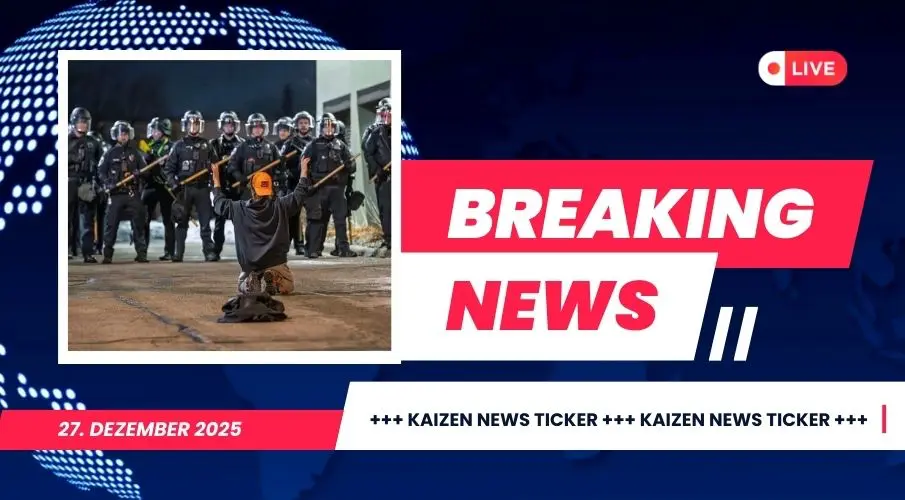
Prospect Heights: Stops without cause, retreat once cameras appear, ICE raids grow ever more massive!
Small fragments from everywhere – ICE agents wait for hours on streets, operations at all kinds of corners, ICE on standby everywhere – over Christmas alone more than 150 new cases reached us, which on top of the cases already ongoing is hardly manageable anymore.
In Prospect Heights, Illinois, immigration agents asked police officers to stop a vehicle because a man was following them. The police officer stated openly that the stop was carried out at the request of the agents. Shortly afterward, several federal agents crowded around the man, who calmly explained that he was a U.S. citizen. The response was that he would have to prove it. When asked about the reason for the stop, there was none. The man directly asked whether his appearance was the reason. The agents avoided the question and demanded a driver’s license. He pointed out that the vehicle was registered in his name and that he did not have to provide any information. One agent falsely claimed that he was required to identify himself. Then the break: a warning went through the group that cameras were to the left. Another agent briefly looked at the ID, glanced at it fleetingly, and ended the stop. No ticket, no arrest, no explanation. Because there had been no legal basis. What remained was the impression of an operation that lasted only as long as it was not documented. And so we all have to carry on.
Corona, California: Christmas, handcuffs, and children as witnesses
On Christmas morning, ICE agents arrested a father near a high school in Corona, California, and made his children witnesses. The children were briefly placed in handcuffs and had to watch as their father was taken away. They shouted that they were children, while an agent ripped a phone out of their hands and damaged it. Three other people who were filming were also arrested. ICE later stated that the family had obstructed the agents by following them with a car. The children were eventually handed over to their mother, but the damage was done. Property was destroyed, trust as well. The arrest did not take place out of sight, but in front of cameras and in front of minors. Christmas became a change of scenery for force. No discretion, no consideration, no restraint. What remained was an image of state violence that leaves an imprint and does not disappear.
Zelensky announces possible meeting with Trump in Florida!
As we had already indicated on December 25, 2025, Ukrainian President Volodymyr Zelensky intends to meet with Donald Trump in Florida on Sunday. The talks are to focus on the further course of the war and possible political exits. Speaking to journalists, Zelensky said that a joint peace plan by Ukrainian and American representatives was ninety percent complete. He did not provide details, but emphasized that it involved concrete security guarantees and binding commitments. The meeting takes place against the backdrop of growing fatigue in the West. Washington is sending increasingly contradictory signals. Florida thus briefly becomes a political stage of international significance. Whether more than symbolism emerges from the conversation remains open. One thing is clear: Kyiv is seeking every remaining door.
Zelensky speaks of a peace plan that is ninety percent finished. Developed jointly by Ukrainian and U.S. representatives. The last open points are likely precisely those that no one has wanted to talk about so far. Territory, security guarantees, timelines. That Zelensky is speaking of progress at this moment is no coincidence. Winter is taking its toll, the fronts are hardening, the patience of the partners is wearing thin.
Santa as an enemy image

The Republican majority leader in the Indiana Senate, Chris Garten, presents himself as a Santa Claus fighter. AI generated images are published showing him attacking Santa Claus in front of the Statehouse. Christmas becomes a backdrop, violence the punchline. Anyone who criticizes the images is dismissed as snowflakes. The message is a cheap political show, staging more important than effect. The calendar says December, the tone knows no holidays. When even Santa has to serve, every measure is lost.

The Republican majority leader in the Indiana Senate, Chris Garten, presents himself as a Santa Claus fighter. AI generated images are published showing him attacking Santa Claus in front of the Statehouse. Christmas becomes a backdrop, violence the punchline. Anyone who criticizes the images is dismissed as snowflakes. The message is a cheap political show, staging more important than effect. The calendar says December, the tone knows no holidays. When even Santa has to serve, every measure is lost.
40 billion for Buenos Aires, emptiness on the farms
A farmer from Virginia: Trump gave 40 billion dollars to Argentina, and since he was elected, suicides among farmers have risen, the number of farm bankruptcies has risen, and forced auctions of farms have also increased.
A farmer from Virginia puts it bluntly. Under Donald Trump, billions flowed abroad, around 40 billion dollars to Argentina, as a loan, as a political signal, as a handshake among elites. Nothing of that reached the farms of the Midwest. No relief for seed or diesel. No help with interest rates or insurance costs. Instead growing debt, tightening margins. Those who produce bear the risk alone. Those who export politics collect applause. What remains is the feeling of having been shortchanged.
Since Trump took office, the hard indicators have been rising. More farm bankruptcies, more foreclosed farms, more final farewells. The number of suicides among farmers is rising dramatically. These are not arbitrary figures, these are names, farms, families. Operations are lost, often after generations. Banks draw lines, courts set dates, the pressure grows quietly but steadily. Political promises do not help here. Subsidies often reach the wrong people. The market devours the weakest first, and Washington rarely listens closely. In recent months we have published several investigations on this.
A case under reservation

A federal judge, Paula Xinis, has halted the criminal proceedings against Kilmar Abrego Garcia and thereby triggered a legal chain reaction. Paula Xinis suspended the trial and ordered that central questions regarding the lawfulness of the approach be examined. In parallel, Waverly D. Crenshaw Jr. stated that there are sufficient indications to publicly clarify whether the prosecution is being pursued out of retaliation. For this purpose he scheduled a hearing for January 28. The prosecution must explain there why it is now pursuing a case of human smuggling. If this explanation fails, dismissal of the charges looms. The starting point of the whole matter is a deportation that should never have taken place. Abrego Garcia was deported to El Salvador in March, to a notorious prison. Only massive public pressure and a court order led to his return to the United States in June. But this return did not mark the end, rather the beginning of a new criminal escalation.
The case has now become emblematic of immigration policy under Donald Trump. Abrego Garcia vehemently rejects the accusations and speaks of targeted, selective prosecution. The basis of the indictment is a traffic stop from 2022. At that time several passengers were in the car, officers internally voiced suspicion, but ultimately let him continue with only a warning. Years later the same incident resurfaces. An agent of the Department of Homeland Security testified that he only revisited the matter after the Supreme Court ordered Abrego Garcia to be brought back from El Salvador in April. Years earlier he had been granted judicial protection from deportation because he faced concrete danger from a violent gang in his home country. He lived legally in the U.S., worked under Immigration and Customs Enforcement supervision, had an American wife and a child. Nevertheless he was publicly linked to MS-13, without criminal record, without credible evidence. Now it is up to the prosecution to explain why an old, inconsequential incident suddenly became a criminal case. The answer will determine whether this case ends – or whether it remains as evidence of how far a state is willing to go to justify its own mistake.
Seven flights – and the wrong direction of the questions
Mark Epstein says a sentence that sticks. Donald had been on Jeff’s plane about seven times. But the real question, according to Mark Epstein, is another. Whether anyone ever checked how often Jeffrey was on Donald’s plane. Whether the flight logs from those days were ever truly placed side by side. Not just one list, but two. Movements in both directions. Meetings that were not based solely on invitation. Who flew with whom, and exactly when. The public debate remains one sided. It counts routes only in one direction. That is where omission begins.
According to Mark Epstein, Jeffrey Epstein told him on several occasions that he had traveled together with Donald Trump on Trump’s plane. Up or down, not once, but repeatedly. This statement shifts the perspective. It is no longer just about guest lists, but about proximity and familiarity. About flights that apparently required no explanation. To this day it is unclear whether these routes were ever fully evaluated. Whether anyone truly wanted to know how close these paths were. As long as that remains open, the story remains incomplete.
Kyiv in the dark
Missiles rain down on Kyiv, the lights go out, the city trembles. Several heavy explosions hit residential areas as Russia launches a combined attack with cruise missiles and ballistic missiles. Air defense is operating, people seek shelter. Vitali Klitschko reports explosions in the capital and urges people to remain in shelters. Journalists hear detonations in various parts of the city. Ukraine’s air force issues a nationwide alert, drones and missiles move across several regions. Not a pinpoint strike, but a clear signal. Kyiv is visibly being targeted.
The timing is unmistakable. Two days before a planned meeting of Volodymyr Zelensky with Donald Trump at Mar-a-Lago, Moscow escalates. Shortly beforehand, Zelensky had said he was prepared for a referendum if Russia agreed to a sixty day ceasefire. The Kremlin accuses him and his EU partners of trying to torpedo a U.S. brokered plan. Then missiles strike the capital. Zelensky warns that a vote under fire would not be a free decision. If people are asked to vote while missiles are falling, they will see them.


Eine Spirale der Gewalt eskaliert in den USA und ist durch besonnene Dokumentationen zu stoppen. Wenn es also mehr Menschen gibt, die von Euch oder hoffentlich noch mehr solcher Teams lernen, könnte ein grossartiger Widerstand gelingen. Ich weiss, dass das zur Zeit in einem so grossen Land wie den USA zu wenige sind. Aber steter Tropfen höhlt den Stein. Das beweist eindrucksvoll der Fall Kilmar Abrego Garcia. Für mich ist das eine Weihnachtsbotschaft, die auf der Höhe der Zeit ist. Es wäre auch die richtige Botschafter für alle Länder.
In Deutschland würden das aber auch nur investigative Journalisten und allenfalls Wähler des Grünen und Linken Spektrums verstehen. Und der Leidensdruck ist bei vielen noch zu klein. Ausserdem reagieren viele genau in den Gruppen, die sich gegen Rechts richten, mit viel Abkehr und glauben nicht, dass das was in Amerika passiert, bei uns zeitversetzt folgt.
Wie meinte mein eigener Bruder gestern zu mir “ ich verstehe nicht, dass Dich das SEK noch nicht abgeholt hat“. Meine Antwort, dass ich Aussagen teile, die dokumentiert sind und juristisch abgeklopft, ist im Nirwana gelandet. Mein Bruder war Berufssoldat und auch im Kosovo …und er wünscht sich eine neue Schwester. Ich bin ihm zu grün und Antifa. Was er nicht sagt, ist dass er leidet, dass ich behindert und krank bin und er davor wegjäuft und ich nicht mehr vor den Schwierigkeiten meines Lebens weglaufe und wieder Kämpfe. Etwas das Du mir wieder beigebracht hast und ich wieder Sebstwertgefühl habe. Und das lernen andere auch von Dir und der Arbeit Deines Teams. DIesen Dank musste ich hier mal aussprechen. Denn Dein Weihnachten war arbeitsreich und hat anderen Menschen geholfen.Und mir auch. Danke für alles.
…
ich danke dir für deine Worte. Es ist leider der härteste Weg der Aufklärung, weil Du Dich richtig durchsetzen musst und wie sagt man so schön; „Dreck fressen muss; auch oft allein auf weiter Flur stehst, weil es nicht in das Bild passt, dass alle aber schnell haben möchten“ – Ich wünsche Dir für 2026 jeden Tag jegliches Glück und das für uns alle die Zeiten besser werden.
Sehr interessante Recherche zu den Flügen mit Epstein.
Hoffentlich wird weiter ermittelt und ans Licht gebracht.
Das Ihr dran seid, dass weiß ich.
Ice ist wirklich Gestapo 2.0
Ohne jedes Gewissen, bereit zu jeder Brutalität, auch Kinder sind kein Tabu mehr.
Was für ein Trauma für die Kinder 😔
Die Polizeibeamten in den demokratischen Staaten sollten grundsätzlich nicht mit ICE zusammenarbeiten.
Was aus einer „Kontrolle“ wurde, sieht man ja.
Ich frage mich, wie die ICE Typen Ihre Staatsbürgerschaft beweisen wollen würden.
Oder der Gros der MAGA, die gerade mal einen Führerschein besitzen.
Ich glaube, dass Jeder Kameras mit directed Upload im Auto haben sollte.
Um genau bei solchen Situationen, wie von Euch recherchiert, ein kleines Ass im Ärmel zu haben.
Putin zeigt, was er von einem möglichen Frieden hält.
Nämlich gar nichts.
Immer weiter bomben und bomben.
Trump nickt es ab, weil er ja Selensky ohnehin für den Schuldigen hält.
Kilmar…. die unendliche Rachegeschichte.
Hoffentlich können seine Familie und er irgendwann zur Ruhe kommen und die traumatischen Ereignisse verarbeiten.
Die Farmer in Virginia haben ihn zu, locker, 85% gewählt.
Sie würden ihn auch jetzt noch zu 60% wieder wählen.
Wo Trump doch ein paar Millionen für die Farmer locker gemacht hat.
Schon sind sie wieder auf seiner Seite, sogar die, die ihre Farmen verloren haben.
Und das geht mir nicht in den Kopf. Wie engstirnig und blind muss man sein?
Wie absolut tief kann man nur sinken?
Den Weihnachtsmann (wenn auch als KI) zu verprügeln.
Hat der Typ keine Kinder oder Enkel? Kleine Nichten oder Neffen?
Was last so etwas bei einem 4 jährigen Kind aus, was an Santa glaubt.
Absolut abscheulich 🤬