
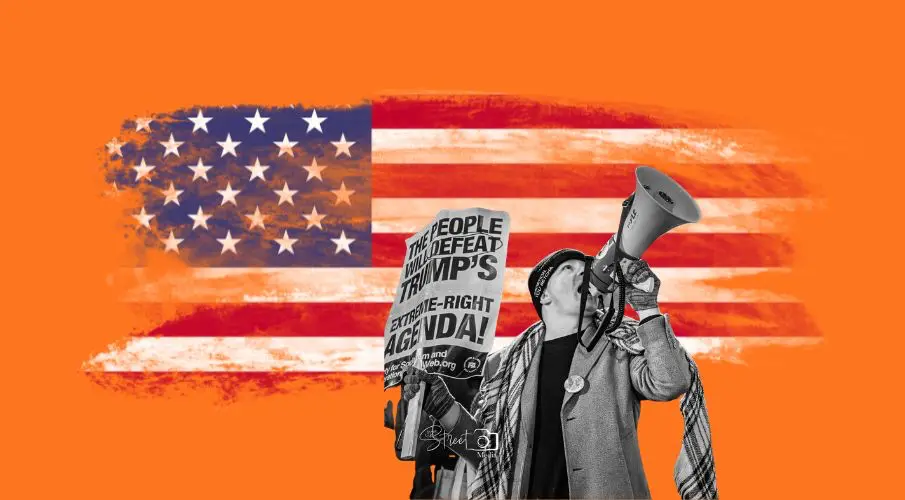
There are sentences that carry weight on their own. Placed next to each other, they form a picture – of what the United States currently is, a country that has lost its bearings. JD Vance says Germany is destroying itself. It is taking in millions who do not belong there, from cultures that are incompatible with its own. These are fascist words, things that are none of Vance’s business. For Vance, migration is an enemy that must be confronted, that must be repelled. The sentence fits into a language that has become everyday speech for many in America.
In Florida, there is a law. It allows someone to drive a car into a crowd of people, for example demonstrators, if they feel surrounded. Not in an exceptional situation that hardly ever occurs. But as a right one possesses. The state is saying: You decide. You decide. Violence becomes an option one can choose. Ron DeSantis’ explanation is simple and cheap, “No one has to sit there like a helpless sitting duck.” In Florida, he says, one has the right to defend oneself. But against what? Against people demonstrating for democracy? What kind of logic is that. Decide in seconds over the lives of others, without anyone later being able to tell you that you decided wrongly.
DeSantis: “You don’t have to sit there and just be a sitting duck. And you don’t have to let a mob grab you out of your car and drag you through the streets. In Florida, you have the right to DEFEND yourself.”
And above it all lies something that is no longer politics, but fanatical belief. Paula White, the spiritual advisor, head of Trump’s faith office, says: Whoever says no to Trump says no to God. This is not an exaggeration, it is simply sick. Terror becomes a holy cause. Dissent is no longer legitimate, it is sin. The president no longer stands under the criticism of the people, he stands above it, because he stands under God.
Trumps spirituelle Beraterin Paula White: Trump’s spiritual advisor Paula White: “To say no to President Trump would be saying no to God.”
Trump himself does not have to say any of this. Others do it for him. His person becomes the measure of what is right. His decisions become a moral obligation. Whoever follows him is on the right side. Whoever objects has excluded themselves.
Images from an ICE detention facility show why these people need help – and how inhumane the system in the United States has become. Harsh lighting, no privacy, people behind bars without conviction, often sick, exhausted, humiliated. This is state organized deterrence. Anyone who sees these images understands: This is not about order, it is about hardness as a message.
Has Höcke not been dreaming for years of exactly such deportation detention facilities – openly, bluntly, at least since 2018? What is reality in the United States is being traded by the AfD as a vision of the future. These images are therefore more than documentation. They are a warning of where politics leads when dehumanization becomes a tool and cruelty a method, if one does not resist it.
A current example: In a remote part of Arkansas, a small group of young white nationalists is trying to build something they believe to be permanent. The project is called “Return to the Land.” It refers to a private community open only to people with so called European heritage. The claim is clear. The implementation is not.
“Pure racism – anyone who supports this should examine their conscience. It is 2025, and this bigotry is vile. Too many fought and died for unity.” (Pastor Jordan Wells, November 12, 2025)
The leader of the group, Eric Orwoll, is asked who is allowed to live there. A simple question, seemingly. At first he appears confident. Europeans, he says. Then the follow up. Greeks. Yes, European. People from the Caucasus. No, not European. The interviewer points out that the term “white” was historically located precisely there. Orwoll hesitates. He begins talking about earlier uses of the term, about legal definitions, about history. In the end, he concedes that Italians and Irish were always considered white for legal reasons. Any certainty is long gone at that point.

Later, Orwoll talks about the admissions process. Sometimes, he says, everything goes smoothly. And then, almost as an aside, a sentence comes up: the wife is Colombian. That does not align with the values of the community. The interviewer presses further. What if the Colombian wife is of entirely Spanish descent. Orwoll thinks. Then he says: Then it would probably be fine. A man who wants to build an exclusively white place cannot say who belongs. He decides case by case. Exactly as it has always been in the United States.

The office of the Republican Attorney General of Arkansas, Tim Griffin, has found no indications in a preliminary review that Return to the Land, a private membership association restricted exclusively to whites in the Ozarks, is breaking the law.
Griffin had previously suggested that the community was engaging in “racial discrimination” against non whites. Inquiries to his office went unanswered. We would have liked to know how this change of position came about.
The term Orwoll and his associates invoke does not come from biology or genetics, but from an aesthetic judgment of the late 18th century. The German anatomist Johann Friedrich Blumenbach coined it after comparing skulls from around the world. He called Europeans “Caucasian” because he considered the skull of a woman from Georgia to be particularly beautiful. From this, he developed an order of humanity that he himself later described as arbitrary. The differences, he wrote, were gradual. There were no clear boundaries. The term survived nonetheless. It migrated from anatomy into courts, into legal codes, into immigration authorities. And there it became useful.
The Caucasus mountains are located in Central Asia. The people who live there – Armenians, Georgians, Azerbaijanis, Chechens – would not be accepted in Orwoll’s settlement. The term he relies on excludes precisely those from whom it takes its name. These contradictions are not a mistake. They are the system. In the 19th century, Irish immigrants in the United States were considered inferior. Caricatures portrayed them as animal like. Job advertisements openly excluded them. Legally they were white, socially they were not. They could become citizens, but they were considered a problem. Only when they distanced themselves from the black population and became politically useful did their status change. Italian immigrants experienced something similar. In the southern states, they were pushed into the same jobs as black workers. Their belonging was publicly questioned. In 1891, eleven of them were lynched in New Orleans after being acquitted. The reaction of many newspapers was muted. Some openly questioned whether these men deserved the same protection as other whites.
“You don’t have to apologize for being white anymore”
Whiteness was not a condition. It was an outcome. After World War II, access opened to suburbs, to state backed loans, to schools. Black veterans were excluded. The children of the Irish and Italians moved in. This is how belonging was produced. Not through origin, but through position. The absurdity of this system is particularly evident in the so called one drop rule. A single ancestor of African descent was enough to classify someone legally as black. Virginia’s 1924 law demanded absolute purity. There was one exception. Descendants of Pocahontas. Too many influential families would otherwise have excluded themselves. Purity was negotiable when it affected the right people.

Many people, journalists and organizations are fighting racism in America – in the media they are shadows, on the streets the last bastion.
Courts turned this into theater. Testimony was evaluated based on hair. People lost their right to speak because an expert interpreted a curl as proof. Verdicts did not hinge on act or guilt, but on classifications that could shift at any time. Back to Arkansas. There, something permanent is now supposed to be built. A community that wants to explain to its children where they come from and why they belong. But the foundation consists of terms that were never stable. The Germans whom Benjamin Franklin once described as dark and unsuitable are today considered the embodiment of white normality. Jews, who were still seen as foreign in the early 20th century, first became “white ethnics” and then simply white. Finns were classified as Mongolian in a Minnesota court in 1908. Today, they no longer appear separately in any statistics.
Who belongs was never a question of origin. It was always a question of order. The people of “Return to the Land” believe they are building something lasting. In truth, they are building on a concept that has shifted with every generation. The boundaries they draw today will be explained, relativized or discarded tomorrow. Not because genes change, but because power relations change.
Anyone who sees this project as merely an exception misses the history behind it. This is not about Arkansas. It is about a country that repeatedly reinvents its categories – and each time claims they are natural. And that is exactly why the question “Who is white?” fails again and again. What emerges when one puts all of this together? A climate that revives the darkest days of the past. In which the citizen is not protected from violence, but is meant to become its warrior. In which migration no longer appears as a problem to be solved, but as a threat that justifies hardness. And hardness is no longer understood as something heavy, applied only when nothing else remains, but as a good virtue one is expected to display. And religious language removes the final barrier, because it renders doubt immoral.
“Creative and nonviolent resistance on December 25, 2025 is the right path”
This is not coincidence, but a line. Language opens laws. Laws shape behavior. Behavior defines what is normal. Anyone who reads each element in isolation sees nothing. Anyone who takes it together sees the development. The development continues and has a name: Donald Trump. But the struggle, the help and the education will also continue – and they require no name.
To be continued ...
Updates – Kaizen News Brief
All current curated daily updates can be found in the Kaizen News Brief.
To the Kaizen News Brief In English


Danke für diese ausführliche Erklärung, aber ich kann nicht anders – mir ist übel 😳
danke dir, und ja, ich kann dich verstehen
Ein interessanter Bericht, der das Thema auch historisch betrachtet.
Es ist furchtbar, was Rassismus und Faschismus anrichten.
Ich bin mir sicher, dass Viele der selbsternannten „Weißen Rasse“ in ihrer Genetik mehr als genug „nicht weiße“ Vorfahren haben.
Wäre mal richtig lusig, deren Genom daraufhin zu untersuchen.
Fakt ist, wir sind alles Menschen.
Aus den gleichen biologischen Bausteinen.
Alle mit rotem Blut und weißen Knochen (außer durch Krankheit verändert).
Egal welche Hautfarbe sich nach außen zeigt.
Ein Mensch definiert sich immer über sein Handeln. Nicht über seine Ethnie oder Hautfarbe.