
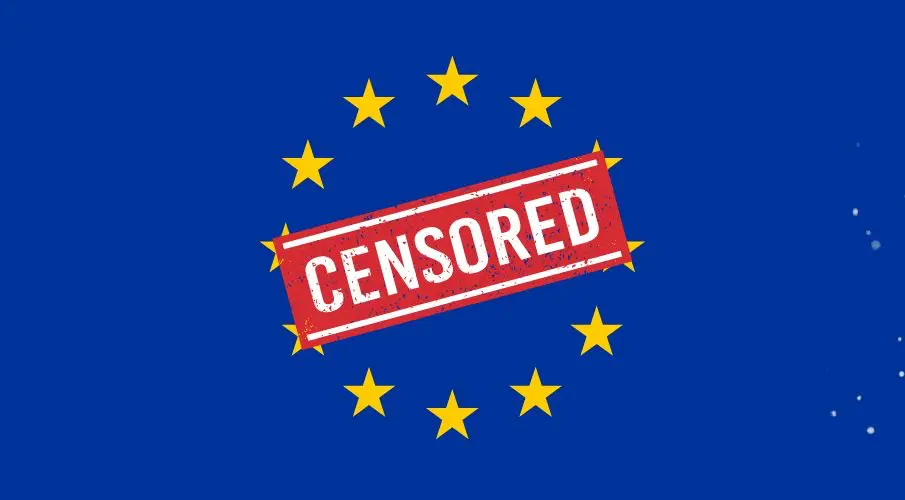
Washington builds a wall, Trump likes doing that, and calls it principle. From one day to the next, several European actors are deemed unwelcome. The accusation: “censorship.” What is meant is the European practice of not accepting hate, threats, and targeted disinformation on major platforms as an unavoidable accompanying phenomenon. Affected are the two leaders of the German initiative HateAid, Anna-Lena von Hodenberg and Josephine Ballon, the British NGO representative Imran Ahmed, Clare Melford of the Global Disinformation Index, and the former EU internal market commissioner Thierry Breton.
Formally, these are entry bans. Politically, they are something entirely different. “If you devote your career to censoring American expressions of opinion, you are unwelcome on American soil” - that is the message from the State Department. Any relativization? None. Marco Rubio speaks of “extraterritorial censorship” that will no longer be tolerated. In this reading, European regulation becomes “radical activists” and “weaponized NGOs” that allegedly force platforms to punish viewpoints they dislike.

For far too long, ideologues in Europe have led organized efforts to coerce American platforms into punishing American viewpoints they do not like. The Trump administration will no longer tolerate these severe acts of extraterritorial censorship. Today, the State Department will initiate steps to deny entry into the United States to leading figures of the global censorship-industrial complex. We are ready and willing to expand this list should others fail to change course. (“Now we are all very, very scared, Little Marco” - editorial note)
The selection of names leaves no doubt about what this is really about. HateAid supports victims of digital violence, documents cases, works together with authorities and platforms, and does so strictly within the bounds of existing law. Anna-Lena von Hodenberg was awarded the Federal Order of Merit only a few weeks ago for this work. It is precisely this work that is now labeled censorship. The response of the two leaders is brief and clear. They speak of repression and of European sovereignty being openly called into question. The tone remains factual, the accusation weighs heavily: a government that increasingly stretches its own rule-of-law standards is targeting those who oppose it.
The connection is obvious. For months, political pressure from Washington has been directed against European digital rules, above all the Digital Services Act. The law obliges large platforms to act against illegal content, disclose risks, and remedy structural violations. In Europe, this is a response to years of inaction by the corporations. In the United States, it is interpreted as an attack on freedom of expression. Thierry Breton, who was politically responsible for the DSA, is declared the “mastermind.” The fact that all 27 member states agreed to the law plays no role in this narrative. Breton’s brief reply points precisely to this: censorship is not located where it is currently being placed.
The timing is also no coincidence. Shortly before, the platform X was fined a substantial sum for transparency deficiencies. In Washington, this was portrayed as an attack on American companies and the American people, although the greatest enemy of the American people is Trump himself. In this logic, European legal enforcement does not appear as the application of rules but as a hostile act. That these rules apply where content is disseminated within the EU goes unmentioned. The European principle is simple: what is illegal offline remains illegal online - without any claim to applicability beyond one’s own legal sphere. What is new is less the conflict itself than the means chosen. Instead of proceedings or negotiations, immigration law is used. Anyone deemed a “censor” is to be kept out. Even citizens from Visa Waiver countries must undergo an electronic screening procedure prior to entry. A single notation can be sufficient to make travel permanently impossible. The instrument is hard to challenge and precisely for that reason so effective.
That, of course, the little piggy bank of intelligence must not be missing is more imposition than substance, but it should not go unmentioned. We refrained from sharpening the image - there are limits.

In Europe, this step generates deep unease. It is not directed at anonymous institutions but at named individuals who stand for a particular understanding of digital responsibility. Organizations that have documented cases for years, prepared complaints, and accompanied victims are turned into political targets. Cause and effect are turned upside down. Rules against violence and hate are constructed as an alleged attack on freedom of expression.
At the end stands a question that is strikingly rarely asked in Washington: who sets the standards where people live, work, vote, and are threatened? The fact is that America violates national and international law every day. When I look at our desks, one could soon justify them as a memorial to the loss of democracy toward the establishment of fascism. Europe has decided not to treat large platforms as lawless spaces any longer. And that is right, even if for right-wing populism this is naturally censorship according to its own definition of freedom. The response from the United States consists of personal entry bans against those who represent or implement this decision. This is no longer a dispute over words. It is a power conflict - and a signal to all those working on digital law in Europe: this conflict is no longer being conducted merely on an abstract level. Donald Trump and his regime represent more than just a threat; they must be confronted with the means of democracy and investigative journalism - in Trump’s new West more a normal state of affairs than an exception.
To be continued ...
Updates – Kaizen News Brief
All current curated daily updates can be found in the Kaizen News Brief.
To the Kaizen News Brief In English


Mir fehlen, wieder einmal, klare und deutliche Worte aus Europa.
Letztlich ist es hier nur eine Schlagzeile unter vielen gewesen.
Das muss groß, ich meine wirklich groß, in die Medien!
Es ist ein Angriff auf Europäisches Recht und Gesetz.
Wer in Europa tätig sein will, muss sich eben hier geltende Gesetze halten.
So einfach.
Da braucht man in Europa nicht diskutieren oder gar verhandeln.
Klare Ansage an die USA und Punkt.
trump versteht nur die ganz harte sprache, wenn das in der eu ankommt, wird alles etwas leichter