
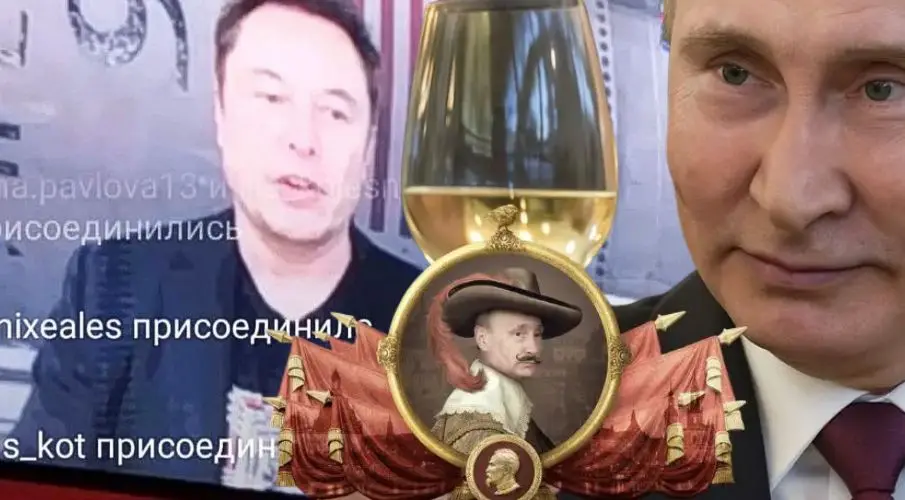
Shortly before the results were announced, a whole series of wines vanished from the program of the renowned San Francisco International Wine Competition. Not because of poor ratings, not because of formal deficiencies - but because of their origin. Russian wines, including bottles from the immediate vicinity of Vladimir Putin’s Black Sea palace and from the circle of Russian Orthodox Patriarch Kirill, were retroactively disqualified. By that point, the jury had already tasted them. The results will nevertheless not be published. According to the Russian Association of Winegrowers and Winemakers, AVVR, the decision came on December 16, 2025. The organizers reportedly said they were responding to an intervention by an unnamed U.S. elected official. For the association, it was an affront. Ninety-five Russian wines had been accepted and tasted, some from producers participating in a U.S. competition of this scale for the first time. That is precisely what makes the case politically explosive.

The centerpiece is the Krinitsawinery, located just a few steps from Putin’s Black Sea palace. With assets valued at more than 27 billion rubles, it is now considered the most valuable winery in Russia - more valuable than the traditional Crimean brand Massandra or the industrial giant Kuban-Vino. Its origins were modest. When Putin visited Silvio Berlusconi’s villa in Sardinia in 2003, he liked the opulence so much that he brought the architect to Russia to build a copy - only larger. Instead of a soccer field, there is now an ice arena. Instead of olive groves, 300 hectares of vineyards stretch across the grounds.
Because among the submitted wines were products from two wineries on the grounds of the widely known palace complex of Vladimir Putin near Gelendzhik: Divnomorskoye Estate and Krinitsa. Added to that were wines from the Mezyb estate, which is linked to Patriarch Kirill. Further submissions came from wineries that are connected to the head of the state-owned Sberbank, German Gref, to a former vice president of Russian Railways, as well as to a regional lawmaker from Krasnodar. It was, soberly put, an exhibition of the Russian power elite in the guise of refined labels.

Israel’s stance on the war in Ukraine is understandable from a security-policy perspective, but it remains problematic. The country is in a permanent threat situation, in which Russia plays a key role in Syrian airspace and Iran is perceived as the immediate adversary. Against this backdrop, Israel avoids anything that could openly provoke Moscow and keeps the war in Ukraine deliberately at a distance. This restraint follows a sober logic of self-preservation and is not an expression of political sympathy for Russia. At the same time, however, a field of tension emerges from it that cannot be explained away. When Russian elites, officials, or intermediaries can live in Israel, work there, or cultivate networks, while in Europe the war in Ukraine is treated as a fundamental rupture, it appears like a break in the international stance toward a war of aggression. It undermines the feeling of shared consequence and reinforces the impression that moral standards are applied differently depending on strategic situation. Israel’s policy may be consistent from its own perspective, but it also contributes to the fact that the war in Ukraine is not everywhere treated internationally as an order-defining turning point. Precisely therein lies the ambivalence: between legitimate self-defense and a stance that remains hard to convey for other partners.
Even more revealing than the selection of the wines is the route by which they reached the United States. The transport did not take place through regular trade channels, but in the personal luggage of Pavel Mayorov, the deputy executive director of the winegrowers’ association. The bottles traveled in suitcases, spread across multiple routes, via Doha, Tbilisi, and Dubai. Russian excise stamps were covered with stickers bearing the Hebrew words “Not for sale.” To create the appearance of a harmless collection, Georgian and Israeli wines were mixed in.
All of this happened against the backdrop of clear legal rules. Since March 2022, the import of Russian alcoholic products into the United States has been prohibited. Goods from the annexed Crimea have not been allowed to be imported since 2014. At least one participating company, which is linked to the Winepark winery, has also been on the U.S. sanctions list for years. That these rules were meant to be circumvented was not a coincidence, but apparently part of the plan. Internal statements by Mayorov suggest that the U.S. side was also aware of the legal risks. Investigations exposed this, however, and thwarted these plans. Correspondence with the organizer of the competition was intended to facilitate the import. If this is confirmed, and the investigations are still ongoing, not only the Russian association but also the American organizer would be under suspicion of having violated multiple sanctions regulations. A statement from the competition leadership has so far not been issued.

On October 18, 2019, Elon Musk appeared via video link at an economic forum in Russia’s Krasnodar region. No political statement, no official occasion, no classification - just a short appearance that was nevertheless meant to have an effect. That it happened at all was no coincidence, but the result of a targeted action. Weeks earlier, a large billboard had been put up in the United States with the Russian inscription “How do you like that, Elon Musk?”, supplemented by a QR code. The message was deliberately provocative, direct, publicly placed, not as a request but as a challenge. Musk reacted publicly and wrote in Russian, in essence, that the author was linguistically skilled. Shortly after that, the agreement to the video transmission followed.

The appearance itself remained controlled, nonpolitical, without an honorarium, without an official livestream, but precisely in that lay its value. In Russia it was sold as a success, as proof of connectivity, as a moment of international normality. In retrospect, this appearance marks an early point of a recurring approach: Western attention is sought deliberately, not through formal channels, but through publicity, provocation, and media reach. Political contexts are blanked out, closeness is suggested, normality is produced. The pattern does not end in 2019. It reappears later when there is an attempt to place projects from the environment of Russian elites internationally - this time not via screens, but via competitions, networks, and personal routes. The appearance of October 18, 2019 thus does not stand for an isolated case, but for a method.
The case shows how deliberately things are done regarding the close personal and economic entanglements around the Russian wine sector. Numerous investigations have shown that companies from Putin’s environment are connected through shared infrastructures, personnel, and digital traces. Employees of more than 80 companies that are attributed to the power circle use email addresses of the same domain. Among them are managers of wineries, operators of luxury resorts, and employees of presidential residences. Mayorov himself has been moving in this network for years. The lawyer from Krasnodar built a career in regional development structures, founded marketing initiatives for Russian wine, and maintains close contacts with Mikhail Kovalchuk, the brother of Yuri Kovalchuk, who is considered Putin’s house banker. Kovalchuk’s research institute appears as a sponsor of that wine agency that Mayorov controls. In the leadership of the supposedly independent winegrowers’ association sit additional figures from the Kovalchuk environment, including high-ranking state media representatives and administrators of major wineries in Crimea.
That wine has long been about more than agriculture is shown by the massive takeover of Crimea’s vineyard areas. A considerable part of the wine production there is now under the control of companies connected to the Kovalchuks’ Rossiya Bank. Traditional businesses were taken over, areas were consolidated, brands were repositioned. Wine has become part of a system of power and prestige that does not want to forgo international recognition even under sanctions.

The disqualification in San Francisco ends this attempt for the time being. It makes clear that even a seemingly apolitical wine competition does not exist outside reality as long as products from the innermost circle of a sanctioned regime are involved. The effort with which the bottles found their way to the United States speaks its own language. It was not about taste alone. It was about visibility, about legitimacy, about the signal, despite everything, of wanting to belong. That precisely this appearance ultimately failed publicly belongs to the overall picture. It shows how thin the line is on which such maneuvers balance - and how quickly it can tear when origin, ownership structures, and political responsibility are no longer blanked out.
Updates – Kaizen News Brief
All current curated daily updates can be found in the Kaizen News Brief.
To the Kaizen News Brief In English


