
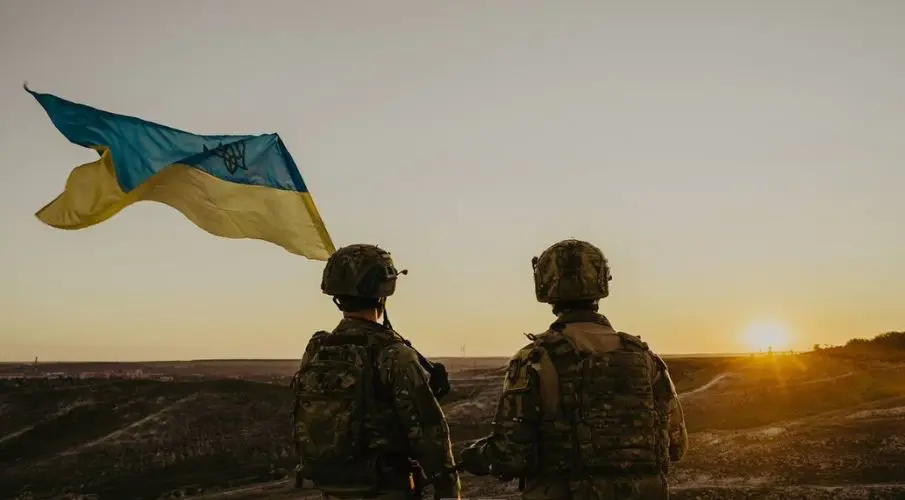
Ukrainian President Volodymyr Zelenskyy made a far reaching offer on Sunday in Berlin - and at the same time drew a clear line. Kyiv is prepared to drop its bid to join NATO if the West provides binding security guarantees in return. What is a painful step for Zelenskyy he himself describes as a compromise. The ceding of Ukrainian territory to Russia, however, he categorically rules out. The statement came on the sidelines of hours long talks with senior representatives of the US government. Zelenskyy met with Steve Witkoff, special envoy of US President Donald Trump, as well as Trump’s son in law Jared Kushner. German Chancellor Friedrich Merz was seated at the negotiating table, accompanying the talks on Germany’s behalf. Zelenskyy later published photos of the meeting himself.

Speaking to journalists, whom he addressed in advance via voice messages in a WhatsApp chat, the Ukrainian president explained why he considers the step necessary. Since the United States and several European states have effectively blocked Ukraine’s NATO accession, Kyiv now expects security assurances equivalent to those enjoyed by NATO members. These guarantees are needed to prevent further Russian aggression. That Ukraine is even willing to abandon its decades long goal of alliance membership is already a concession, he said.
Russian President Vladimir Putin has repeatedly portrayed Ukraine’s NATO course as a threat to Moscow’s security and cited it as one of the reasons for launching the full scale invasion in February 2022. To this day, the Kremlin demands that Kyiv formally renounce its bid to join the alliance as a condition for any peace settlement. Zelenskyy also made clear that mere political assurances are not enough for him. Security guarantees would have to be legally binding and supported by the US Congress. He also expects results from a meeting between Ukrainian and American military representatives in Stuttgart, where concrete security frameworks are currently being discussed.

After the roughly five hour meeting in Berlin, the US side spoke publicly. Via Witkoff’s official social media account, it was said that “significant progress” had been made. Washington has been trying for months to mediate between the positions of Moscow and Kyiv. Trump is pressing for a rapid end to the war and is growing increasingly impatient with the slow pace of the talks. But the search for compromises repeatedly runs into hard limits - above all on the issue of territory. At the center is the eastern Ukrainian region of Donetsk, most of which is occupied by Russian troops. Putin demands that Ukraine also withdraw from those parts that are still under its control. For Kyiv, this is not negotiable.
Zelenskyy said that the US side had proposed that Ukrainian troops withdraw from parts of the region and that a demilitarized free economic zone be established there. He rejected the proposal as unrealistic. The question of who would administer such a zone remained unanswered. If Ukrainian troops were to pull back five or ten kilometers, Zelenskyy asked, why Russian units should not retreat the same distance deeper into the occupied territories. The issue is extremely sensitive, the president said. From his perspective, a freeze along the current line of contact is the only viable option. Ukraine should remain where it stands - not a step further back.
Warnings quickly followed from Moscow. Putin’s foreign policy adviser Yuri Ushakov told the business daily Kommersant that even in the event of a demilitarized zone, Russian police and the national guard would remain in parts of the Donetsk region. He also warned that the search for a compromise could take a long time. Proposals that had originally taken Russian demands into account had, from Moscow’s point of view, been weakened by changes from Kyiv and its European partners.
In an interview on Russian state television, Ushakov said that the contribution of Ukrainians and Europeans to the existing drafts was hardly constructive. Moscow would raise very strong objections. Territorial issues had already been discussed intensively when Witkoff and Kushner met with Putin in Moscow earlier this month. The Americans know Russia’s position well. Alongside the talks, Zelenskyy sought backing from Europe’s key allies. Shortly before meeting the US envoys, he spoke by phone with French President Emmanuel Macron. On X, he thanked him for his support and emphasized that they were working closely together for shared security. Macron, in turn, publicly assured that France would remain at Ukraine’s side to build a lasting peace that guarantees the security and sovereignty of Ukraine and Europe.
Chancellor Merz, who together with Macron and British Prime Minister Keir Starmer is driving European support for Kyiv, had already used blunt words on Saturday. The era of so called American protection was largely over for Europe, he said. Putin is seeking a fundamental change to Europe’s borders and wants to restore old power structures. If Ukraine falls, he will not stop. The Kremlin rejects such accusations. Putin denies any intention to restore the Soviet Union or to attack NATO states.
While negotiations were underway in Berlin, the war continued with undiminished intensity. Ukraine’s air force reported that Russia launched ballistic missiles and 138 drones overnight. Of those, 110 were intercepted, but impacts were recorded at six locations. Hundreds of thousands of families in the south, east and northeast of the country were still without power, Zelenskyy said. Over the past week, Russia has launched more than 1,500 attack drones, nearly 900 guided bombs and 46 missiles of various types. Russia also reported attacks. According to the Defense Ministry, 235 Ukrainian drones were shot down within a few hours. In the Belgorod region, a man was injured when a drone set his house on fire. In the Volgograd region, Ukrainian drones struck an oil depot near Uryupinsk, triggering a blaze. In Russia’s southern Krasnodar region, attacks on the town of Afipski shattered windows in residential buildings. Authorities reported no damage to the refinery located there.
Between diplomatic offers, hard conditions and daily violence, the narrow path on which the peace talks are moving once again becomes clear. Zelenskyy’s message is unambiguous. Ukraine is ready for painful concessions - but not at the price of its land.
Updates – Kaizen News Brief
All current curated daily updates can be found in the Kaizen News Brief.
To the Kaizen News Brief In English


Unglaublich, da wird einmal sogar zugegeben, dass ukrainische Drohnenangriff auf russisches Territorium sich doch auch gegen Zivilisten richten könnten… Lästt hoffen, dass der Anteil ALLER am Krieg endlich zur Kenntnis genommen wird, weil sonst ein echter Frieden schwer möglich ist.
Das wird mit Putin ein Ding, was fast unmöglich erscheint