
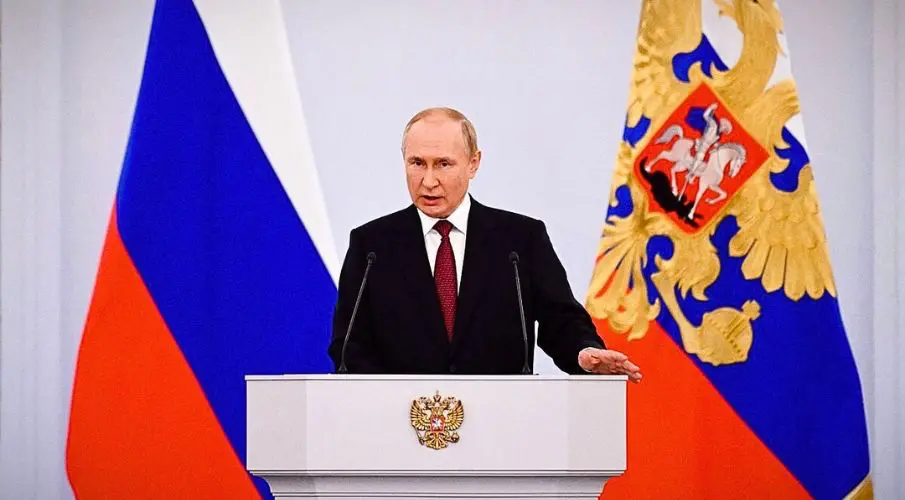
Donald Trump says Vladimir Putin personally informed him that Ukraine had attempted to attack one of his residences with drones. A serious accusation, made at a sensitive moment in ongoing talks about a possible end to the war. But what follows is no evidence, no independent confirmation, no verifiable information. Instead, it is a story that appears precisely when negotiations stall - and one that Russia immediately uses to harden its position.
Trump said Putin was very “angry” that Ukraine had tried to attack his residence.
This attack is neither proven nor confirmed. There are no images or videos - which would have been easy to obtain if it had actually happened. It is standard Kremlin propaganda.
Trump speaks of a “good phone call” with Putin. He says he was “very angry” when Putin told him about the alleged attack. At the same time, he admits he has no confirmation of his own. The source is Putin himself. Nothing more. When pressed, Trump says “we will see” whether it can be confirmed. He even suggests that the attack may not have taken place. But by then, the political damage is already done. Moscow declares that its negotiating position will be reviewed. Tougher lines are announced. The word drone attack works like a switch.

The Russian version is quickly told and full of fractures. Foreign Minister Sergei Lavrov speaks of 91 Ukrainian drones that allegedly attacked one of Putin’s residences in the Novgorod region. All were shot down. There was no damage, no injuries. Which residence exactly is meant remains unclear. The region is home to the so called Valdai estate, a secluded Putin retreat deep in the forest, without public events, without symbolism. The regional governor later speaks of 41 drones shot down, but also names no target. Numbers fluctuate, details are missing, evidence is not presented. What is missing are the usual hard indicators: clear impact evidence at the site, independent geolocation, verifiable debris data, a consistent chronology.
Ukraine immediately rejected the accusations. President Volodymyr Zelensky called the story a complete fabrication. Foreign Minister Andrii Sybiha described it as a pretext to justify further attacks and prolong the war. Ukrainian officials emphasized that drones are used in a targeted manner against military infrastructure - fuel depots, logistics hubs, and weapons production facilities - not against empty buildings with no military function. An attack involving 91 drones on a presumably unoccupied residence makes no military sense. Networks we work with reacted unanimously as well: shaking their heads. No confirmation, no indications, nothing that supports the Russian account.
Nevertheless, the story has an effect. Russia links the alleged attack to an announcement that previously reached understandings will be reconsidered. Putin’s adviser Yuri Ushakov says the Americans must “show understanding.” This is remarkable. While Trump publicly says he believes Putin, Moscow uses exactly this trust to apply pressure. Analysts in Russia are already talking about demanding full control over Zaporizhzhia and Kherson. Regions Russia currently only partially occupies.
Kupjansk erobert – rückwärts aus der Stadt, das nächste Kreml-Märchen
At the end of December, Russia’s military channel Zvezda presented videos from Kupiansk as alleged proof of the capture of the city. The images were meant to show strength, control, progress. In reality, they show something else. In one of the central clips, Russian soldiers are not moving toward the city center, but toward the outskirts. Out of Kupiansk, not into it. Exactly this scene was sold as “proof” of control. The footage comes from a residential area near a television tower, clearly identifiable through buildings also visible in older drone videos from 2020. Geolocation confirms it: the soldiers are moving toward an exit road, past the last houses, just before open terrain. A withdrawal from the inner city.
A group of Russian soldiers moves toward the exit of Kupiansk, December 2025 The images show Russian soldiers in Kupiansk, that part is true, but not during the capture of the city, rather during a withdrawal toward the outskirts.jansk, der Teil stimmt, aber nicht bei der Einnahme der Stadt, sondern beim Abzug in Richtung Stadtrand.
Satirically, one could say the soldiers are using the “exit from the city” as proof of control over the city. More irony is hardly needed. Control is claimed while the footage shows the opposite. Still, Moscow’s leadership and military repeated the claim several times. Chief of the General Staff Gerasimov reported Kupiansk captured already in November, Defense Minister Belousov again in December. In between, Volodymyr Zelensky published a video at the western entrance of Kupiansk. Ukrainian presence, openly documented.
No serious analyst confirms the capture of the city. Russian troops operate on both sides of the Oskil River, yes. But having control of Kupiansk and reaching Kupiansk are two different things. What remains is a familiar pattern, one also known from Trump and FOX News: images are used, statements amplified, reality replaced. Only this time, the material itself shows how fragile the story is.
At the same time, Putin is sharpening the military tone. At a meeting with his generals, he declares that Russian troops are only a few kilometers from the city of Zaporizhzhia. The offensive should be continued, the city taken “in the near future.” While peace is being discussed, preparations for further attacks are underway. Zelensky states plainly what is happening: Russia is trying to justify additional attacks, including on Kyiv, while masking its own refusal to end the war.

The timing is also striking. The story emerges exactly one day after Zelensky’s meeting with Trump in Florida. Both sides emphasized that the talks were constructive. Zelensky said the US was offering security guarantees for 15 years, with an option to extend. No breakthrough was achieved, but movement was signaled. And precisely at this moment, Moscow delivers a narrative that allows everything to be questioned again. Not because of its own demands, but because of an alleged Ukrainian provocation.
Trump himself contributes to the blur. He says it is “not the right time” to attack someone’s house. He says he blocked the sale of Tomahawk cruise missiles to Ukraine to prevent such escalations. When asked whether US intelligence agencies have evidence, he answers: “We’ll find out.” A president reacting to suspicion while admitting he knows nothing provides, unintentionally, the blueprint for what is happening here: politics based on assertion.
There is also the memory of earlier incidents. In May 2023, two drones exploded over the Kremlin. Russia spoke of an assassination attempt. Ukraine denied involvement. US officials later said it was likely an operation by Ukrainian special forces. The difference to today is decisive. Back then, there were images, explosions, visible traces. Today, there are only words. And yet the story is used to burden negotiations. That Russia shows no embarrassment in doing so is part of the problem. Anyone who invents 91 drones without presenting a single piece of evidence, who varies numbers, leaves targets vague and still demands political consequences, is not aiming for credibility but for effect. It is not about being believed, but about sowing doubt and buying time. Time for new attacks. Time for new demands. Time to continue the war while claiming to be ready for peace.
In the end, one assessment remains, sober and therefore heavy. There is no confirmation of a Ukrainian drone attack on Putin’s residence. Not by intelligence agencies, not by independent observers, not by verifiable data, not by networks we know very well. What does exist is Russia’s political interest in increasing pressure, and a US president willing to publicly pass on an unproven story. Maybe it was an attack. Maybe not. At present, everything points to the latter. And maybe Putin really just forgot to turn off the grill. That would at least be the first explanation for all these stories.
Updates – Kaizen News Brief
All current curated daily updates can be found in the Kaizen News Brief.
To the Kaizen News Brief In English


Kopfschütteln reicht nicht.
Für was gibt es die Vereinten Nationen noch? Es gibt keine Reaktion, wenn doch etwas gesagt wird, nützt es nichts.
…gute frage, so braucht man sie nicht, als abnickende köpfchen mit lecker essen
Toller Bericht, mit vielen Fakten, die mir nicht bekannt waren.
..ich danke dir
Ihr habt genau das jetzt recherchiert, was mir gleich, nachdem ich die Melding hörte, durch den Kopf schoß.
Militärisch macht es keinen Sinn.
Die Ukraine muss mit ihren Waffen haushalten.
Da greift man doch nicht mit 91 Drohnen eine wahrscheinlich ohnehin leere Residenz an.
Wenn man Lügen erzählt, sollte das nicht so offensichtlich sein.
Es war doch mehr wie eindeutig, dass der „Friedensprozess“ damit gestoppt und der Ukraine -wieder mal- der schwarze Peter zugeschoben wird.
Für den Einfaltspinsel Trump reichte die Lüge um sich gleich gegen die Ukraine zu echauffieren.
Wo er doch vorher gelobt hat, wieviel Interesse Putin am Frieden, Wiederaufbau und Erfolg der Ukraine hat.
Das war sicher wieder ein Trump-Alleingang
Putin reagierte mit einem Fake Angriff und einer Lügengeschichte.
So bleibt Trumps „Gesicht“ gewahrt (Putin braucht seinen besten Agenten boch( und Putin kann wieder weiter drohen und Bomben.
Die Tomahawk Lieferungen hatte der Kongress schon, soweit ich mich erinnere, vor dem Shutdown parteiübergreifend genehmigt.
Trump hat sich dazu nicht geäußert und nutzt diese Lügengeschichte um die Blockade der Tomahawk zu erklären
Und wo bleibt Merz, der in der Opposition ständig getõnt hat „mit mir als Kanzler wären schon lange Taurus geliefert worden“
Große Worte, nichts dahinter.
Und die Ukraine muss es ausbaden.
…die ganze geschichte ist erfunden und gelogen. wir haben sehr gute kontakte zu netzwerken dort, die lachen sich schlapp