
In March 2025, remarkable things happened behind the doors of the FBI: a week in which the agency assembled 934 employees to review and redact the documents related to the Jeffrey Epstein case. The amount is as precise as it is unusual: 851,344 dollars. That is how much the agency paid in overtime alone to prepare the documents for release. The work lasted only a few days, from March 17 to March 22, and exceeded anything one would expect from a routine document release. A total of 14,278 overtime hours were incurred, paid with the corresponding surcharges. Nearly a thousand people working on the same records at the same time. An internal email stated dryly that phase 1 of the redactions had been completed and the project teams could be released again. Phase 2 was still pending.

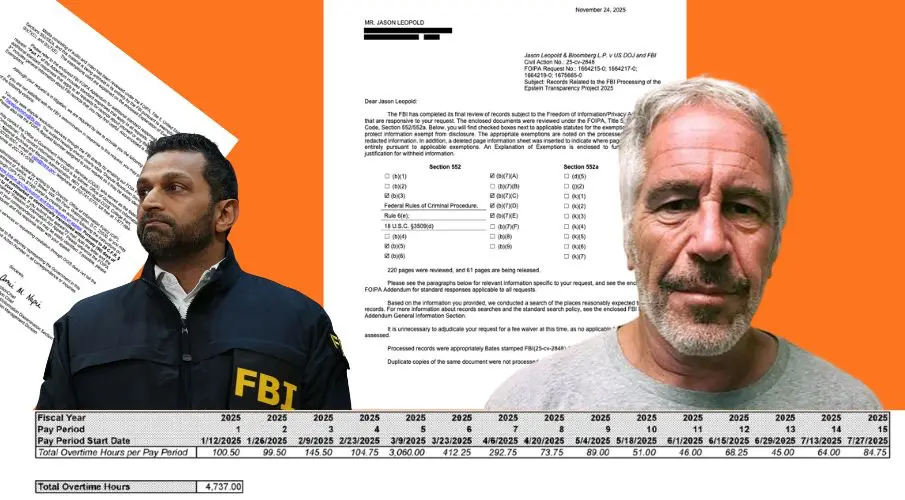
The letter informs that the FBI has reviewed and completed its response to the request for the Epstein records. A total of 220 pages were reviewed, of which 61 pages were released, some of them in redacted form. The rest remains withheld due to statutory exemptions. The FBI explains which legal provisions were applied for the redactions and notes that no fee waiver review was necessary. The records were assigned consecutive tracking numbers and duplicate documents were not processed again.
The documents leave no mystery as to the nature of the work: it was about redaction. Lists, training videos, Adobe instructions, tables of working hours, reports from headquarters and field offices. The agents were instructed to prepare the files so that they complied with the law while removing anything the agency deemed unfit for public release. The documents do not reveal what exactly was removed. But they show the scale of the effort.

The page explains that the FBI also reviewed audio and video material but withheld all of it, based on several statutory exemptions. The letter includes additional guidance on standard procedures and an overview of the exemptions applied. It also informs about the options for challenging the decision: one may use the FBI’s dispute resolution service, contact the FOIA ombudsman OGIS, or file a formal appeal with the Department of Justice within 90 days. Finally, the FBI asks that future inquiries always include the relevant case number.
The trigger was a FOIA request by several journalists. We filed ours in May 2025, which the FBI initially ignored. FOIA stands for Freedom of Information Act, the American law on access to government information. It allows any person, including journalists, citizens or organizations, to request records, emails, internal documents, videos or administrative material from government agencies, as long as these are not withheld for legal reasons such as ongoing investigations, national security or privacy. All U.S. agencies, from the FBI to the Department of Justice to the Pentagon, are required to respond to such requests. If they do not respond or redact too much, they can be sued. A FOIA request is therefore one of the most important tools to compel the U.S. government to transparency. Only after five months without an answer did Leopold and Bloomberg go to court. The Department of Justice was forced to respond and eventually submitted a 71-page reply. It included not only the tables and emails but also confirmation of the enormous effort involved. The agency disclosed how many employees had been assigned by order of the leadership, how many hours they worked and how much money was spent.

The table shows how many overtime hours FBI employees worked in each pay period of 2025. Particularly striking is the period beginning March 9, 2025, in which more than 3,000 overtime hours were recorded - exactly the week in which the Epstein file was being intensely reviewed and redacted. In total, overtime hours between January and July 2025 amounted to 4,737 hours.
The rumors circulating online went further. Some claimed the overtime had been paid to remove the name of Donald Trump. Others spoke of a million dollars spent solely on redaction training. There is no evidence for this. The documents show neither which names were removed nor which information the government particularly sought to shield. But they do prove that the FBI built a massive operation with the sole purpose of reviewing every line of the Epstein file. Also noteworthy is what the documents do not contain: indications that the agency intended to inform the public early. The release shows how difficult the FBI finds the handling of the Epstein records. The scale of the effort undertaken in those few March days suggests how sensitive the material is. If nearly a thousand people must be mobilized to prepare records for release, it says something about the political volatility of the material and about how strongly the authorities seek to control every line that reaches the public.
This is only phase 1. Phase 2 will follow. How many pages will remain visible then is another question.
Investigative journalism requires courage – and your support.
Support our work against right-wing populism, disinformation, and violations of human and environmental rights. Every contribution goes directly into our daily reporting – we operate without advertising, without subscriptions, without corporations, without political parties. Our journalism is meant to remain freely accessible. For everyone.
Independent – Critical – For Everyone
Thank you for making our independent work possible.
Updates – Kaizen News Brief
All current curated daily updates can be found in the Kaizen News Brief.
To the Kaizen News Brief In English


🙄😡
👍
und kein einziger Whistleblower?
nein, aber gab einen Beamten, Angel der Name, der es als tabulos bezeichnete und betonte, das natürlich kein Interesse bestand, dass es an die öffentlichkeit kommt, weil dann der schaden sehr groß werden wird😉