
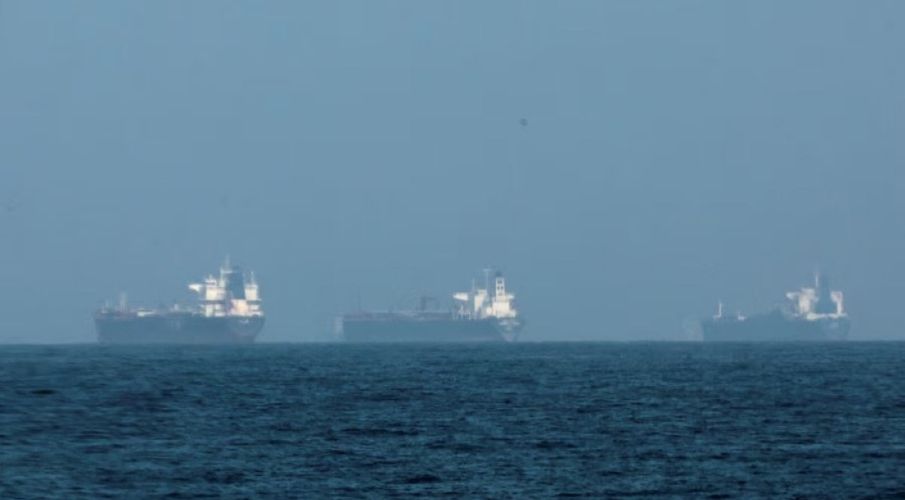
57 container ships are stuck in the Strait of Hormuz. You write that down and it sounds like a number. It is more than that. Tanker traffic has collapsed by 90 percent. Maersk has suspended new bookings for the entire region. MSC is diverting cargo to safe ports. Containers sit at ports of origin and are not being loaded. Goods are in the wrong place, and storage costs rise every day. These are not simple processes. These are decisions someone has to make, daily, under pressure, with incomplete information and the quiet sense that tomorrow everything could change again.
In its second week, the Iran war has stopped being a military event. It has become an economic event that eats its way through freight exchanges, insurance premiums, and exchange rates, from Singapore to Seoul, from Rotterdam to Mumbai. The bill for this is not paid in Washington. The Strait of Hormuz is 54 kilometers wide at its narrowest point. A significant share of global oil and gas supply flows through it. It is strange how much depends on so little. When this channel stalls, you do not feel it immediately at the supermarket, but within a few weeks in your energy bill, in the gasoline price, in the price of refrigerated goods, in the price of fertilizer. The connection is direct, even if it runs through futures markets and freight exchanges. The world has been built in such a way that a single chokepoint is enough to set many things swaying. No one planned it. It evolved that way.
Since the start of the war, jet fuel has risen by 72 percent and is approaching the level seen after Russia’s invasion of Ukraine in 2022. Air freight from Asia to Europe costs 45 percent more. For shipments to the United States, the increase is less than half as strong. That is not coincidence, but geography. Europe and Asia are closer to the events and are more dependent on energy imports. Maurice Obstfeld, former chief economist of the IMF, said it without embellishment: shock waves hit them faster and harder. The logistics industry describes this in the language of people who have learned that stability is not a condition, but a daily task. Oscar de Bok, head of DHL Global Forwarding, says that for every week of standstill, at least one and a half weeks are needed to catch up. Everything depends on how stable the situation is and how many drones are in the air. A strange formula for what normality once was.
Stefan Paul of Kuehne + Nagel reports backlogs in Southeast Asia and China. The situation recalls the pandemic period. Aircraft that normally make stopovers in Dubai or Qatar are now flying detours, must carry more fuel, and thereby lose cargo capacity. Brian Bourke of SEKO Logistics puts it succinctly: one can neither fly too far north nor too far south. Aircraft from China or Northeast Asia squeeze through a narrow route over Turkmenistan, between Iranian airspace to the south and closed Russian airspace to the north. There is not much in between. Ryan Petersen, head of Flexport in San Francisco, speaks of massive distortion. Europe and Asia pay the higher price. That is true for freight, for energy, and for everything that depends on both.
At the same time, facilities of QatarEnergy have been attacked. Production of liquefied natural gas is at a standstill. Customers in Europe and Asia could be pushed into a bidding war for available supplies. Analysts at TS Lombard in London explicitly warn of this. Inflation in the euro area was already higher than expected in February. Additional energy costs will drive it further. This is no longer a forecast, it is mechanics.
For American farmers, a burden arises that is easily overlooked in the larger picture. Saudi Arabia, Qatar, and Iran are among the ten largest producers of urea and ammonia in the world. Prices for urea rose by around a quarter last week. Josh Linville of StoneX expects further increases should the Strait of Hormuz remain closed. China, also a significant producer, is restricting its exports at least until August. Just now, when farmers are placing their largest fertilizer orders of the year, the calculation shifts. Wars disrupt that as well.
In the United States, the effects are more muted, but noticeable. The gasoline price averages 3.41 dollars per gallon according to AAA, one week earlier it was 2.98 dollars. The S&P 500 fell by around two percent. In South Korea, the stock market plunged by 20 percent before recovering slightly. The Indian rupee fell to its lowest level in more than half a century. India subsidizes energy prices with more than 32 billion dollars per year. A long war burdens public finances in a way that cannot yet be fully expressed in numbers, but at some point it will be.
Eric Robertsen of Standard Chartered in Dubai warns against underestimating the impact on Asia. Should the conflict continue, Asia will suffer a severe blow. Asia is the production space of the global economy, and that production space requires energy, functioning air and sea routes, fertilizer, fuel, and stable insurance premiums. All of this is under pressure right now. You only realize how many parts a system has when they begin to fail.
There is an additional variable. After a ruling by the Supreme Court, emergency tariffs are temporarily suspended. For goods from India, a rate of 10 percent currently applies instead of previously up to 50 percent. US importers thus have a sudden incentive to move telecommunications equipment or generics quickly into American ports. This additional demand for air freight meets capacity that is already tight. That drives prices further. Two independent events reinforce each other without anyone having planned it that way.

The data basis is built on AIS signals, the Automatic Identification System. Every larger commercial vessel is required to continuously transmit an electronic radio signal. This signal contains, among other things:
- Ship name and identification
- Position GPS coordinates
- Course and speed
- Ship type
- Port of destinationSatellites and coastal stations receive these signals in real time. Data providers analyze them, filter the ships by region - here: departures from the Persian Gulf through the Strait of Hormuz - and count the visible movements daily.
The key term is visible ships. If a vessel deliberately switches off or manipulates its AIS, it does not appear in this statistic. That is precisely why sudden drops are considered particularly significant: either fewer ships are actually sailing - or part of the fleet is moving in the shadows.
Wars create winners and losers beyond the battlefields, and the distribution rarely follows the line one might intuitively expect.
For the world as a whole, a stalling Hormuz means uncertainty that quickly translates into numbers. Energy prices rise, transport costs increase, insurance premiums climb. States with high import dependency come under pressure. This affects households and companies directly, not abstractly, not later, but now.
Russia looks at the same figures with strategic calculation. Higher oil prices mean higher revenues for Moscow, stabilizing the state budget and facilitating the financing of the war in Ukraine. The more the market comes under pressure, the greater Russia’s financial leeway becomes. At the same time, international attention shifts. If the United States and its allies concentrate military capacities in the Middle East, room for further deliveries to Ukraine shrinks. Politically, a second major conflict can also strain the unity of Western states. All of this lies in plain sight, even if no one says it aloud.
But for Russia as well, the situation is not without risk. An open regional conflagration could destabilize financial markets and cause global demand to collapse. If energy prices rise too sharply, they slow the global economy. A recession would also depress Russian export revenues. And Moscow is, despite strategic partnerships, neither in a position nor apparently willing to support Iran militarily in a direct way. That also says something.
For the United States, the situation is ambivalent. American energy producers benefit from rising prices. US oil and gas become more competitive, especially if deliveries from the Gulf stall. Washington’s strategic role as security guarantor in the Gulf is strengthened, Gulf states seek security, and in this phase security is primarily guaranteed by the United States. At the same time, Patriot interceptors and other defense systems tie up resources that are lacking elsewhere. Every missile intercepted in the Gulf is not available elsewhere. Rising gasoline prices are a sensitive domestic political issue. Inflationary effects also hit the American economy. And every further escalation increases the risk of direct confrontations that Washington would actually prefer to avoid. Advantages and disadvantages balance each other, for now.
Somewhere behind all these figures sits a simple fact. 54 kilometers of narrow sea are enough to set a significant part of the global order swaying. Aircraft fly detours. Ships wait. Farmers recalculate. Households pay more. Governments revise plans. Everything is connected, and the connecting element is a waterway that most people have never seen and will never see.
Updates – Kaizen News Brief
All current curated daily updates can be found in the Kaizen News Brief.
To the Kaizen News Brief In English


Die Weltwirtschaft ist verwoben.
An einigen Stellen mehr, an anderen weniger.
Energierohstoffe und Dünger werden überall gebraucht.
Sei es direkt oder indirekt, wie Treibstoffe zum Transport von Waren.
Trump und Israel haben einen Krieg begonnen, dessen Preis sie am Wenigsten zahlen.
Zumindest die Reichen in diesen Ländern.
Den größten Preis zahlen die Getöteten 😞
Die Verletzten 😞
Die, die ohnehin schon wenig haben. 😞
Ich weiß nicht ob Millers Plan (Project 2025)die treibende Kraft ist.
Das Timing ist erstaunlich.
Ablenkung von den Epstein Files, weil sich der Fokus auf den Irankrieg kept.
Weniger Unterstützung für die Ukraine, „weil man die Waffen selber braucht“
Weniger Fokus auf Russland, „weil der Krieg in der Ukraine ja schon ewig dauert und Gespräche nichts gebracht haben“
Die ersten Prifiteure kristallisieren sich herays.
Die USA als Energielieferant (auch durch venezulanisches Öl).
Trump hat Israel schon dafür scharf kritisiert, dass sie Ölanlagen zerstören … da zeigt sich der wahre Grund… die Ölvorkommen, due Trump kontrollieren will.
Russland aufgrund der gestiegenen Rohstoffpreise.
Und Asien erleidet herbe Verluste.
Europa steckt im Dilemma und wird wieder nur diskutieren.