
Nearly ten years after the protests against the Dakota Access oil pipeline, the legal reckoning has struck the environmental organization Greenpeace with full force. A judge in North Dakota has announced that he will order Greenpeace to pay an estimated 345 million dollars in damages - a sum that, according to the organization, it cannot possibly raise.
Judge James Gion stated in a court filing submitted Tuesday that he will sign a corresponding order. The money is to go to the pipeline company Energy Transfer. Already last year, Gion had nearly halved the 666.9 million dollars originally awarded by a jury. In his current filing, he did not name a new final total, but confirmed the reduced framework of 345 million dollars. With the formal order now forthcoming, an appeal before the North Dakota Supreme Court is expected - from both sides.
Blood in the Water - The Language in Court

(Our article from March 21, 2025)
A verdict is handed down. Harsh. Relentless. And perhaps more consequential than the blunt moralism of a jury ruling can grasp. It strikes Greenpeace - but it concerns us all. It is not only about 600 million dollars. It is about a principle. About language. About the right to raise one’s voice. About the last, sometimes only protection of the individual against power: the word.
At the center of the proceedings are three organizations: Greenpeace International, based in the Netherlands, Greenpeace USA, and the financial arm Greenpeace Fund Inc. A nine member jury found them liable last year for defamation and additional claims. Greenpeace USA was found guilty on all counts - including conspiracy, trespass, nuisance, and unlawful interference with business relations. The two other entities were found liable on certain counts.
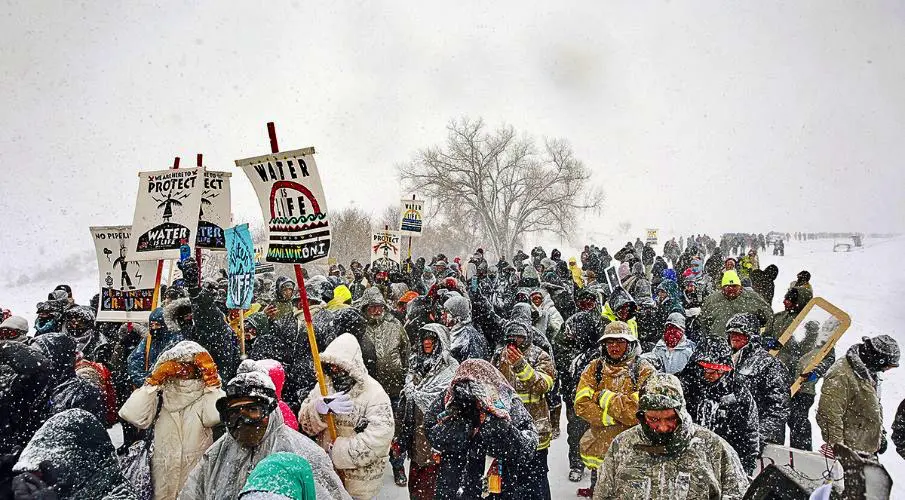
The lawsuit stems from the massive protests in 2016 and 2017. Thousands of people demonstrated and camped near the pipeline route along the Missouri River, upstream from the Standing Rock Sioux reservation. The tribe had early on criticized the project as a threat to its drinking water supply. Images of blockades, camps, and police operations circled the globe at the time.
The jury initially set total damages at 666.9 million dollars and distributed them differently among the three Greenpeace organizations. Greenpeace USA alone was ordered to bear 404 million dollars. Energy Transfer has already announced that it will also challenge the reduction of the amount. The jury’s original findings and the amount of damages were lawful and just, the company said.
Greenpeace, however, points to its financial reality. In a financial filing at the end of 2024, Greenpeace USA stated that as of December 31 it had 1.4 million dollars in liquid assets and total assets of 23 million dollars. Even the 404 million dollars set by the jury cannot be paid without shutting down its operations. The interim general counsel of Greenpeace USA, Marco Simons, has now reiterated that mid sized organizations are not in a position to pay hundreds of millions of dollars in damages. At the same time, he expressed confidence that the case is far from over. The lawsuit should never have gone before a jury, he argued, and there are numerous legal grounds for appeal - including insufficient evidence for key findings and serious doubts about the fairness of the proceedings.
Greenpeace sees the lawsuit as an attempt to silence critics through litigation and to create a chilling effect on activists. Energy Transfer rejects that and emphasizes that the case is not about free speech, but about violations of the law.
In court, an attorney for Energy Transfer argued that Greenpeace deliberately coordinated the protests, organized demonstrators, supplied blockade materials, and spread false claims about the pipeline project. The defense for the Greenpeace organizations countered that there is no evidence for that portrayal. Staff members played little or no role in the protests, they said, and Greenpeace bears no responsibility for construction delays or difficulties in refinancing the project.
With the now announced order, Greenpeace faces an existential legal battle. If the ruling stands, it would be one of the highest financial penalties ever imposed on an environmental organization in the United States. If it is overturned or further reduced, a signal would nevertheless remain: protests against multibillion dollar infrastructure projects can be decided years later in courtrooms - with sums that determine the survival of entire organizations.
Updates – Kaizen News Brief
All current curated daily updates can be found in the Kaizen News Brief.
To the Kaizen News Brief In English


So kann man quasi Jeden mundtot machen.
Greenpeace hat Demonstrationen MIT organizerst.
Die Menschen kamen aus Sorge für die Umwelt zum Protestieren.
Menschen aus dem indigenen Reservat.
Wofür soll dieser Schadensersatz sein?
Konnte der Pipelinebetreiber telegram Darlene, welcher finanzielle Schaden ihnen, reinweg durch Greenpeace, entstanden sind?
Oder ist diese Summe einfach ein Fantasiekonstrukt um sich auf Kosten von Greenpeace zu sanieren?
Leider ist North Dakota ein tiefroter Staat.
Ich befürchte, dass das Berufungsverfahren für Greenpeace dort nicht besser laufen wird. 😞