
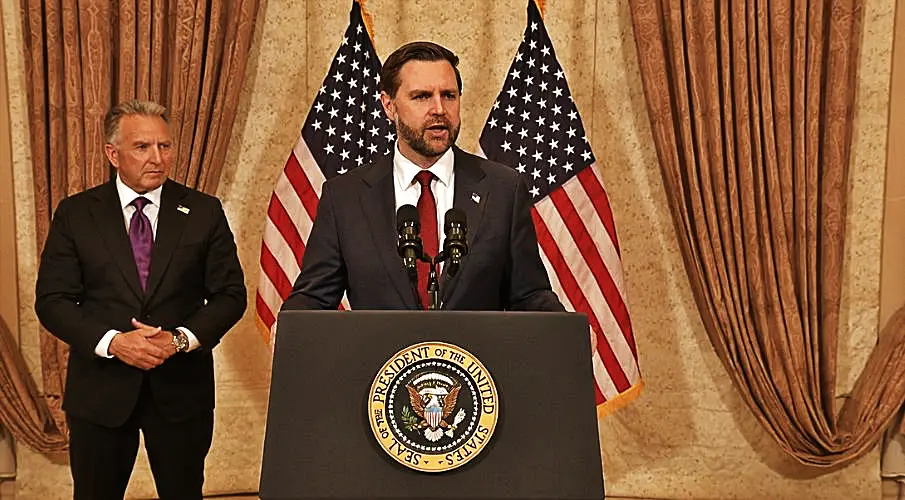
Islamabad – Shortly after 6 a.m. Islamabad time, JD Vance stepped in front of the cameras and said that no agreement had been reached. They had decided not to accept our conditions. He then added that a final and best offer had been left on the table. We will see whether Iran accepts it. Then he left. Without answering any questions.
Shortly afterward, Air Force Two rolled to the runway.
The talks had lasted 21 hours. The longest direct negotiations between American and Iranian officials since the Islamic Revolution of 1979, which put the two countries on a collision course they have not escaped since. Six weeks earlier, American and Israeli airstrikes had killed Iran’s Supreme Leader. Now Iran’s parliament speaker Mohammad Bagher Ghalibaf was sitting across from Vance, in Islamabad, mediated by Pakistan, while the city outside was locked down.

That alone is extraordinary. And it still was not enough.
The sticking point is the same one that has been on the table for weeks. Vance said the United States needs a clear commitment that Iran will not pursue a nuclear weapon and will not develop the means to build one quickly. In practice, that means no uranium enrichment on Iranian soil, no stockpiles of highly enriched uranium. In Isfahan, around 440 kilograms of weapons-grade material are currently stored. Iran says the right to enrichment is non-negotiable, even if the level is. This gap is not small. It is fundamental.
Iran’s foreign ministry spokesman Esmaeil Baqaei had earlier written from Islamabad that the talks had covered various dimensions of the main negotiation topics – the Strait of Hormuz, the nuclear issue, war reparations, the lifting of sanctions, and a complete end to the war. Success, he said, would depend on whether the United States recognizes Iran’s legitimate rights and interests.

Waiting – across from the Serena Hotel, directly on the other side at the Convention Center, which served as the media center
Iranian state television said excessive American demands had blocked the talks. Despite various creative approaches by the Iranian team, no progress had been possible. Ali Gholhaki, a conservative analyst with close ties to the Iranian government, wrote after the collapse of the talks what many in Tehran were thinking but not saying out loud. Washington had accepted no enrichment, demanded the removal of almost all uranium stockpiles from the country, and placed a new demand on the table that had not appeared in any previous negotiation framework: American control over the security of the Strait of Hormuz under American conditions. And not a word about ending Israeli strikes on Lebanon. Gholhaki drew a conclusion that could not have been more concise: the Americans had not come to negotiate at all.

Mohammad Bagher Ghalibaf, the “butcher of Tehran,” a term that dates back to 2003, when as police chief he was responsible for the harsh crackdown on student protests and remains associated with his role during that period.
During the 21 hours, Vance said he had spoken with Trump a dozen times, as well as with Secretary of State Marco Rubio, Treasury Secretary Scott Bessent, and Admiral Brad Cooper, commander of US Central Command. We negotiated in good faith, he said.
At that same time, Trump was watching a UFC event in a sports arena in Miami together with Rubio, a mixed martial arts league with cage fights. Earlier in the evening, he had said it does not matter whether an agreement is reached. We win either way. We have defeated them militarily.
US President Donald Trump is currently attending UFC 327 in Miami, Florida, and appeared together with Dana White, the president and long-time head of the UFC.
Experts had already warned before the talks that an agreement in a single session was unrealistic. The 2015 nuclear deal had taken two years. The complexity of the issues, the central importance of the nuclear program for Iran’s national identity, and the dispute over control of the Strait of Hormuz all pointed from the beginning to a long negotiation.
May God help us, that means we are back at war.
Many Iranians had followed the talks closely, hoping for a diplomatic breakthrough that would end the war and bring much-needed economic relief with the lifting of sanctions.
Israel was not present in Islamabad. Its forces have not attacked Iran since the ceasefire but continue strikes in Lebanon. Netanyahu said on Saturday the war is not over, even if Iran’s military has been heavily damaged.
The two-week ceasefire is still in effect. What comes after that, Vance left open.
The final and best offer is on the table.
Islamabad is empty.
Our journey continues as well. Almost all of us have been on our feet for more than 70 hours. Times like these demand it as a simple fact. Next week, ICE will be in focus, and further planning for the Middle East begins today. The next reporting will therefore follow around 4:00 PM CET.
Updates – Kaizen News Brief
All current curated daily updates can be found in the Kaizen News Brief.
To the Kaizen News Brief In English


Wenn ihr nicht auf euch selbst achtet, schadet ihr nicht nur euch, sondern auch denen, für die ihr da sein wollt. Also bitte gönnt euch Pausen und ausreichend Schlaf!
Vielen Dank für Eure ausfühliche Berichterstattung👍, bitte passt auf Euch auf.