
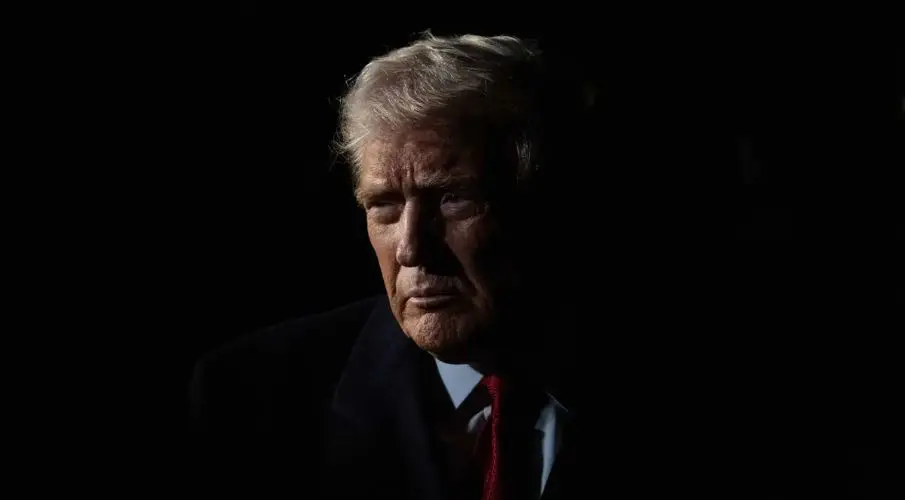
The Supreme Court set limits for him. Donald Trump responds with higher tariffs. One day after the Court declared large parts of his sweeping import duties unconstitutional, the president announced that he would raise the new global tariff rate from 10 to 15 percent. The message is clear: the ruling does not restrain him, it provokes him. On Friday, the Court ruled six to three that Trump may not unilaterally impose and alter tariffs because the power of taxation lies with Congress. The duties in question had been imposed under an emergency statute against nearly every country. The justices found that this approach was unconstitutional. With that, a central instrument of his trade policy fell away.
Trump reacted immediately. That same day he signed an order allowing him, under a different statutory provision, to impose blanket tariffs for 150 days unless Congress extends them. Initially, he set the global rate at 10 percent, effective Tuesday, the day of his State of the Union address. On Saturday he increased it by announcement to 15 percent - the maximum permissible value under this provision. He wrote that he would, “with immediate effect,” raise the worldwide tariff from 10 to the “fully permissible and legally tested” level of 15 percent. Some White House staff were surprised by the sudden increase. It came less than 24 hours after the 10 percent rate had been set. The uncertainty that has accompanied companies and trading partners for months is not diminished by this.
For some countries such as the United Kingdom or Australia, the new rate represents an even heavier burden than before. For others, including China, Vietnam, India, or Brazil, it is lower than the now invalidated duties. Nevertheless, the blanket approach affects all exporters equally, regardless of their trade practices or concessions already made. Trump also announced that he would pursue additional tariffs under other legal authorities, such as Section 301 of the Trade Act of 1974, which provides for investigations into unfair trade practices, or Section 232 of the Trade Expansion Act of 1962, which allows tariffs for reasons of national security. These procedures, however, require time. Until then, the new global rate applies.
On social media, Trump sharply attacked the ruling, calling it a “ridiculous, poorly written, and extraordinarily anti American decision.” At a press conference, he personally targeted the justices, including those he himself had appointed: Neil Gorsuch and Amy Coney Barrett. Their stance was “an embarrassment to their families.” John Roberts, who authored the majority opinion, also came under fire. On Saturday, Trump declared that his “new hero” was Brett Kavanaugh, who had written a 63 page dissent. He also explicitly praised Clarence Thomas and Samuel Alito, writing that there was no doubt they wanted to make America great again.
Tariffs have been the central instrument of his economic policy since the beginning of his second term. Trump repeatedly claims that they correct trade imbalances, strengthen US industry, and force other states into political concessions - whether in the fight against drug trafficking or in geopolitical conflicts. He also repeats the claim that foreign governments pay these duties, not American consumers or businesses. Economic data tells a different story: by December, the Treasury Department had collected more than 133 billion dollars from import taxes imposed under the emergency statute. The Supreme Court left open what will happen to these already collected funds.
The opposition reacted immediately. Democrats on the House Ways and Means Committee accused Trump of “picking the pockets of the American people” in order to continue raising prices despite the ruling. Gavin Newsom, governor of California and political rival of the president, said Trump does not care about citizens. The new global duty contains exceptions. Certain agricultural products such as beef are spared to avoid price spikes. Goods already subject to national security tariffs - including steel, cars, or certain minerals - are not additionally burdened. Imports from Canada and Mexico covered by the existing trade agreement remain tariff free. Countries in Central America that are part of a trade pact concluded in 2004 also receive new exemptions.
At the same time, numerous trade agreements rest on uncertain ground. Many of the deals negotiated last year were based on tariffs that have now been declared impermissible. Countries such as India or Indonesia, which faced domestic criticism for concessions to Washington, will reassess how durable those agreements are.
The Supreme Court marked the constitutional boundary. Trump shifts the economic one. Instead of moderating his course, he raises it. The question is no longer whether tariffs will remain his preferred instrument. The question is how long companies, trading partners, and consumers can bear the fluctuations that accompany each new announcement.
Updates – Kaizen News Brief
All current curated daily updates can be found in the Kaizen News Brief.
To the Kaizen News Brief In English


Und heute hörte ich, dass Trump seine Aufrüstungspläne für das Militär noch mal drastisch erhöht.
Auch kann jeder spekulieren:
a) will der „Friedenspräsident“ einen neuen Weltkrieg vom Zaun brechen?
) oder ist der Neid, weil China gerade den größten Flugzeugträger der Welt gebaut hat?
Wie auch immer, finanzieren will er das über seine Zölle.
Deswegen sind ihm seine Zölle so heilig.
Donald Trump plant eine massive Ausweitung des US-Militärbudgets, um seine Vision einer „Traum-Armee“ zu verwirklichen.
Hier sind die aktuellen Details zu seinen Plänen:
Trump reagiert auf Kritik und Grenzen grundsätzlich bockig.
Nach dem Motto „jetzt erst recht“
Beleidigungen der Kritiker inklusive.
Er ist von Zöllen besessen.
Wahrscheinlich träumt er davon.
Und Trump braucht Geld.
Für die Erhöhung des Militärbudgets und natürlich für ICE und all was dazu gehört.
Die anderen Länder tun gut daran die ursprünglichen Verträge zu prüfen, die aufgrund der unzulässigen Zölle erhoben wurden.
Und dann sollten sie nicht auf jeden dieser bockigen Aktionen reagieren.
Soll er Zölle verhängen.
Die beste Antwort ist schweigen und abwarten (bei diesem Thema).
Er will die Bühne, er will, dass die Länder ihn anbetteln und ihm die Füße küssen.