Power Over Law - How the United States Stormed Venezuela, Claimed at Least 40 Lives, Shattered the International Order and Merz’s Position Is Modest

During the night into Saturday, a line was crossed in Caracas that reaches far beyond Venezuela. US forces incapacitated Nicolás Maduro and his wife using military force, removed them from the country, and delivered the president to New York just a few hours later. What Washington sells as a swift operation was the targeted overthrow of a sitting head of state – carried out on foreign territory, without an international mandate, without judicial proceedings, without the consent of the United Nations. That Maduro was an authoritarian ruler is beyond dispute. But this is precisely the dangerous point: It is not the assessment of his rule that determines the permissibility of such acts, but the law.
Nicolás Maduro enjoyed personal immunity as a sitting president. This immunity does not protect a person, but the international order. It is intended to prevent states from beginning to eliminate political opponents through military force. The seizure of Maduro, his forcible transfer abroad, and the subsequent announcement that the United States intends to govern Venezuela itself completely undermine this protection. From a legal perspective, this constitutes a cross-border deprivation of sovereign authority – something international law clearly prohibits.

According to their own statements, the United States deployed more than 150 aircraft, disabled air defenses, and inserted special forces by helicopter into the military complex of Fuerte Tiuna. At least 40 people, including civilians and soldiers, are said to have been killed. The operation lasted just over two hours. Shortly afterward, President Donald Trump declared that the United States would govern Venezuela “for a certain period of time.” Whether American troops would occupy the country was left open, but ground forces were explicitly not ruled out.

It was followed by a press conference that resembled less a situational briefing than the public proclamation of a claim to power. Trump spoke of total control, of an operation that only the United States could have carried out. He shifted almost seamlessly from the military to the economic, spoke of oil, of American corporations that would rebuild Venezuela’s energy infrastructure and make money. Previous governments, Trump said, had “stolen our oil.” At the latest at this point, it became clear what this was about besides everything else: resources, influence, and the open willingness to subordinate state sovereignty to one’s own benefit.
In Caracas, the government continued to appear before the cameras. Defense minister, attorney general, and governors declared the attack illegal and announced resistance. Vice President Delcy Rodríguez spoke of a military aggression and demanded proof that Maduro was still alive. Armed civilian groups began patrolling streets. State media showed rallies that spoke of kidnapping and called for international support. There was no public sign of an actual American presence in the country.

Internationally, the reaction was unusually clear. France openly spoke of a violation of international law. President Emmanuel Macron made clear that no political transition could be forced from outside. The United Nations expressed alarm. Secretary General António Guterres warned of a dangerous precedent. Russia and China condemned the operation as armed aggression and announced they would demand an emergency meeting of the Security Council.

All the more striking was the reaction from Berlin. Chancellor Friedrich Merz spoke of a “complex” legal situation and urged an orderly transition. Maduro had led his country into ruin, Merz said, and referred to election fraud and links to drug trafficking. All of that may be true. But it does not answer the decisive question: May a state unilaterally kidnap a president because it considers him illegitimate? No, the answer is that simple. Anyone who evades this weakens the law precisely where it must provide support. Forty dead and 115 additional deaths from 35 attacks on boats by the United States seem to offer little cause for questions for Chancellor Merz.
In the United States itself, a constitutional debate erupted. Trump had not obtained explicit approval from Congress. Critics warned of an open military engagement without a time limit. Trump brushed this aside. The operation had been “brilliant,” and he called his critics weak. At the same time, he hinted that similar steps could follow elsewhere – up to and including Mexico. Secretary of State Marco Rubio verbally put pressure on Cuba. The message was unmistakable: Anyone who defies Washington’s expectations must reckon with force.
At the same time, the official justification is becoming increasingly fragile. Venezuela is not a significant producer of cocaine, but primarily a transit country. The main flow of drug trafficking toward North America runs through the Pacific. Fentanyl, which causes the actual catastrophe in the United States, comes from entirely different supply chains. Nevertheless, Venezuela is declared the central enemy. It is a politically useful opponent – weakened, isolated, rich in oil. In Florida, parts of the Venezuelan diaspora celebrated Maduro’s arrest. Many suffered under his rule, many fled. This joy is understandable. It does not change the fact that the path to it is a dangerous one. History shows how rarely militarily forced upheavals bring stability. But it very often shows how quickly violence takes on a life of its own.
What remains is a disturbing picture. A president who openly speaks of occupation. An attack that is declared law enforcement even though it was conducted militarily. A world in which rules apparently only apply as long as they do not stand in the way of powerful states. International law is not a moral seal of approval. It is a barrier against escalation. If this barrier is torn down, it loses its effect everywhere. The decisive question is therefore not how one judges Nicolás Maduro. It is whether the international order is prepared to defend law even when it is inconvenient. Or whether we accept that strength decides – today in Caracas, tomorrow elsewhere.
Jubilation behind bars
Nicolás Maduro arrived at DEA facilities and wished the officers who brought him to New York a “Happy New Year.” He is now being held at the Brooklyn Detention Center, where he will be formally processed and read the charges.

Throughout the day, Venezuelan flags could be seen in New York
When Nicolás Maduro was admitted to the Metropolitan Detention Center in Brooklyn on Saturday evening, the mood outside shifted abruptly. A police officer confirmed over loudspeakers that the ousted president was in the building. Cheers erupted, Venezuelan flags were waved, chants echoed between barricades. Around one hundred people had waited for hours. For many, it was not a political event but a personal moment. One woman said he must pay for the crimes against the Venezuelan people. For her, this moment was the visible break with a past that had forced her to flee.
Maduro leaves the DEA office in New York City and is on his way to the Metropolitan Detention Center in Brooklyn
The transfer itself followed a precise choreography. Via Guantánamo Bay, Maduro and his wife were brought onto US soil, from there on to Stewart Air National Guard Base north of New York. Shortly before 7 p.m., a helicopter landed on the Hudson, a convoy with flashing lights moved south. Streets were closed, parking areas cleared, officers ran across the grounds. It was less a reception than a shielding. Everything indicated that this moment was meant to be controlled, visible, and final. While there was cheering in Brooklyn, Republican lawmakers in South Florida celebrated. The United States, they said, was not an occupying power but a liberating force. At the same time, the secretary of war spoke openly about Americans benefiting from new resources. Access to wealth without spilling American blood. The sentence sounded revealing. Between freedom rhetoric and economic benefit, there was little distance. Who exactly was liberated and who would decide in the future remained open.
The first images show Maduro leaving the aircraft
At Stewart Air Base, families with children stood wrapped in Venezuelan flags. One man said he wanted his family to see that it had really happened. That the dictatorship had fallen. Hope was in the air, but also uncertainty. What follows this overthrow, no one asked out loud. The images told of relief and expectation at the same time. History, many said, was unfolding here. But which history will be written remains open.
Absolute Resolve – How the United States removed Nicolás Maduro from the power center of Venezuela

In the early hours of a January day, the United States carried out a seizure that abruptly altered the political map of Latin America. On the order of Donald Trump, Venezuela’s President Nicolás Maduro was arrested in a military operation and taken out of the country. What Washington presents as the necessary enforcement of law reads, upon closer inspection, like the protocol of a takeover of power with an open outcome. For months, the US military had built up a presence off Venezuela’s coast. Patrols, targeted attacks on suspected drug shipments, the demonstrative use of force at sea – all of this formed the visible part of a preparation that ran far deeper behind the scenes. In parallel, US intelligence agencies worked on a meticulous picture of the Venezuelan head of state. Daily routines, locations, even habits were recorded, while special forces used a detailed replica of Maduro’s residential complex to rehearse the operation again and again. The goal was clear: no room for chance.

Photos document severe damage to the military complex Fuerte Tiuna in Caracas, the base where Nicolás Maduro was arrested. President Trump stated that Maduro and his wife were captured there and then flown out of the country. According to US government sources, an intelligence source supported the localization of Maduro within the military restricted area. The United States attacks were also directed against other targets, including the La Carlota air base and the port of La Guaira.
The order was given when weather and visibility conditions were favorable. Under the name “Absolute Resolve,” US forces advanced into Caracas during the night. The capital was plunged into darkness at times, air defenses were disabled, helicopters flew in at low altitude. Within the shortest time, they reached the militarily secured area of Fuerte Tiuna. Massive doors, Trump later said, would have been opened with cutting tools if necessary. That did not occur. Maduro was overpowered before he could reach a shelter. The entire action lasted only a few minutes, but its impact was maximal.

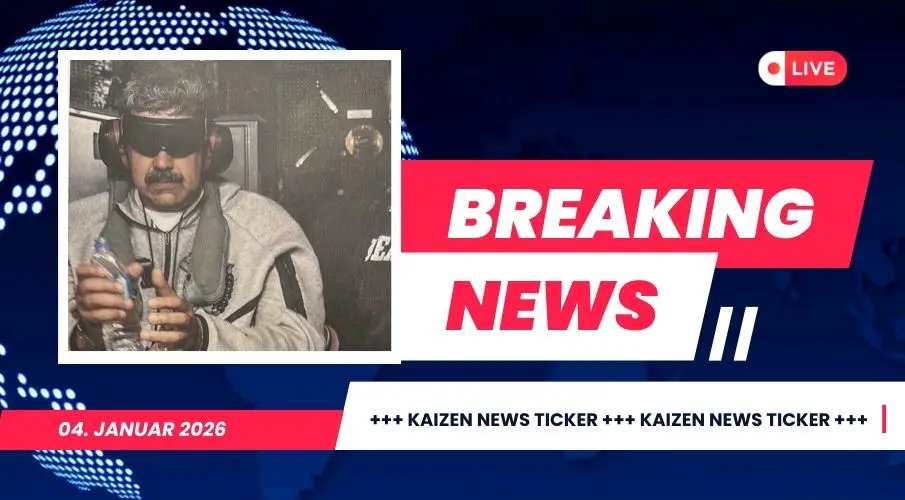
Shortly thereafter, Maduro was flown out together with his wife by helicopter to a US warship. Images later published by the president himself showed him in gray clothing, with hearing protection and a blindfold – staging as proof of control. US military officials confirmed that during the operation a helicopter came under fire but remained airworthy. Some US soldiers were injured, there were no fatalities on the American side. Venezuelan authorities, by contrast, reported around 40 victims among civilians and military personnel.
It was striking how quickly the president shifted from military details to economic prospects. Again and again he spoke of oil, of destroyed infrastructure that American companies would rebuild. Venezuela, according to his portrayal, could become rich – and the United States as well. That this openness fuels the accusation that the operation was not only about law enforcement but about access to resources, he accepted.
Legally, the seizure raises fundamental questions. The arrest of a sitting head of state by foreign troops on his own territory breaks previously accepted boundaries. International criticism did not take long to emerge, including within the United States itself. Nevertheless, Trump made it unmistakably clear that he does not intend to back down. The United States would determine how things proceed, he said, and when control would be handed back.
Murkowski dissents – Even Republicans question Trump’s Venezuela course

Republican Senator Lisa Murkowski openly opposes the military escalation of the United States in Venezuela. As early as the end of last year, she voted for two resolutions intended to halt an expansion of the operation without explicit approval from Congress. Her reasoning is clear: Then as now, the administration lacked the necessary information to enable Congress to make a well-founded assessment of the legal basis. This was not a formal dispute, but a question of democratic oversight. Murkowski makes clear that nothing has changed in this assessment. The recent events rather confirm her earlier doubts. That criticism is now also coming from within Republican ranks shows the growing unease in Washington and deepens the conflict between the executive and legislative branches.
Judge steps down – Criminal conviction, political pressure, and the limits of the judiciary

Convicted Judge Hannah Dugan of Wisconsin has announced her resignation, thereby preempting an impending impeachment. After her conviction for obstruction of an arrest, Republicans had openly prepared an impeachment course. In her letter to the governor, Dugan stated that she had dispensed justice with dignity, care, and respect for years, but that the proceedings had become a burden on the court. Federal prosecutors accuse her of distracting federal agents and guiding a migrant through an internal exit of the courthouse. The man was later apprehended after a brief escape and has since been deported. President Trump publicly used the case to reinforce his hard migration line. Democrats see this as an attempt to place judicial independence under political pressure. Republicans welcomed the resignation as a constitutional consequence. The governor announced that the vacant judgeship would be filled promptly. We had reported on the case frequently.


Und man darf raten, was für ein Richter den Platz von Hannah Dugan einnehmen wird.
Sehr wahrscheinlich ein Trumployalist.
Merz ist mega peinlich und offensichtlich viel unfähiger, als man erwartet hätte.
An der Kriegshandlung der USA und Maduro ist rein gar nichts komplex.
Es ist glasklar.
Aber nein, Merz entscheidet sich für die Schleimspur und das Wegducken.
Zumindest von ein paar Staatsmännern kamen deutliche Reaktionen.
Aber seien wir ehrlich, insgesamt waren die Reaktionen beschämend.
Ich sehe, dass Trump damit durch kommen wird.
Ja, es gibt ein wenig öffentlichen Schlagabtausch.
Die Demokraten sagen was es ist „Bruch des Völkerechtes und Entführung“
Ein paar Republikaner äußern Kritik… aber werden verstummen.
Die Weltengemeinschaft wird einige Tage diskutieren, eine UN Sitzung abhalten und das war es dann.
Bei der UN Sitzung wird genau so wenig bei rum kommen, wie bei der, die Venezuela inszeniert hat.
Überall nur noch Schleimspurkriecher und Duckmäuser.
Und das ist nur der Anfang.
Trump kommt damit durch, also macht er weiter.
Wir können würfeln, welches Land er sich als nächstes vornimmt.
Grönland, aufgrund der Bodenschätzen, ganz weit oben auf der Liste.
Grönland, Panama, Iran …… müssen höllisch aufpassen.
Es ist irgendwie bicht mehr eine Frage des ob, sondern des wann.
Denn die offene Drohung gegen Mexiko ist sehr krass. Und nein, dass war kein Ausrutscher oder Versprecher.
Nach der Aktion, muss auch Selensky höllisch aufpassen.
Sonst fängt ihn Russland weg… oder Putin lässt es Trump machen.
Zum Abschluss noch was sarkastisches.
Maduro sitzt im Detention Center…. wäre doch urkomisch, wenn ein übereifriger ICE Mitarbeiter nicht aufpasst und ihn nach Venezuela abschiebt 🤣🤣🤣
….das wärs noch, abgeschoben, der ist gut …. ja, leider das problem der heutigen zeit, duckmäuser, feiglinge und nur auf eigene sicherheit aus, da wird es schwer mit erhalt der demokratie
Maduro war ein Diktator. Daran gibt es keinen Zweifel.
Das einige Menschen über die Festnahme jubeln, ist verständlich.
Aber die Venezulaner in den USA, die gerade Trump bejubeln, sollten nicht vergessen, dass die Abschiebemaschinerie rollt.
Und ohne Maduro wird Trump Venezuela als sicher einstufen und den Schutzstatus der Venezulaner aufheben. Und die gerade boch Jubelnden sind schneller in einem Detention Center, als sie gucken können 😟
absolut, aber das spielt bei völker- und menschenrecht keine rolle, und das ist auch gut so, sonst wäre die welt ein tollhaus